
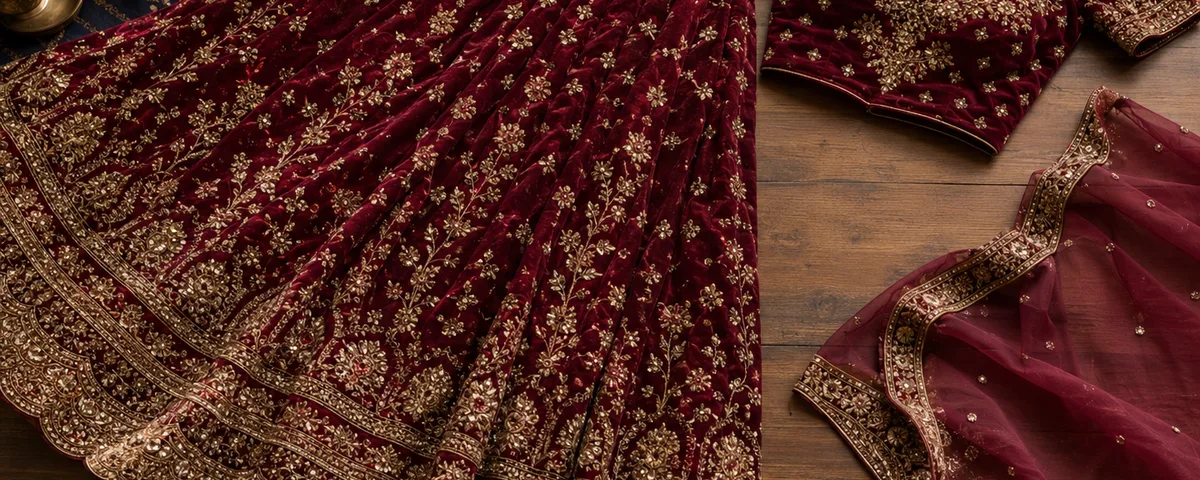
A bride from JP Nagar brought us a wine-coloured lehenga she had bought ready-made from a Commercial Street showroom in Bangalore, along with the plain blouse piece stitched to go with it. The lehenga was heavily worked; the blouse was flat, a slightly different shade of wine, and in photographs the two looked like they belonged to different outfits. She did not need a new lehenga — she needed a blouse designed for it. Matching a bridal blouse for a lehenga is a different exercise from matching one to a saree, because a lehenga is already a complete, worked outfit and the blouse has to sit inside it rather than carry it. This guide covers how to get the colour, the embroidery, the neckline, and the dupatta drape to agree with each other.
Should Your Bridal Blouse Match or Contrast Your Lehenga?
You have three honest options — match, tonal, or contrast — and the right one depends on how heavily worked your lehenga already is. Match when the lehenga has medium embroidery and you want a cohesive, traditional look. Go tonal — the same colour a shade deeper or lighter — when an exact match is hard to reach, which it usually is with a ready-made lehenga. Contrast only when the lehenga is relatively plain and you want the blouse to add the interest.
- Matching blouse — the same colour and a coordinated design. Safe and traditional, and it works best when the lehenga has medium embroidery so the two pieces do not compete.
- Tonal blouse — the same colour family, a shade deeper or lighter than the lehenga. The most forgiving choice, because an exact dye match to an already-made lehenga is very hard to get.
- Contrast blouse — a deliberately different colour that picks up one accent already present in the lehenga or its embroidery. Best on a plain or lightly worked lehenga.
The one rule I give every bride: a contrast blouse must borrow a colour that already exists somewhere in the lehenga — a thread in the border, a stone in the yoke, the edge of the dupatta. Contrast that comes from nowhere reads as a mistake; contrast that echoes an existing accent reads as deliberate. If your wedding outfit is a saree rather than a lehenga, saree blouse colour combinations covers the same match-tonal-contrast decision applied to how a saree drapes, because there the saree carries most of the visual weight and the blouse mostly has to stay out of its way.
How to Match Embroidery Between Your Blouse and Lehenga
Balance the embroidery weight between the two pieces — they should not both be maximal. If the lehenga is heavily worked, keep the blouse to a coordinated neckline, sleeve, and back rather than dense all-over embroidery. If the lehenga is relatively plain, the blouse can carry more of the work and become the focal point. The aim is one clear centre of attention, not two competing ones.
When the lehenga is already heavily worked
Hold the blouse back. A restrained neckline border and a light sleeve in the same metal tone as the lehenga — gold with gold, silver with silver — is usually enough to tie the set together. Mixing a silver-worked blouse with a gold lehenga is the fastest way to make the two look bought separately, because they were. If you are weighing how much heavy work is worth putting on the blouse at all, what heavy hand embroidery is actually worth on a bridal blouse walks through it honestly.
When the lehenga is plain or lightly worked
Let the blouse lead. A plain silk or lightly worked lehenga gives the blouse full permission to carry a worked yoke, a detailed back, or a structural neckline. This is where a contrast blouse in a rich colour, worked in aari or zardosi, turns a simple lehenga into a considered outfit rather than a plain one — and it is also the pairing where a jacket-style blouse works best, since the jacket becomes the design statement and the plain lehenga stays out of its way.
Matching the craft matters as much as matching the colour. If the lehenga is done in gold zardosi and stones, echoing that technique on the blouse reads far more cohesive than pairing it with a different craft — so it helps to know the difference between aari, maggam and zardosi work before you brief the studio.
Does the Dupatta Change Your Blouse Design?
Yes — decide how you will drape the dupatta before you finalise the blouse back and sleeves, because the drape decides how much of the blouse actually shows. A dupatta pinned flat across both shoulders covers most of the back and the upper arms, so heavy back embroidery there is money spent on something nobody sees. A single-shoulder or seedha drape leaves the back and one arm fully visible, which is exactly where a worked back earns its cost — choosing a bridal blouse back design walks through which back suits which function.
- Both-shoulder drape, pinned flat across the chest and back — keep the back minimal and put the design on the neckline and front yoke.
- Single-shoulder or side drape — the back and one arm stay visible, so a worked back and sleeve are worth the spend here.
- Seedha pallu or front drape — the front yoke is on show; invest there and keep the back simpler.
- Dupatta carried on the arm or not worn over the blouse at all — the whole blouse is visible, so design it as a complete piece, front and back.
A bride from Indiranagar last season had planned a heavily embroidered back for her sangeet blouse, then decided the night before to pin her dupatta flat across both shoulders for the ceremony. The back she had paid for never showed in a single photograph. Five minutes spent deciding the drape at the consultation would have moved that embroidery to the neckline, where it would have been seen all evening.
Should the Blouse and Lehenga Be Stitched Together?
If you can, yes — stitching the blouse and lehenga together, from the same fabric lot, is the single easiest way to get a true colour and fabric match. Cloth dyed in different lots almost never matches exactly, and trying to match a blouse to an already-finished lehenga months later is where most colour mismatches come from. When both are made together, we cut the blouse from the same cloth as the lehenga bodice or border, and the two read as one outfit.
Plan 6 to 8 weeks for a bridal blouse made alongside a lehenga, and up to 10 weeks if both carry heavy hand embroidery. If you are having the lehenga stitched from scratch as well, what custom lehenga stitching in Bangalore actually involves sets out the timeline, the three coordinated pieces, and how we keep the blouse and skirt consistent from the start.
How to Match a Blouse to a Ready-Made Lehenga in Bangalore
Bring the actual lehenga to the consultation — the whole outfit, not a photo — and match the blouse to it in daylight. Showroom lighting and phone screens both lie about colour, and a wine that looks identical under halogen can read purple in the sun. At our Bangalore studio we lay the lehenga against fabric swatches near a window before choosing anything, because daylight is the only light that tells the truth about a shade.
Most brides who come to us for this have bought their lehenga ready-made — from Commercial Street, from a Jayanagar showroom, or online — and now need a blouse that agrees with it. A coordinated blouse with a matched neckline and light embroidery for a ready-made lehenga typically runs ₹1,500 to ₹4,000 at our studio in Bangalore; matching a richly embroidered lehenga with heavier work on the blouse can go to ₹8,000 or more. The wider the gap between the plain blouse piece that came with the lehenga and the work on the skirt, the more the blouse has to do to close it.
One practical warning: if the lehenga came with its own stitched blouse piece and it is even slightly off in colour, do not assume a boutique can dye it to match. Re-dyeing an embroidered or lined piece rarely lands on the exact shade, and it can weaken the fabric. It is usually cleaner to stitch a fresh blouse in a fabric matched to the skirt than to chase a colour correction on the original. We stitch lehenga blouses to match an existing skirt as part of our bridal and occasion wear work.
Frequently Asked Questions
Should my bridal blouse match my lehenga exactly?
An exact match is not always the goal, and it is hard to achieve with a ready-made lehenga because dye lots differ. A tonal blouse — the same colour a shade deeper or lighter — is the most forgiving choice. A matching blouse works well when the lehenga has medium embroidery, and a contrast blouse works on a plain lehenga as long as it picks up an accent colour already in the outfit.
Can I wear a contrast colour blouse with my lehenga?
Yes, and a contrast blouse works best when the lehenga is plain or lightly worked. The rule is that the contrast colour must already appear somewhere in the lehenga — a thread in the border, a stone in the yoke, or the dupatta edge — so it reads as deliberate rather than mismatched. On a heavily embroidered lehenga, a strong contrast blouse usually makes the outfit look overloaded.
Should the blouse and lehenga be stitched together?
Where possible, yes. Stitching both together from the same fabric lot gives a true colour and fabric match, which is very hard to reproduce when matching a blouse to a lehenga that is already finished. Plan 6 to 8 weeks for a bridal blouse made alongside a lehenga, and up to 10 weeks if both carry heavy hand embroidery such as zardosi or maggam work.
How much does a blouse to match a ready-made lehenga cost in Bangalore?
A coordinated blouse with a matched neckline and light embroidery for a ready-made lehenga typically costs ₹1,500 to ₹4,000 at our Bangalore studio. Matching a richly embroidered lehenga with heavier zardosi or maggam work on the blouse can rise to ₹8,000 or more, depending on how much work is needed to close the gap between the plain blouse piece and the worked skirt.
Does the dupatta drape affect the blouse design?
Yes, and you should decide the drape before finalising the blouse. A dupatta pinned across both shoulders hides most of the back and upper arms, so heavy back embroidery is wasted there. A single-shoulder or seedha drape leaves the back and one arm visible, which is where a worked back is worth the cost. Deciding the drape early lets you put the embroidery where it will actually be seen.