
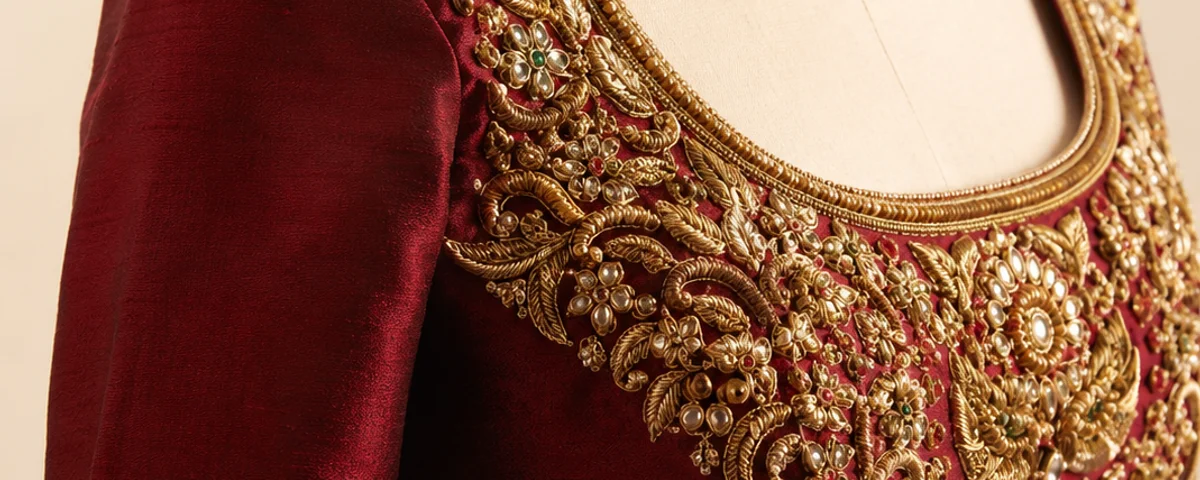
A bride came to us in Jayanagar last season with a reference photo of a blouse worked edge to edge in zardosi — front, back, sleeves, not a plain centimetre anywhere. Her budget was fixed and her wedding was 5 weeks away. Coverage at that level is close to a month of hand work and sits well above what she had planned to spend. So we had the conversation I have with most brides: not "can we do it", but "where does heavy embroidery actually earn its cost, and where are you paying for work nobody will ever see." This article is that conversation, written out — so you can decide what is worth the price before you walk into a single boutique.
What "Heavy Hand Embroidery" Actually Means on a Bridal Blouse
Heavy work is not one thing. It describes coverage and density together — how much of the blouse is embroidered, and how tightly the work is packed into that area. A blouse with a richly worked yoke and plain sleeves is heavy. A blouse worked front, back, and sleeves in dense zardosi is very heavy, and can weigh close to a kilogram once the wire and stones are on it. Those are two very different pieces at two very different prices, and both get called "heavy embroidery" in a boutique.
Most heavy bridal blouses combine techniques. Zardosi — raised, three-dimensional metal-wire work — carries the richness that photographs well from across a room. Maggam and aari work with mirrors, stones, and kundan adds the detail that catches light indoors. A single bridal yoke often uses zardosi for the main motifs and aari to fill around them. If those terms run together in your head, the difference between aari, maggam, and zardosi work is worth ten minutes before you commit — it changes what you should ask for and what you should expect to pay.
One practical constraint decides a lot: heavy work needs a base fabric strong enough to hold it. Raw silk, dupion, and velvet carry dense zardosi well. Chiffon and very fine silks cannot — the weight of the wire pulls and puckers them. If your saree blouse fabric is delicate, that alone limits how heavy you can sensibly go.
What Actually Drives the Price of a Heavy Embroidery Bridal Blouse
Four things decide the number. Understanding them tells you exactly where your money goes — and, more usefully, where you can adjust without the blouse looking any cheaper.
1. Coverage — how much of the blouse is worked
This is the biggest lever. A worked yoke and neckline is one price. Add a statement back and you have roughly doubled the embroidered area. Add fully worked sleeves and you are into full-coverage territory. Every zone you add is more days and more cost, in a fairly straight line. Most of the difference between a ₹6,000 blouse and a ₹20,000 blouse is simply how much of it is covered.
2. Density — how tightly the work is packed
The same area can be lightly filled or solidly packed, and the price between them can triple. A neckline with well-spaced motifs and breathing room around them takes a fraction of the hours that solid, edge-to-edge coverage of the same neckline takes. Density is invisible in a budget line but it is where a lot of the labour hides.
3. Materials — wire grade, stones, and kundan
Real versus imitation, the grade of kasab wire, whether you are using kundan, real pearls, or glass stones — this is where premium quotes come from. Good imitation materials look excellent in photographs and at arm's length. Real materials matter most on the motifs people will see up close. Spending on high-grade materials for a zone that stays hidden all day is the easiest money to waste.
4. Hand-work hours
Ultimately you are paying for a person's time. A full-coverage bridal blouse is 25 to 35 days of one artisan working by hand. That labour — not the materials — is the bulk of what a heavy bridal blouse costs. It is also why the timeline and the price move together: you cannot rush dense hand embroidery without either paying for more hands or accepting less work.
Where Heavy Embroidery Is Worth the Money
The honest principle is simple: spend heavily where the work will be seen, photographed, and lit. Everything else is negotiable.
The yoke and neckline
This is the one zone I never tell a bride to economise on. The yoke frames your face. It is in every close-up photograph, every posed shot with family, every frame where someone is looking at you and not the whole room. This is where density belongs and where your best materials should go. If the budget only stretches to doing one thing properly, do this.
A statement back — but only if your back shows
A heavily worked back photographs beautifully, and reception and sangeet outfits often show it off. But this depends entirely on how you drape. If your saree pallu is pinned across the back and stays there all day, a dense back design is money spent on something the camera never sees. Decide your drape first, then decide the back.
The zones that catch indoor light
Most wedding functions are shot indoors under warm, directional light. Zardosi and kundan are at their best in exactly that light — the raised wire and stones catch it and give the dimension that flat work cannot. On the visible front zones, that dimensional quality is genuinely worth paying for. It is what separates a bridal blouse from an ordinary embroidered one in photographs.
Where Heavy Embroidery Is Usually Not Worth It
This is the part most boutiques will not say, because more embroidery means a bigger bill. But if you are spending your own money, here is where heavy work rarely earns it.
- Fully covered sleeves. They are expensive, they add real weight, they chafe over a long function, and they are half-hidden by bangles and mehndi anyway. A worked sleeve border or a decorated cuff gives you most of the look for a fraction of the cost — and far more comfort across a 6-hour event.
- Anything under heavy jewellery. A dense bridal necklace covers most of a neckline; a full choker means the throat area of the yoke is never seen. Plan the embroidery around the jewellery you will actually wear, not as if the blouse will be seen bare.
- Matching an already-heavy saree. A Kanjivaram with a wide gold border and a heavy pallu does not need a fully loaded blouse fighting it for attention. A lighter, well-placed yoke reads as more expensive than piling weight on weight.
- "More is always better" as a rule. Over-embroidered blouses photograph as busy and can read as costume rather than couture. Restraint is often the more premium choice — and, usefully, the cheaper one.
How to Get the Full Bridal Look for Less
None of this is about spending less for its own sake. It is about spending where it shows. A few ways to do that without the blouse looking economised:
- Concentrate the heaviest, best-material work on the yoke and neckline, and let aari or lighter thread work fill the surrounding areas. A zardosi focal with an aari fill costs far less than solid zardosi and looks completely intentional.
- Borrow weight from the saree. If the saree already carries the richness, the blouse can be a refined complement rather than a second centrepiece.
- Use good imitation materials for the fill and reserve real or high-grade materials for the focal motifs people will actually see up close.
- Choose one function to go heavy for — usually the main wedding — and keep the reception or sangeet blouse lighter. You rarely need two full-coverage blouses.
If you are still deciding the technique itself, our guide to zardosi blouse stitching in Bangalore covers the prices, fabrics, and care in detail, and it pairs well with the planning side of this decision.
Real Price Ranges at Akira (Bangalore)
Here are honest starting ranges for heavy hand embroidery bridal blouses at our studio. Final quotes come after the design consultation, because density and materials move the number more than anything else. For the full picture across every level of work — plain to heavy — our transparent blouse stitching price guide breaks it all down.
Rich worked yoke and neckline
₹4,000 to ₹9,000, with 15 to 22 days of embroidery. For most brides this is the highest-value choice — heavy where it counts, plain where it does not. It photographs like a bridal blouse without the cost or weight of full coverage.
Yoke plus a statement back
₹8,000 to ₹15,000, with 20 to 28 days of embroidery. The right choice when your outfit genuinely shows the back — an off-the-back drape, a reception look, a photographer you know will shoot from behind.
Full coverage — front, back, and sleeves
Full hand-embroidered coverage starts from around ₹8,000 for lighter work and runs to ₹15,000 to ₹25,000 or more for dense zardosi with premium materials, over 25 to 35 days. Reserve this for the main wedding function — it is the piece you will remember, and rarely worth repeating across every event.
Because the embroidery alone is 3 to 5 weeks of hand work, you have to add fabric sourcing, stitching, and a trial fitting on top. Begin at least 8 to 10 weeks before your wedding function. Coming to a boutique 4 weeks out and asking for heavy coverage is the single most common bridal mistake we see — along with nine others brides make, it is entirely avoidable with a little planning. Heavy work is scheduled around your function date on every bridal and occasion wear order we accept.
Frequently Asked Questions
Is heavy hand embroidery worth it for a bridal blouse?
For the main wedding function, yes — on the zones that show. Concentrate heavy work on the yoke, neckline, and a statement back where it is photographed at close range and catches indoor light. Full edge-to-edge coverage, including fully worked sleeves, is usually not worth the extra cost or weight, because much of it stays hidden under jewellery, bangles, and the saree pallu.
How much does a heavy embroidery bridal blouse cost in Bangalore?
At Akira Fashion Studio, a richly worked yoke and neckline ranges from ₹4,000 to ₹9,000. A yoke plus a statement back is ₹8,000 to ₹15,000. Full coverage in dense zardosi with premium materials runs ₹15,000 to ₹25,000 or more. The final quote depends on coverage, density, and materials, and is given after the design consultation.
How long does a heavy embroidery bridal blouse take?
The embroidery alone takes 15 to 22 days for a worked yoke, 20 to 28 days for a yoke plus back, and 25 to 35 days for full coverage. Once you add fabric sourcing, stitching, and a trial fitting, you should begin at least 8 to 10 weeks before your wedding function.
Is zardosi or maggam work better for a heavy bridal blouse?
Zardosi — raised metal-wire work — gives dimensional richness that photographs well from a distance, which suits a blouse meant to be the centrepiece. Maggam work with mirrors, stones, and kundan catches light indoors and pairs well with heavily worked South Indian sarees like Kanjivarams. Many bridal blouses combine both. The difference between aari, maggam, and zardosi work explains which suits which saree.
How can I reduce the cost without losing the bridal look?
Concentrate the heaviest, best-material work on the yoke and neckline where it shows, and fill the surrounding areas with lighter aari or thread work. Skip full sleeve coverage in favour of a worked border or cuff. If your saree is already heavy, let it carry the richness and keep the blouse a refined complement. Placement matters more than total coverage.