
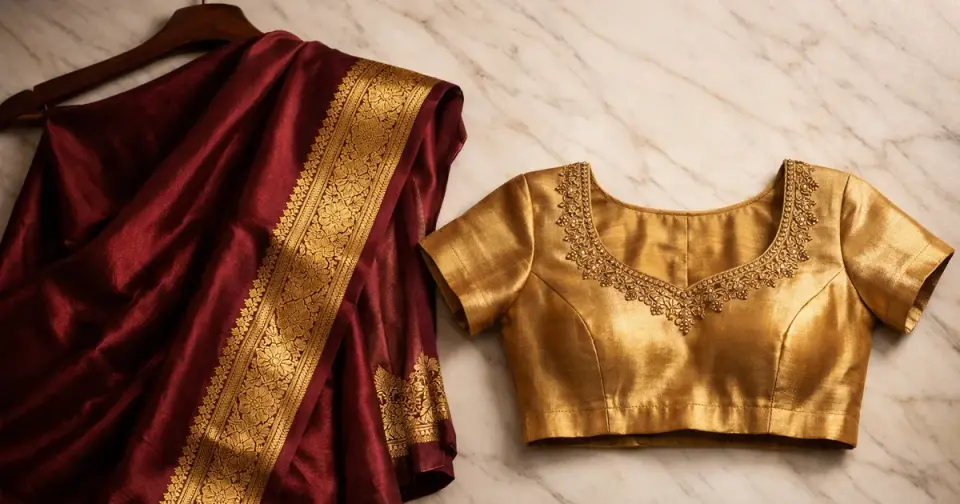
A bride from Whitefield came in last month with a heavy Kanjivaram saree — deep burgundy with a wide gold zari border — and a phone full of blouse references she had been collecting for six months. Every reference was from a different saree, a different occasion, a different skin tone. We put the phone down and looked at the saree for two minutes. In that time, half the references became irrelevant. The saree told us almost everything we needed to know about the right blouse design for her wedding saree. That is always where the decision starts — not with Instagram, not with what worked on someone else's outfit.
How Your Saree's Fabric Weight Should Guide Your Blouse Design
A heavy, densely woven saree — a Kanjivaram, a Banarasi, a Paithani — already carries significant visual weight. The border, the pallu, and the body weave are all working at once. A heavily embroidered blouse added on top creates a combination that competes with itself. In most cases, the right blouse for a heavy woven saree is a restrained one: a clean cut, neckline embroidery that picks up one colour from the saree's border, and nothing more. If your wedding outfit is a lehenga instead of a saree, the balance runs the other way — matching a bridal blouse to a lehenga is about supporting an already-worked outfit rather than leading it.
A plain silk or georgette saree is the opposite situation. The saree is understated, and the blouse has room to carry the design statement. Full yoke embroidery, a detailed back design, or a structural neckline all read well here. The blouse becomes the focal point. Matching the visual weight of the blouse to the visual weight of the saree is the single most important principle in bridal blouse design — and the one most commonly ignored when people choose from references rather than from the actual saree in front of them. Once the weight is right, choosing the hand embroidery blouse design itself — placement, density, and back work is the next decision.
Blouse Design for Kanjivaram and Banarasi Wedding Sarees
Kanjivaram and Banarasi sarees are the most common wedding sarees we see at our studio in Bangalore. Both have specific characteristics that determine what the blouse should do. If your saree is a Kanjivaram, our dedicated guide to bridal blouse designs for Kanjivaram sarees goes deeper on colour, neckline, and embroidery for that silk.
Kanjivaram sarees
The gold zari border is typically the dominant design element. The blouse should echo the border colour and weight — not replicate the motif. A contrast blouse (a different colour from the saree body, picking up the border) is traditional for South Indian weddings and works well. Aari or zari thread embroidery along the neckline ties both pieces together cleanly. If aari is the direction, our guide to aari work blouse stitching in Bangalore covers what it costs and how long it takes.
- A neckline border or light yoke in aari or zari thread is the most reliable approach.
- Full maggam or zardozi coverage over a heavy Kanjivaram creates visual competition — avoid it.
- Contrast colours that consistently work well: gold on burgundy, ivory on navy, green on magenta, red on teal.
Banarasi sarees
The Banarasi body weave is often dense with brocade patterns — not just the border. The blouse needs to be more restrained than instinct suggests. A structured neckline with minimal embroidery frequently reads as more intentional than a heavily worked blouse over a Banarasi.
- A boat neck or clean round neck with a simple border or no embroidery is often the strongest choice.
- If you want embroidery, limit it to the neckline border and keep the sleeves plain.
- Avoid echoing the brocade pattern in the blouse — it competes directly with the saree body.
Blouse Design for Plain Silk, Georgette, and Chiffon Sarees
Plain sarees give the blouse full permission to carry the design. This is where I often see customers under-design — a plain georgette saree paired with a plain blouse reference produces a flat, unanchored look. A plain saree is not a constraint. It is an opportunity.
Plain silk
- Full yoke embroidery in zari, aari, or maggam work reads well — the saree drape shows the blouse front prominently.
- Back designs — keyhole backs, cut-outs, detailed back panel embroidery — are worth considering, especially for receptions; how to choose a bridal blouse back design covers which suits your event.
- The blouse can introduce a colour not in the saree at all, anchored by the embroidery choice.
Georgette and chiffon
- Lightweight fabrics call for lighter embroidery — sequin work, fine thread work, small mirror accents.
- Heavy zardozi on chiffon or georgette adds too much weight and pulls the fabric.
- Georgette and chiffon take more time to stitch cleanly — the fabric shifts under the needle. Build this into your timeline.
How Your Wedding Function Type Changes the Blouse Design
The same saree worn to a morning ceremony and an evening reception often needs two different blouse designs — or ideally, two separate blouses. I say this at almost every bridal consultation, and most customers are surprised.
Morning ceremony (muhurtham, vidai, wedding rituals)
A morning ceremony typically runs 3 to 6 hours and involves real movement — sitting cross-legged, bending, rising repeatedly. Comfort carries as much weight as aesthetics. Heavy embroidery that looks rich under artificial reception lighting can look hard and metallic in outdoor morning light. A lighter neckline treatment in silk thread or moderate aari work photographs better in daylight and is easier to wear for a long morning. The sleeve matters here too — bridal blouse sleeve styles for South Indian weddings explains why a short or elbow-length sleeve suits a long daytime ceremony.
Evening reception
A reception typically runs 2 to 3 hours, primarily standing, photographed under mixed artificial light. This is where heavier zardozi or maggam work earns its place. Metal thread catches light at an indoor reception in a way it simply does not outdoors. If you are wearing one blouse for both functions, weight the design toward the reception — but plan the stitching for all-day comfort.
Which Blouse Design Element Should You Lock In First?
The neckline must be decided first. It is the only design element that cannot be meaningfully changed after stitching has begun. Embroidery coverage can be adjusted before work starts. Colour can be refined. But once the neckline pattern is cut and stitched, any significant change means a new pattern — adding 5 to 7 days to the timeline and extra cost. This is why the design conversation comes first in every bridal and occasion wear order.
At our studio in Bangalore, the order that works best at every bridal consultation:
- Lock the neckline shape and depth first.
- Decide embroidery type and coverage (aari, zardozi, thread work, machine).
- Confirm colour — whether the blouse matches the saree body or contrasts it.
- Settle the back design — this can follow the neckline, but must be fixed before cutting begins.
Frequently Asked Questions
How do I choose a blouse design for my wedding saree?
Start with your saree's weight and weave. Heavy woven sarees (Kanjivaram, Banarasi) need a lighter blouse — neckline embroidery or a simple border, not full yoke coverage. Plain silks and georgettes can carry full embroidery. Bring the actual saree to the consultation — decisions made from a photo are unreliable because fabric weight and true colour cannot be judged from a screen.
What blouse design works best for a Kanjivaram wedding saree?
A contrast blouse in a colour that picks up the saree's border, with aari or zari thread embroidery along the neckline. Avoid heavy zardozi or full maggam coverage over a Kanjivaram — the saree already carries significant weight. A clean neckline embroidery that echoes the border is the most reliable choice for South Indian weddings in Bangalore.
Should my wedding blouse match my saree or contrast it?
Both work, and both are traditional. A matching blouse (same colour as the saree body) creates a seamless, elongated look. A contrast blouse — picking up one of the border colours — is the more common South Indian wedding choice and creates a clear silhouette. The right answer depends on your specific saree, your body proportion, and your jewellery. Discuss both at the consultation before deciding.
Can I wear the same blouse for my morning wedding ceremony and evening reception?
You can, but it is a compromise. Morning functions suit lighter embroidery that photographs well in daylight and is comfortable for 3 to 6 hours of movement. Evening receptions suit heavier zardozi or maggam work that catches artificial light well. If wearing one blouse for both, weight the design toward the reception — but have the stitching fitted for a full day of wear.
How far in advance should I finalise my wedding blouse design?
Lock the design at your first consultation — at least 6 to 8 weeks before your wedding function. For heavy hand embroidery (full yoke zardozi or maggam work), 10 weeks is safer. The neckline in particular cannot be changed after stitching begins, so the earlier the decision, the more options remain available.