
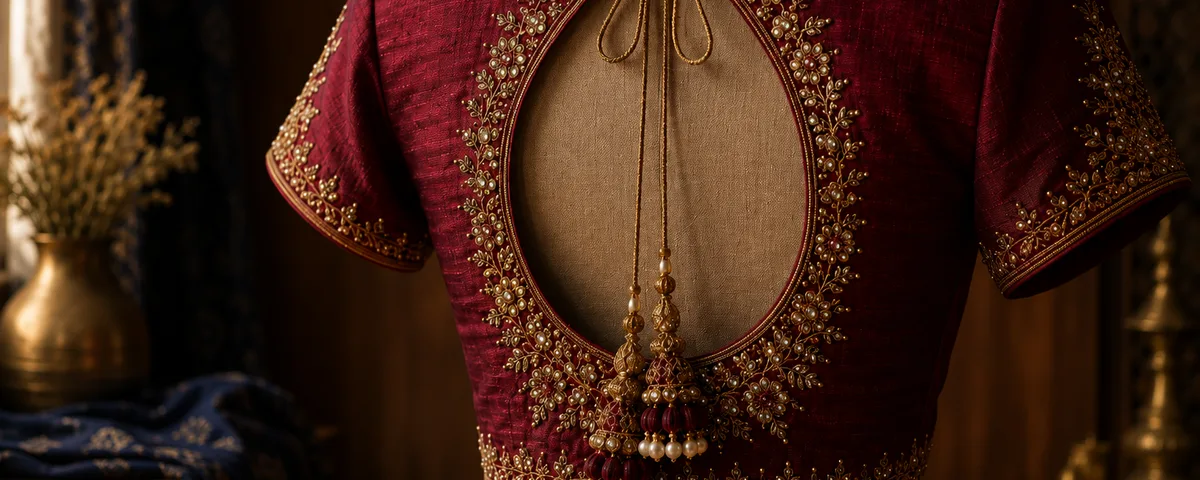
The back of a bridal blouse gets photographed more than the front. During the pheras, while you are seated facing the fire, and in almost every candid shot taken from behind, the back is what the camera sees for a large part of the wedding day. Yet it is the element most brides decide last, usually from a single Pinterest screenshot. Bridal blouse back designs deserve more thought than that, because the back is where design ambition and real comfort collide hardest. A bride from Koramangala came to us with a photo of a deep U-back she had saved months earlier; her muhurtham was a five-hour seated ceremony, and the design in that photo would have had her adjusting her blouse all morning. We kept the look she wanted and changed the part that would have made her miserable. This guide covers how to choose a back that works for your event, your saree, your jewellery, and a full day of wear. If your silk saree is for a different kind of day altogether — a festival, or a wedding where you are a guest rather than the bride — blouse back designs for silk sarees covers the same classic-to-contemporary decision from the fabric's perspective rather than the ceremony's.
Which Bridal Blouse Back Design Suits Your Event?
Match the back to how long you will wear the blouse and how much you will move in it. A long seated ceremony needs a back you can sit, bend, and breathe in for hours. A two-hour reception where you are mostly standing and being photographed can carry a deeper, more dramatic back. The most common mistake I see is a bride choosing a reception-level back for a morning ceremony, then spending the ceremony uncomfortable in it.
For a long ceremony (muhurtham, pheras, vidai)
Choose a moderate, secure back. A Bangalore wedding ceremony that runs 4 to 6 hours involves real movement — sitting cross-legged, bending, rising repeatedly — and a back that is too deep or too loosely closed will not hold up. A round or keyhole back with a hook or zip closure stays put and still looks considered. This is also where a worked back panel behind a single-shoulder drape earns its place, because the seated shots from behind are some of the most-used photographs from the whole day.
For a reception or sangeet
You have more room here. A reception runs 2 to 3 hours, mostly standing, under artificial light, so a deeper U, a sweetheart back, or a dori tie-back all work. This is the function to save your most dramatic back design for, rather than trying to wear one back through both the ceremony and the party.
Popular Bridal Blouse Back Neck Designs and When They Work
Here are the back designs we are asked for most often, from the most covered to the most open, with an honest note on where each one belongs. The neckline is always locked first and the back follows it — which neckline suits your body type and occasion covers choosing it, and how to choose the blouse design for your wedding saree sets out that order, because the neckline cannot be changed once the pattern is cut. The sleeves are the companion decision to the back — bridal blouse sleeve styles for South Indian weddings covers choosing them alongside it.
- Round or high back with embroidery — the most covered and the most comfortable. Carries a full embroidered panel well and suits long ceremonies and heavy Kanjivaram sarees.
- Keyhole (teardrop) back — a small cut-out below the neckline, closed with a button or dori. It adds interest without exposure, and it is the safest designed back for a long ceremony.
- U-back and deep U — a scooped opening, moderate to deep. It photographs beautifully and suits receptions; the deeper it goes, the more the fit and support have to be engineered.
- Sweetheart or V back — a shaped dip that flatters the shoulders and frames a back chain or jhumka. Works well for receptions and lighter sarees.
- Dori or tie-back with latkan tassels — decorative tie strings that read rich and traditional. Beautiful, but the fit depends entirely on how it is tied, and it can gape if the tension is off.
- Backless or near-backless — maximum drama, minimum coverage. Realistic only for a short, mostly standing reception, on a lightweight saree, and it needs precise stitching and usually a hidden support.
If a backless or near-backless design is what you are actually considering, backless blouse designs for brides goes deeper on which sarees and functions suit it and the support structure that keeps it in place through a full event.
How Your Dupatta and Jewellery Affect the Back Design
Decide your dupatta drape and your back jewellery before you finalise the back design, because both change how much of the back is actually seen. A dupatta pinned flat across both shoulders covers most of the back, so an elaborate back panel behind it is money spent on something nobody sees. If you plan to drape it to one side, or skip it for the reception, the back is on full show and worth the investment. This is the same logic that governs matching a bridal blouse to a lehenga, where the drape decides where the embroidery should go.
Back jewellery competes with back embroidery, so plan them together. A heavy back chain or a long braided jada sitting down the centre of the back will cover or fight a dense embroidered panel. A bride from Jayanagar last season had commissioned a full zardosi back, then wore a thick back chain over it for the reception — the two cancelled each other out in every photograph. If you are wearing statement back jewellery, keep the back embroidery to a border around the opening rather than a full centre panel.
How Deep Should a Bridal Blouse Back Be?
For comfort and support through a long function, a back depth of 8 to 10 inches measured from the shoulder seam is a safe, flattering range. Deeper than that — 11 inches or more, toward a true backless look — starts to trade away support and is realistic only for a short, mostly standing reception. The right depth is the deepest you can wear comfortably for the full length of your event, not the deepest in the photograph you saved.
Depth is also a fit and support question, not just a style one. A deep back needs proper lining, sometimes built-in cups, and a closure placed where it will not gape when you raise your arms. At our Bangalore studio, all of this is what the trial fitting is for — a deep back that looked fine standing still can gape or slip the moment you move, and the fitting is where we catch it. Bring the actual saree and blouse petticoat to the fitting so the back can be judged against how the outfit will actually sit.
Is Embroidery on the Blouse Back Worth It?
Back embroidery is worth it when the back will genuinely be seen — a reception, a single-shoulder drape, the seated shots from behind — and a waste when a flat dupatta will cover it. A worked back panel at our Bangalore studio adds roughly ₹2,000 to ₹8,000 on top of the base blouse stitching, depending on density and technique. Before committing to a heavy back, it is worth reading what heavy hand embroidery is actually worth on a bridal blouse, because the back is one of the easiest places to over-spend on work that stays hidden.
Match the back technique to the rest of the outfit rather than choosing it on its own. If the front and the lehenga or saree lean on gold zardosi, the back should echo it; a different craft or metal tone on the back reads as an afterthought. The difference between aari, maggam and zardosi work is worth knowing so the back panel matches the front instead of competing with it. Where the back does show, a border framing the opening or a single centred motif usually reads more elegant than dense all-over work. Back design and closure are settled together at the start of a bridal and occasion wear order, since both affect the pattern.
Frequently Asked Questions
Which bridal blouse back design is best for a long wedding ceremony?
A round or keyhole back with a secure hook or zip closure and a moderate depth of 8 to 10 inches. A long ceremony involves sitting, bending and rising for 4 to 6 hours, so the back needs to stay closed and comfortable. Save deep U-backs, sweetheart backs and dori tie-backs for a reception where you are mostly standing for 2 to 3 hours.
How deep can a bridal blouse back go?
A depth of 8 to 10 inches from the shoulder seam is comfortable and supportive for most brides through a full function. Going to 11 inches or more toward a backless look trades away support and is realistic only for a short, mostly standing reception on a lightweight saree. A deep back also needs proper lining and sometimes built-in cups, which is checked at the trial fitting.
Does the dupatta cover the bridal blouse back?
It depends on the drape. A dupatta pinned flat across both shoulders covers most of the back, so heavy back embroidery there is wasted. A single-shoulder or side drape, or skipping the dupatta for the reception, leaves the back visible and worth the investment. Decide the drape before finalising the back so the embroidery goes where it will be seen.
How much does back embroidery add to a bridal blouse in Bangalore?
A worked back panel at Akira Fashion Studio adds roughly ₹2,000 to ₹8,000 on top of the base blouse stitching, depending on the density and whether it is aari, maggam or zardosi work. A border around the back opening costs less than a full centre panel, and it is often the more elegant choice when back jewellery is also in play.
What back closure is best — hooks, zip or dori?
Hooks are the most secure and the standard for a fitted bridal back. A concealed zip gives the cleanest line on a very fitted or deep back. A dori tie-back is the most decorative but its fit depends on how tightly it is tied, so it can gape if the tension is uneven — we usually add hidden hooks behind a decorative dori so the look stays put through the event.