
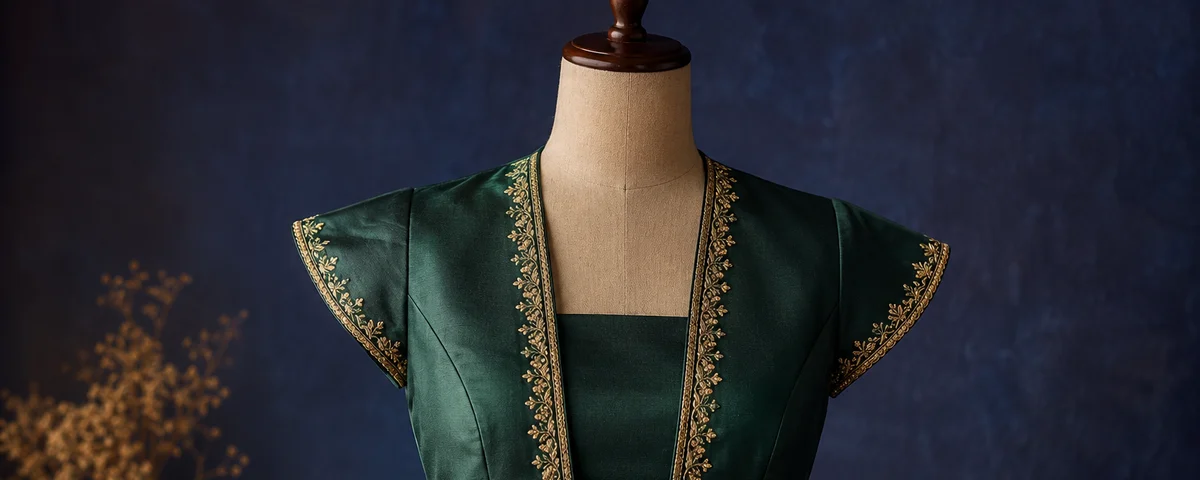
A customer from Jayanagar brought in a Pinterest photo of a jacket-style blouse for her sangeet lehenga and asked us to "just stitch the same thing." What she had saved was a single garment in the photo — what it actually requires is two: an inner blouse cut to her measurements, and a separate structured jacket cut to sit over it without pulling at the shoulders or gaping at the front. Jacket-style blouse designs read as one dramatic piece in a photograph, but they are engineered and fitted as two, and most of what goes wrong with them happens when that is not planned for from the start. This guide covers when the jacket look genuinely works, how the two layers should be designed together, and where I tell brides to save it for a different function.
What Is a Jacket-Style Blouse, and How Is It Different From a Regular Blouse?
A jacket-style blouse is a structured outer layer — often sleeveless or cap-sleeved, sometimes with a peplum or cape hem — worn over a separately fitted inner blouse. The inner blouse carries the actual fit and support; the jacket sits over it as a design layer and is cut looser, so it does not compete with the inner blouse's seams. Treating the jacket as "the blouse" and the inner piece as an afterthought is the most common mistake — both need their own neckline and fit decisions, made together.
When Does a Jacket-Style Blouse Work for a Bride?
It works best on a plain or lightly worked lehenga or saree, where the jacket is the design statement and the base outfit stays out of its way. It also works better for a shorter, mostly-standing function than a long seated ceremony, because the extra layer adds real weight and warmth.
- A plain silk or georgette lehenga, where the jacket carries the embroidery and the skirt stays clean — this is the pairing we recommend most often.
- A reception or sangeet, where you are standing and being photographed for 2 to 3 hours rather than seated through a long ceremony.
- A bride who wants a dramatic silhouette change between two functions without two separate outfits — the jacket comes off for the after-party, and the inner blouse still works on its own.
I do not recommend a heavy structured jacket for a long daytime muhurtham. A Bangalore ceremony running 4 to 6 hours in a jacket with an inner blouse underneath is genuinely warm, and the added layer restricts movement exactly when a bride needs to sit, bend, and stand repeatedly through the rituals. Save the jacket for the function where you are on your feet for a shorter stretch.
How Should the Inner Blouse and Jacket Be Designed Together?
Decide the inner blouse's neckline first, then cut the jacket to reveal exactly as much of it as intended — not more, not less. A jacket neckline that sits even slightly off from the inner blouse's neckline shows an ugly gap of skin or fabric at the collarbone, which is one of the most common fitting errors we correct at the trial. How to choose the right blouse design for your wedding saree covers how neckline decisions should anchor everything else in the design — the same logic applies here, just across two garments instead of one.
The sleeve is the other decision that has to be made jointly. A full-sleeve inner blouse under a cap-sleeve jacket shows the inner sleeve past the jacket's edge, which can look deliberate or accidental depending entirely on whether it was planned. Bridal blouse sleeve styles for South Indian weddings covers the sleeve options we work with, and for a jacket look, I usually recommend picking the inner sleeve length first and then deciding how much of it the jacket should cover.
Where Should the Embroidery Go on a Jacket-Style Blouse?
Put the embroidery on the jacket, not the inner blouse. Because the jacket is the visible outer layer, work on the inner blouse is mostly wasted — a plain inner blouse with a fully worked jacket edge, collar, and hem is both the most cost-efficient and the most visually correct way to build the look. A two-piece look is quoted as a single bridal and occasion wear order, since the jacket and inner blouse have to be patterned together.
- Jacket edge and collar — a worked border here is the most seen and most worthwhile placement, whether the jacket is open-front or fully closed.
- Jacket hem or peplum — a second worked line here balances the collar and gives the jacket a finished, considered silhouette rather than a plain shape with only a decorated neckline.
- Inner blouse — keep this largely plain. Any part visible past the jacket's edge (a sleeve cuff, a hint of neckline) can carry a light matching border, but full inner-blouse embroidery is money spent on fabric the jacket will cover.
A fully worked jacket at our Bangalore studio typically runs ₹4,500 to ₹9,000 depending on density and technique, on top of the inner blouse's own stitching cost. Before committing to a heavily embroidered jacket, what heavy hand embroidery is actually worth on a bridal blouse is worth reading, because the same logic applies — work that stays under a stole or gets covered by jewellery is not worth the density some brides ask for.
How Much Does a Jacket-Style Blouse Cost in Bangalore, and How Long Does It Take?
Budget for two garments, because that is what you are ordering. A plain inner blouse runs from our standard ₹800 base, and a structured jacket with a worked edge adds ₹4,500 to ₹9,000 depending on the embroidery. Together, a jacket-style bridal set at our Bangalore studio typically comes to ₹6,000 to ₹12,000. Because two garments have to be fitted to work as one, plan for 12 to 15 days of stitching time rather than the 7 to 10 days a single blouse usually takes, and do not skip the trial — it is the only point where we can check that the jacket sits correctly over the inner blouse's seams rather than just looking right on its own on the hanger.
If the jacket is going over a lehenga rather than a saree blouse, how to match your bridal blouse to your lehenga covers the colour and embroidery balance between the blouse and skirt — the jacket adds a third layer to that same balancing act, so it needs to echo the lehenga's colour and craft rather than compete with either piece underneath it.
Frequently Asked Questions
What is a jacket-style blouse?
A jacket-style blouse is a structured outer layer, often sleeveless or cap-sleeved, worn over a separately fitted inner blouse. The jacket is cut roughly 1 to 2 inches looser at the shoulder and armhole than the inner blouse so it sits over the seams without pulling, and it usually carries most of the embroidery while the inner blouse handles the actual fit and support.
Is a jacket-style blouse comfortable for a full wedding ceremony?
It is better suited to a reception or sangeet than a long seated ceremony. A Bangalore muhurtham running 4 to 6 hours in a jacket over an inner blouse is genuinely warm and can restrict movement during the rituals. For a shorter, mostly-standing 2 to 3 hour function, the extra layer is far more comfortable.
How much does a jacket-style bridal blouse cost in Bangalore?
At Akira Fashion Studio, a plain inner blouse starts from ₹800 and a structured, worked jacket adds ₹4,500 to ₹9,000 depending on the embroidery density. A complete jacket-style bridal set typically runs ₹6,000 to ₹12,000.
How long does it take to stitch a jacket-style blouse?
Plan for 12 to 15 days, longer than the 7 to 10 days a single blouse usually takes, because two garments have to be cut and fitted to work together. The trial fitting is essential here — it is the only stage where we confirm the jacket sits correctly over the inner blouse's seams and neckline.
Should the embroidery go on the jacket or the inner blouse?
Put the embroidery on the jacket. It is the visible outer layer, so work on the inner blouse is mostly hidden and wasted. A fully worked jacket at our studio runs ₹4,500 to ₹9,000 — keep the inner blouse largely plain, with at most a light matching border on any part that shows past the jacket's edge, such as a sleeve cuff, rather than paying twice for embroidery that will not be seen.