
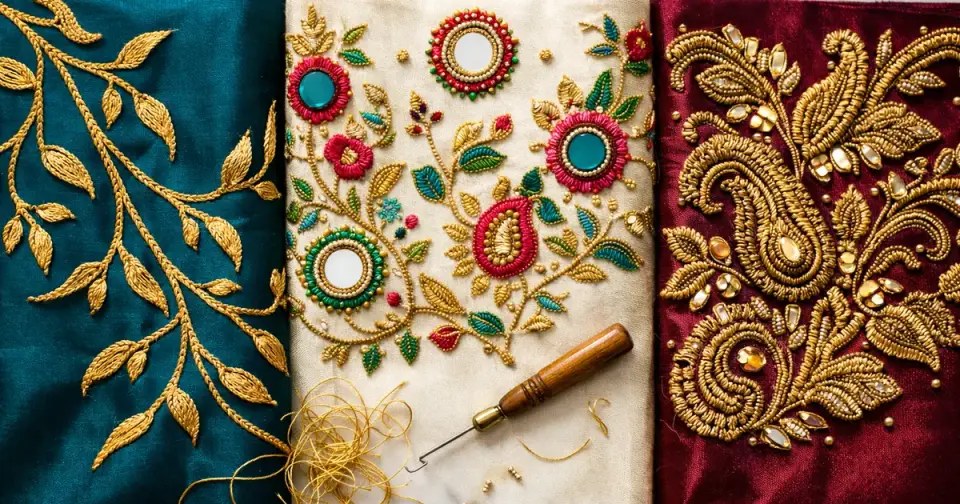
A customer from Jayanagar called recently, a little frustrated. She had visited two boutiques asking about embroidery for her wedding blouse and left more confused than when she arrived. One boutique called it aari work. Another called it maggam work. A third told her she needed zardosi. All three were talking about different things — but none explained the difference. If you are in the same position, here is a clear breakdown of all three, based on how they are actually done.
What Is Aari Work Embroidery?
Aari work is named after the needle used to create it — a long, thin needle with a hooked tip, similar to a fine crochet hook. The embroiderer works from the top of the fabric, using the hooked needle to pull thread from underneath and form a continuous chain stitch on the surface. The result is a smooth, flowing line of interlocked loops.
Because the chain stitch follows the movement of the needle without lifting, aari work is well-suited to curved and flowing patterns — vines, flowers, paisley borders, and the kind of continuous neckline designs that move naturally around a blouse edge. The thread used is typically silk thread, cotton thread, or thin zari (gold or silver metallic thread).
Aari embroidery lies flat against the fabric. It adds colour and pattern without adding significant weight — which makes it a good choice for lightweight silks, chiffons, and georgettes. A neckline border design in aari work typically takes 5 to 8 days and costs ₹800 to ₹2,500 depending on coverage and complexity. If aari is the direction you are leaning, our dedicated guide to aari work blouse stitching in Bangalore covers the costs, designs by occasion, and how to order one. Aari's use of coloured silk thread is also where it gets confused with plain thread work — thread work blouse designs covers that distinction, since thread work uses an ordinary needle and shaded stitches rather than the aari hook's continuous chain stitch.
What Is Maggam Work and How Is It Different From Aari?
Maggam is the Telugu word for frame. Maggam work refers to embroidery done on a stretched frame — the fabric is pulled taut across a wooden frame before work begins. The technique itself often uses the same aari needle, which is why the two are frequently confused. The distinction is the frame, not always the stitch.
Working on a stretched frame allows greater precision and density. The embroiderer can pack stitches more tightly, achieve more even coverage, and incorporate heavier elements — mirrors (sheesha work), metal beads, stones, sequins — that need the fabric to be held firmly in place. This is why maggam work is associated with heavier, more decorative pieces.
Maggam work is the more common term in Andhra Pradesh and Telangana. In Bangalore and across Karnataka and Tamil Nadu, the same framed embroidery technique is often called aari work. Customers asking for maggam work blouses in Bangalore and customers asking for heavy aari work blouses are often looking for the same thing — dense, framed hand embroidery with mirror or bead elements. A neckline with moderate maggam coverage takes 8 to 12 days and typically costs ₹1,500 to ₹4,000. For a fuller look at the designs themselves — motifs, coverage levels, and why brides choose it — our guide to maggam work blouse designs goes deeper.
What Is Zardosi Embroidery and Why Does It Cost More?
Zardosi comes from the Persian words zar (gold) and dozi (embroidery). It is a Mughal-era technique that uses metal wire — originally real gold and silver thread, now typically brass or copper wire coated in gold or silver — to create three-dimensional, raised embroidery on fabric.
The wire is couched onto the fabric surface and stitched down with a fine thread, building up layers to create relief and texture. The result is dimensional — you can feel the raised surface with your fingers. This is the defining characteristic of zardosi: it has depth and weight in a way that aari or maggam work does not.
Because metal wire is significantly heavier than silk or cotton thread, zardosi requires a base fabric strong enough to bear the weight. It cannot be done on chiffon or very fine silk. Heavy silk, dupion, and velvet are the most common base fabrics. A full yoke in zardozi work takes 15 to 25 days and costs ₹3,500 to ₹10,000 or more depending on coverage density and the grade of wire used. Heavy bridal zardosi that covers the front and back of a blouse sits at the upper end of this range. For prices, timelines, the fabrics that work, and how to care for it, our dedicated guide to zardosi blouse stitching in Bangalore goes deeper.
Aari Work vs Maggam Work vs Zardosi — Which Should You Choose?
The right choice depends on three things: the fabric of your saree or lehenga, the occasion you are dressing for, and how much visual weight the finished piece should carry. All three are hand techniques — if you are also weighing whether machine work would do, the honest comparison of hand vs machine embroidery covers that. Here is how I guide customers at our studio in Bangalore through this decision — and once you have settled on a technique, what to know before you book hand embroidery blouse stitching in Bangalore covers the prices, timelines, and questions to ask.
For festive and occasion blouses (Navratri, Diwali, Ugadi)
Aari work is the most practical choice for festive blouses. It is lighter, faster to complete (3 to 4 weeks total), and works across fabric weights. A border design in gold silk thread on a deep-coloured saree blouse reads as intentional and crafted without overwhelming the outfit. If you want to add mirrors for a festive shimmer, maggam-style work gives you that option without the weight of zardosi.
For bridal blouses
Bridal work most commonly uses zardosi or heavy maggam work — and many bridal pieces combine both. Zardosi creates the richness and dimension that photographs well at a distance, which matters for a wedding. Maggam work with mirrors and stones adds the kind of detail that catches light indoors. The choice between them depends on your saree: if you are wearing a heavily worked Kanjivaram with its own gold border, a lighter maggam yoke will complement it. If your saree is relatively plain — a deep solid silk — zardosi bridal embroidery will carry the weight and make the blouse the centrepiece. Whichever you choose, the harder question is how much heavy work is actually worth paying for — where heavy hand embroidery earns its price on a bridal blouse is the honest breakdown.
For everyday silk saree blouses
For blouses you will wear regularly — monthly puja, family functions, office events — aari work is the right answer. It washes better than zardosi, is lighter to wear for longer durations, and holds up to more frequent use. Zardosi is best reserved for pieces worn 2 to 4 times a year at most. The metal wire, while durable, can snag on fabric and does not survive rough handling the way thread embroidery does. All three techniques are available as hand embroidery blouse work at the studio.
Frequently Asked Questions
What is the difference between aari work and maggam work?
Aari work refers to embroidery done with a hooked aari needle that creates a chain stitch. Maggam work refers to embroidery done on a stretched frame (maggam = frame in Telugu). The two often use the same needle and stitch, so they overlap — but maggam work specifically implies framed, denser embroidery that can incorporate mirrors and beads. In Bangalore, both terms are used for what is essentially the same hand embroidery tradition.
What is zardosi embroidery and how is it different from aari work?
Zardosi uses metal wire — gold or silver-coated brass or copper — to create raised, three-dimensional embroidery. Aari work uses thread (silk, cotton, or zari) to create flat chain stitch patterns. Zardosi is heavier, takes longer (15 to 25 days for full yoke coverage), costs more (₹3,500 to ₹10,000+), and requires a heavier base fabric. Aari work is lighter, faster, and works on finer fabrics.
Which embroidery is best for a bridal blouse?
Zardosi or heavy maggam work are the most common choices for bridal blouses in Bangalore. Zardosi creates the dimensional, metallic richness that photographs well at weddings. Heavy maggam work with mirrors and stones works well for South Indian bridal wear, especially paired with Kanjivaram sarees. The right choice depends on your saree fabric weight and how much visual presence the blouse should carry.
How long does aari work embroidery take compared to zardosi?
A neckline border in aari work takes 5 to 8 days. Full yoke coverage in maggam-style aari work takes 8 to 15 days. Zardosi work takes significantly longer — 15 to 25 days for full yoke coverage, and up to 30 days for full front and back bridal coverage. This difference in time is one of the main reasons zardosi blouses cost more and need earlier planning.
Can I get aari work and zardosi on the same blouse?
Yes — combining techniques is common in bridal work. A typical combination is zardosi for the main yoke or neckline design, with aari chain stitch filling in the surrounding areas and along the sleeve edges. At Akira Fashion Studio in Bangalore, we discuss which technique goes where based on the visual weight needed in each area of the blouse. The design consultation determines the combination before any work begins.