
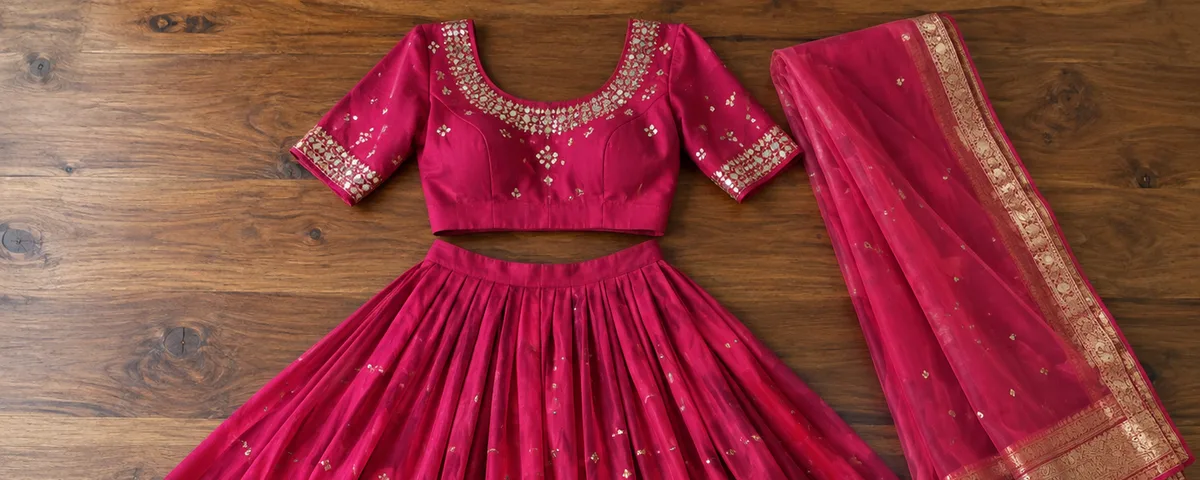
A family from Jayanagar came in three weeks before their daughter's half-saree function wanting the same zardosi-heavy blouse her older cousin had worn as a bride two years earlier. The two occasions do not carry the same weight, and copying a full bridal blouse onto a twelve-year-old's choli usually looks borrowed rather than considered. Half saree blouse designs for Karnataka and Tamil Nadu follow their own rules — a different fit, a lighter embroidery register, and a relationship to two other pieces of the outfit that a regular saree blouse never has to manage. This guide covers what actually works, who wears a half saree and for which occasions, and what to get right before you commission the choli.
Half Saree Blouse Designs for Karnataka and Tamil Nadu: What Makes Them Different
A half saree blouse, or choli, is cut and fitted differently from a regular saree blouse because it is one of three coordinated pieces rather than one paired with a single drape. The outfit is called Langa Davani in Karnataka and Pavadai Davani in Tamil Nadu — langa or pavadai for the flared skirt, davani for the saree-like piece draped over it — and the choli has to agree with both, not just sit under one saree the way a regular blouse does.
The choli is usually cut shorter and more fitted at the waist than a full-length bridal blouse, since it sits above a high-waisted langa rather than tucking into a saree pleat. It is also, structurally, closer to a lehenga's choli than to a saree blouse — how a bridal blouse is matched to a lehenga covers the same three-piece coordination logic, and most of it carries over directly to a half saree.
Who Wears a Half Saree and For Which Occasions?
A half saree is most commonly worn by young girls and teenagers for their half-saree function — a coming-of-age family celebration held in many Karnataka and Tamil Nadu households — and by young women at engagement ceremonies, temple functions, and festivals such as Ugadi, Pongal, and Tamil New Year. It is a distinct occasion from a wedding ceremony itself, where a bride typically wears a full saree or a lehenga rather than a half saree.
This matters for the blouse brief you bring to a consultation. A half-saree function for a twelve or thirteen-year-old calls for a different weight of embroidery and a more modest cut than an engagement outfit for an eighteen or twenty-year-old, even though both are technically the same three-piece garment. Being clear about the wearer's age and the occasion's formality at the start saves a redesign later.
What Neckline and Sleeve Work Best for a Half Saree Choli?
Keep the neckline modest and the sleeve short to elbow-length for a younger wearer, and save deeper necklines and sleeveless cuts for engagement-age half sarees where the dress code is closer to festive wear than a child's function. A round or boat neck with a light embroidered border is the safest, most-requested choice for a half-saree function choli at our studio in Bangalore. How to choose a blouse neckline for your occasion covers the same decision framework applied more broadly; for a half saree, occasion and age should outweigh trend photos.
Sleeve length follows the same logic. A short puff or elbow-length sleeve is standard for a half-saree function; a fuller three-quarter sleeve with a worked cuff suits an older teenager's engagement-style half saree better than a sleeveless cut would. A half saree choli should stay a register lighter in embroidery and cut than anything designed for a wedding day.
How to Match the Choli to the Langa and Davani
Match, tonal, or contrast — the same three options that apply to a bridal lehenga blouse apply here, and the right one depends on how heavily worked the langa already is. Saree blouse colour combinations sets out the general logic; for a half saree specifically, a contrast choli that picks up a colour from the davani's border is the most requested option at our Bangalore studio, because it reads festive without needing heavy embroidery to do the work.
- Matching choli — same colour family as the langa, safest for a modest half-saree function
- Tonal choli — a shade lighter or deeper than the langa, forgiving when the langa and davani are bought separately
- Contrast choli — a distinct colour picked from the davani's border or the langa's embroidery, the most requested option for festive and engagement functions
How Much Embroidery Is Right for a Half Saree Blouse?
Less than a bridal blouse, almost always. A half-saree function choli with a worked neckline border and a light back detail is enough for most families, and it typically uses thread work or light aari rather than the zardosi or heavy maggam work reserved for a wedding blouse. The family from Jayanagar I mentioned earlier settled, after a longer conversation, on a gold thread border with small mirror accents on the neckline — festive enough for the photographs, appropriate for a twelve-year-old, and a fraction of the cost and time of the zardosi blouse they had originally asked to copy.
For an older teenager's engagement-style half saree, a heavier hand-worked yoke is reasonable, since the occasion and the wearer's age both support it. The same discipline that applies to bridal embroidery decisions applies here too: match the density of the work to the weight of the occasion, not to what the budget can technically stretch to.
What Does a Half Saree Blouse Cost and How Long Does It Take in Bangalore?
At our Bangalore studio, a half saree choli with a light thread-work or aari border starts from ₹1,200 and rises to ₹3,000 to ₹5,000 with mirror work or a fuller yoke. Plan for 2 to 3 weeks from consultation to delivery for a festive half saree, and closer to 3 to 4 weeks in the run-up to Ugadi or Tamil New Year, when the embroidery queue in Bangalore is longer. Blouse stitching for Navratri and Diwali covers the same seasonal planning logic — book ahead of the festival rush rather than the week before.
Bring the langa and davani to the consultation rather than a reference photo, for the same reason it matters with a lehenga — colour and embroidery density can only be judged against the actual fabric, in daylight. We stitch half saree cholis as part of our custom stitching work at the studio.
Frequently Asked Questions
What is the difference between a half saree and a regular saree?
A half saree, called Langa Davani in Karnataka and Pavadai Davani in Tamil Nadu, is a three-piece outfit — a flared skirt (langa or pavadai), a fitted choli, and a saree-like drape (davani) worn over one shoulder. A regular saree is a single draped length of fabric worn with one blouse. The choli is cut shorter and more fitted at the waist than a standard saree blouse.
At what age do girls wear a half saree?
Most commonly between ages 10 and 16, worn for a half-saree function that marks a coming-of-age milestone in many Karnataka and Tamil Nadu families. Older teenagers and young women also wear half sarees for engagement ceremonies, temple functions, and festivals such as Ugadi and Pongal.
How much does a half saree blouse cost in Bangalore?
A half saree choli with a light thread-work or aari border starts from ₹1,200 at our Bangalore studio, rising to ₹3,000 to ₹5,000 with mirror work or heavier yoke coverage. Pricing depends on embroidery density rather than the size of the choli.
How early should I order a half saree blouse in Bangalore?
Plan for 2 to 3 weeks for a standard festive half saree, and 3 to 4 weeks in the weeks leading up to Ugadi or Tamil New Year, when the embroidery queue is longer across boutiques in Bangalore. For an engagement-style half saree with heavier work, book at least a month ahead.
Should the choli match or contrast with the langa?
Either works, and the choice depends on how heavily the langa is worked. A matching choli in the same colour family is the safest, most traditional option. A contrast choli that picks up a colour from the davani's border is the most requested option at our studio for festive and engagement half sarees, since it reads deliberate rather than mismatched.