
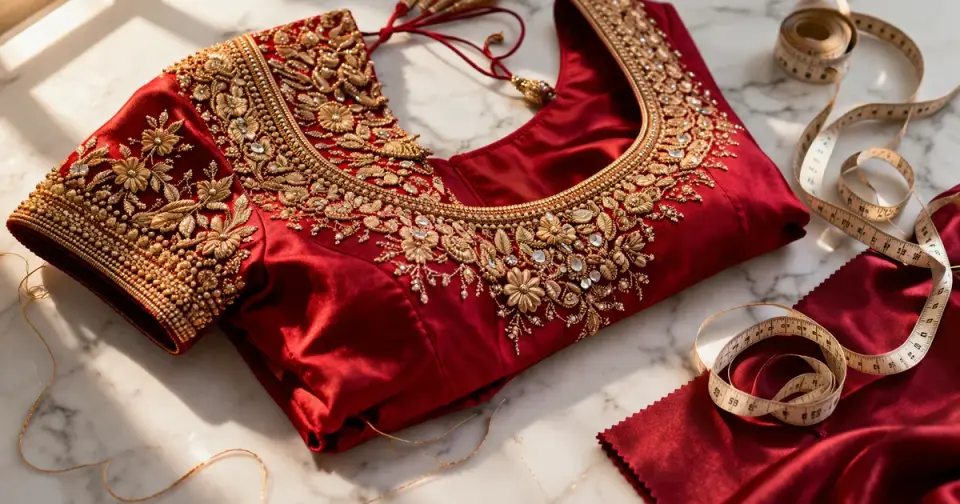
Most bridal blouse problems are not caused by bad stitching. They are caused by decisions made — or not made — weeks before the needle touches the fabric. Some are small and fixable. Others surface at the trial fitting, with 10 days to the wedding and nowhere to go. Last year I had a bride come in at the 3-week mark wanting full zardozi coverage — something that takes 20 days of hand work alone. We had an honest conversation about what was possible, redesigned around a lighter technique, and she was happy with the result. But that conversation should have happened 3 months earlier. These are the 10 mistakes I see most often — and how to avoid every one of them.
Timing Mistakes That Leave No Room to Fix Anything
Mistake 1 — Starting less than 6 weeks before the wedding
This is the most common and most damaging mistake. A bridal blouse with hand embroidery needs 8 to 10 weeks from the first consultation to the final delivery. Brides who come to us at the 4-week mark are already in a compressed timeline — and if they want zardozi or full-coverage zari work, some of what they envisioned simply cannot be done. I tell every bride who contacts us late the same thing: I will tell you what we can do well in the time we have, and what we cannot. I would rather say that now than take the order and deliver something I am not satisfied with. If you are still in the planning stage, how to plan bridal blouse stitching without last-minute stress breaks the timeline down week by week, and the reverse calendar for ordering a bridal blouse gives you the last safe booking date for your design.
Mistake 2 — Scheduling the trial fitting too close to the event
The trial fitting is not the end of the process — it is the middle. After the trial, there are almost always adjustments: a sleeve that needs to come up 1 cm, a neckline that sits slightly higher than expected, a hook placement that needs shifting. These corrections take 2 to 4 days. Brides who schedule their trial fitting 5 days before the wedding have no buffer. Schedule the trial at least 10 days before your first wedding function.
Mistake 3 — Leaving fabric sourcing until after the first consultation
If you need fabric that is not in stock — a specific silk, a particular brocade, anything that needs to be sourced from outside Bangalore — that sourcing adds 5 to 10 days before embroidery can even begin. Brides who discover this at the first appointment lose a full week they did not budget for. If you are not bringing your own fabric, call ahead and ask what is in stock. It saves time for everyone.
Design Mistakes That Are Hard to Undo Once Stitching Starts
Mistake 4 — Not bringing your actual saree to the consultation
This is the mistake I see most often from brides who book consultations and assume they can describe the saree well enough. They cannot — and neither can anyone else. The specific silk weight, the border colour, the way the pallu falls — none of these can be accurately described in words. Earlier this year, a bride from Koramangala described her saree as a deep red Kanjivaram with a gold border. Based on that, we planned a moderately embroidered neckline in antique gold. When she brought the saree in two weeks later, the border was closer to copper than gold, and the woven work ran much higher than she had described. The neckline we had designed would have competed with it. We fixed the design in 10 minutes once the saree was in the room — but that would not have been possible if we had already cut the fabric. Come with the saree. Every time.
Mistake 5 — Changing the neckline design after stitching has started
Once the blouse pattern is cut and stitching has begun, the neckline cannot be significantly changed without cutting a new pattern from scratch. I have had brides ask for this and we have done it — but it adds 5 to 7 days and the cost increases accordingly. Lock the neckline in the first consultation. It is the most consequential design decision and the one that cannot be adjusted the way a sleeve length or hook placement can.
Mistake 6 — Deciding embroidery density from photos alone
A neckline that looks balanced on a model in a photo may look completely different on your fabric, your blouse cut, and your body. Photos also flatten depth — heavy zardozi work looks rich in a well-lit campaign image and can look overwhelming on a dark silk saree in an indoor wedding hall. Before finalising embroidery density, ask to see a sample on your fabric or on a piece of comparable weight. At Akira we keep samples for exactly this reason.
Consultation Mistakes That Lead to the Wrong Blouse
Mistake 7 — Describing the design from memory instead of bringing references
Memory is unreliable for design details. "A round neckline with gold embroidery" describes about 200 different blouses. Bring reference images — from Pinterest, Instagram, or a photo of a blouse you already own and love. The more specific your references, the faster we reach the right design. Brides who come with 3 to 4 clear reference images reach a design decision in one consultation. Brides who come with a vague description often need 2 to 3 rounds.
Mistake 8 — Not discussing your jewellery during the design consultation
The neckline of your blouse and the necklace you plan to wear work together — or against each other. A heavy temple necklace against a high embroidered neck creates a cluttered, layered look. A long pendant disappears into a deep V neckline. These combinations need to be decided at the consultation, not discovered in the mirror on the wedding morning. Bring the jewellery, or at minimum a clear photo of it.
Fitting Mistakes Brides Regret After the Wedding
Mistake 9 — Rushing through the trial fitting
The trial fitting should take at least 30 to 45 minutes. Move in the blouse — sit, stand, raise your arms, check how it looks from the back. A blouse that fits beautifully while standing still can cut under the arms when you sit, or pull across the back when you raise your hands during a ritual. Every one of these issues is correctable at the trial. None of them are easy to fix at 6 a.m. on the wedding morning.
Mistake 10 — Not saying what feels wrong at the trial
Some brides hesitate to ask for corrections at the trial — they do not want to seem difficult, or they assume a small discomfort will not matter on the day. It always matters. A hook that digs in slightly will dig in for 8 hours at a wedding function. A neckline that feels slightly low will feel very low in every photograph. The trial fitting exists precisely so these things can be corrected. Tell us everything. That is what the trial is for. Avoiding all ten starts with booking your bridal and occasion wear order with enough time in hand.
Frequently Asked Questions
How early should a Bangalore bride start getting her bridal blouse stitched?
At least 8 weeks before the wedding function for a blouse with hand embroidery. For heavy zardozi or full-coverage bridal work, 10 to 12 weeks is safer. During peak wedding season in Bangalore — October through February — studios fill up quickly, so earlier is always better.
What should I bring to a bridal blouse consultation in Bangalore?
Bring your actual saree, your wedding jewellery or a clear photo of it, and 3 to 4 reference images of blouse styles you like. These three things allow the designer to make accurate decisions about neckline depth, embroidery density, and colour matching in a single consultation.
Can I change my blouse design after stitching has started?
Minor changes — sleeve length adjustments, hook placement, small embroidery additions — are possible before stitching is complete. Significant neckline changes after stitching has begun require cutting a new pattern, which adds 5 to 7 days and an additional cost. Lock the neckline and back design at the first consultation.
How long should a bridal blouse trial fitting take?
Allow 30 to 45 minutes for a bridal blouse trial at Akira Fashion Studio in Bangalore. Use the time to move in the blouse — sit, stand, raise your arms. Any corrections identified at the trial take 2 to 4 days to complete, so schedule the trial at least 10 days before your wedding function.
What is the most common bridal blouse mistake made by Bangalore brides?
Starting too late. Brides who come to a studio with less than 6 weeks before their wedding and want hand embroidery work are already in a difficult position. The embroidery alone takes 10 to 25 days depending on density — that leaves very little time for stitching, fitting, and corrections.