
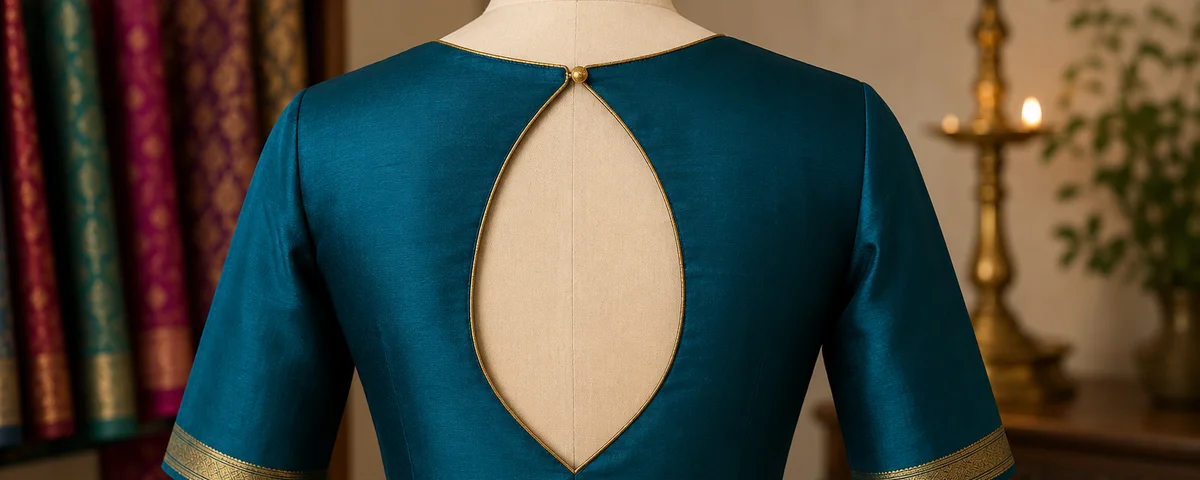
A customer from Indiranagar brought in a Mysore silk saree her mother-in-law had gifted her and asked for the same deep cutout back she had seen on a bridal Instagram page, worked in dense zardosi from the collar to the waist. Her saree was soft, lightweight, and almost plain except for a narrow zari border. The design she had saved was built for a heavy bridal Kanjivaram, and stitched onto her Mysore silk it would have sat on top of the fabric rather than belonging to it. We kept the cutout shape she liked and cut the embroidery back to a thin gold edge instead of a full worked panel, and the blouse read as considered rather than borrowed. Blouse back designs for silk sarees are not one category — a design that suits a heavy Kanjivaram can overwhelm a soft Mysore silk, and a design built for a plain georgette can look thin on a densely woven Banarasi. This guide covers the classic-to-contemporary range of back designs and how to match one to the specific silk you are wearing, whether the occasion is a wedding, a festival, or a family function in Bangalore.
How to Choose a Blouse Back Design for a Silk Saree
Decide the back after the neckline, not before, since the two need to work together rather than being chosen from two different photos. How to choose a blouse neckline for your body type and occasion covers that first decision. Once the neckline is set, the back really comes down to three questions, and silk sarees rarely get asked the last two the way bridal blouses do:
- How heavy is the silk — a dense Kanjivaram carries a back design differently than a soft Mysore silk.
- How much of the back will actually be seen — once your dupatta or pallu is draped, a lot of an elaborate back design disappears.
- How long you will be wearing the blouse in one sitting — a five-hour temple function asks more of a back closure than a two-hour evening out.
Those last two questions change the answer more than the wedding-versus-festival distinction most customers start with.
Classic Blouse Back Designs for Silk Sarees
A classic back — round, high, or a small keyhole — is the safest choice on every silk type, and the one I recommend by default when a customer has not already settled on something more dramatic. If you want that same restraint through the whole blouse rather than just the back, simple blouse designs for silk sarees that still look elegant covers what makes minimal read as considered instead of plain.
Round or high back with a bordered edge
A round or high back closes fully at the neck and carries a thin gold zari border well on almost any silk, from a heavy Kanjivaram to a light Mysore silk. It photographs cleanly, sits comfortably through a long family function, and never looks out of place, which is why it remains the most requested back design at our Bangalore studio even with more contemporary options now widely seen on Instagram.
Keyhole or teardrop back
A keyhole back adds a small cut-out below the neckline, usually closed with a button or a thread loop, without opening the full back the way a cutout or U-back does. It works on any silk weight because the opening stays small enough that it does not compete with the saree's own richness, and it is what I suggest most often to a customer who wants more than a plain round back without committing to a fully open one.
Contemporary Blouse Back Designs for Silk Sarees
Contemporary backs — a deep U, a full cutout, a dori tie-back with tassels — carry real visual weight of their own, and that only works when the silk has room for it.
- Deep U or scoop back — a rounded opening well below the shoulder blades, best on plain or lightly worked silk where the back can carry the design on its own.
- Full cutout, taken larger than a keyhole — a defined shape, often lined in gold piping or a contrast colour, that reads as deliberate on soft, lighter silks.
- Dori tie-back with tassels — decorative cord ties finished with latkan tassels, traditional in feel but contemporary in how open the back sits; needs a fabric that holds a clean line rather than one that puckers around a tied closure.
When a contemporary back works against the saree instead of with it
A heavy Kanjivaram or Banarasi already carries a dense woven border and often a worked pallu, and a large cutout back on top of that usually reads as two design decisions competing rather than one considered outfit. Bridal customers run into the same principle with ceremony wear — bridal blouse back designs goes further into how a deeper, more open back is engineered specifically for a long wedding ceremony, but the fabric logic holds whether or not the occasion is a wedding at all.
Does the Type of Silk Change What Back Design Works?
Yes — weight and weave decide how much back design a silk saree can carry more than the occasion does.
Kanjivaram and Banarasi (heavy zari silk)
Both are dense, structured silks with their own woven statement, so a classic round or keyhole back usually suits them better than a dramatic cutout, since the saree is already doing the work a contemporary back is trying to do. Bridal blouse designs for Kanjivaram sarees covers this same restraint principle applied to the front of the blouse as well.
Mysore silk and soft silk
Lighter and closer to the body than a Kanjivaram, these silks have the drape and the visual space for a deeper U or a larger cutout back without looking overloaded. This is where a contemporary back earns its place most easily, since there is no dense border for it to compete against.
Tussar, matka and raw silk
These textured silks already have body and structure of their own, so a back design with fine detail — a narrow keyhole, a thin piped edge — tends to read more cleanly than a very open cutout, which can look at odds with the fabric's natural texture rather than complementing it.
How Should Back Embroidery Match the Rest of the Blouse?
Match the back's embroidery technique and metal tone to the front of the blouse, not to whichever back-design photo you saved. A gold zardosi front with a silver-worked back edge is one of the more common mismatches we correct at the trial fitting, and it happens because the back gets decided on its own instead of alongside the front. Aari work vs maggam work vs zardosi is worth reading before you brief a back design, so the craft on the back agrees with whatever technique is already on the neckline or sleeves.
- Border only, no full panel — a thin worked edge around the opening, the most common and most versatile choice across all silk types.
- Single centred motif — one small worked detail at the base of the opening, suited to a keyhole or a small cutout back.
- Full worked panel — dense embroidery covering most of the visible back, reserved for a plain or lightly worked silk where the panel will not compete with anything else on the outfit.
How Much Does a Silk Saree Blouse Back Design Cost in Bangalore?
A classic round or keyhole back with a thin gold border adds roughly ₹500 to ₹1,500 to standard blouse stitching at our Bangalore studio. A contemporary cutout or deep U back with a worked edge runs ₹1,500 to ₹3,500, and a fully worked back panel in aari or zardosi can go up to ₹6,000 depending on density. Standard stitching takes 7 to 10 days; a contemporary back with a lined cutout or a tied closure adds a day or two for the trial, since the closure and the drape both need checking once the blouse is on the body rather than on the hanger. That extra trial round is built into our blouse stitching service, not charged as an extra.
A customer from JP Nagar came in wanting a dori tie-back on a soft silk saree for her sister's reception, worried it would not hold its shape through the evening. We added a concealed hook behind the visible tie so the decorative dori was doing none of the actual work of keeping the blouse closed, and it held cleanly through a five-hour evening without needing a single adjustment.
Frequently Asked Questions
What is the safest blouse back design for a silk saree?
A round or high back with a thin gold border. It works across every silk type — from a heavy Kanjivaram to a light Mysore silk — closes fully, and photographs cleanly through a long function. At our Bangalore studio it adds roughly ₹500 to ₹1,500 to standard blouse stitching, less than any contemporary back design.
Does a Kanjivaram saree need a dramatic back design?
No. A Kanjivaram already carries a dense woven border and often a worked pallu, so a classic round or keyhole back usually suits it better than a large cutout, which competes with the saree rather than adding to it. Save the more open, contemporary backs for a plainer or lighter silk that has visual room for one.
How much does a back design add to blouse stitching cost in Bangalore?
A classic round or keyhole back with a gold border adds ₹500 to ₹1,500. A contemporary cutout or deep U back with a worked edge runs ₹1,500 to ₹3,500, and a fully worked back panel in aari or zardosi can go up to ₹6,000 depending on density, at our Bangalore studio.
Can I get a contemporary cutout back on a heavy silk saree?
Yes, but I usually recommend scaling it down — a smaller, cleanly finished cutout with a thin border rather than a large open back with heavy embroidery. On a dense Kanjivaram or Banarasi, keeping the back design restrained lets the saree's own weave stay the focus instead of competing with it.
How long does it take to stitch a blouse with a worked back design?
Standard blouse stitching takes 7 to 10 days. A contemporary back with a lined cutout or a tied dori closure adds a day or two, since the fit and the closure both need to be checked at the trial once the blouse is on the body rather than on the hanger.