
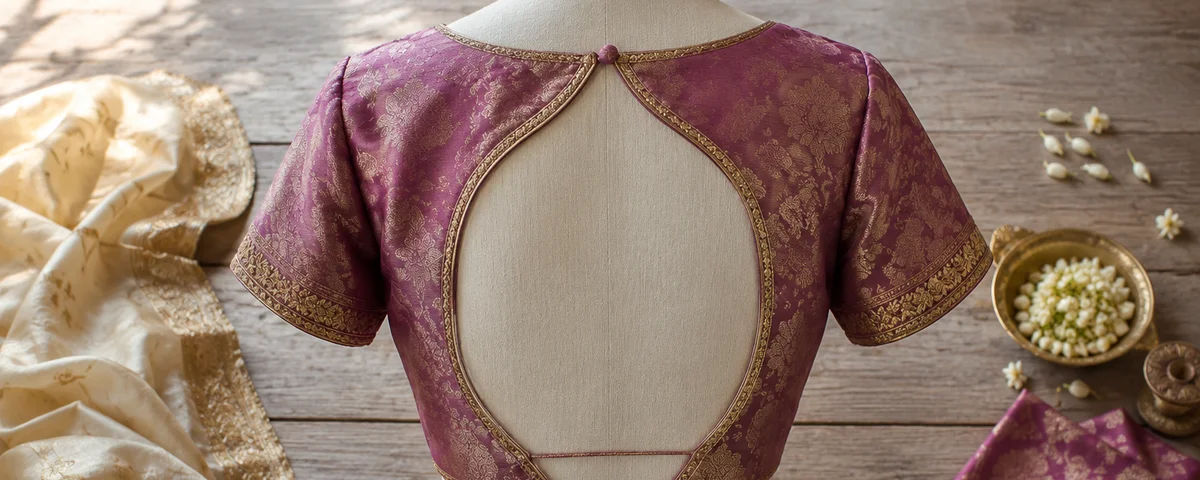
A bride from HSR Layout brought us a reception photo of an influencer in a fully backless blouse and asked for the same cut for her entire wedding day — a five-hour outdoor muhurtham included. We told her plainly that it would not hold up. Sitting cross-legged through the pheras in Bangalore's midday sun is a different proposition from twenty minutes of reception photographs under indoor lighting at night. She kept the backless design for her reception two days later and chose a fuller keyhole back for the ceremony instead. Backless blouse designs for brides can look striking in photographs, but they only work for specific sarees, specific functions, and specific engineering underneath the fabric that most inspiration photos never show. This guide covers what actually holds a backless blouse up, which sarees and functions suit it, and what to know before you order one.
What Counts as a Backless Blouse Design?
A backless blouse is any design with a back opening deeper than about 11 inches from the shoulder seam — beyond that point, the back needs its own support system rather than relying on the blouse's regular seams and lining to hold it. Within that, the styles vary in how much skin they show and how they stay in place.
- Halter or cross-strap back — two straps that cross or tie at the base of the spine, leaving the full back open. The most exposed of the group and needs the most support underneath.
- Low U-scoop backless — a deep, rounded scoop that stops a few inches above the natural waist. Reads dramatic without going as low as a full halter, and is easier to keep in place.
- Sheer or net illusion back — a fitted net panel, sometimes with light embroidery or a few placed motifs, that gives the appearance of a backless blouse while offering more coverage and support than an open cut.
- Strappy or cage back — several thin straps arranged in a pattern rather than one continuous panel. Decorative and moderately supportive, since the straps themselves help anchor the fit.
Does a Backless Blouse Work for a Long Wedding Ceremony?
No — save it for the reception. A muhurtham or pheras ceremony in Bangalore typically runs 4 to 6 hours with real movement through the rituals, and a backless design has none of the structure that a round or keyhole back has to stay comfortable through that. A reception runs 2 to 3 hours, mostly standing, under indoor lighting, which is where a backless blouse earns its place and does not fight the rest of the day.
Which Wedding Sarees Work With a Backless Blouse?
A backless blouse works best with a lightweight, fluid saree — georgette, chiffon, or a soft silk that drapes rather than sits stiffly. How to choose the blouse design for your wedding saree sets out the weight-matching principle behind this: a heavy Kanjivaram or Banarasi already carries significant visual weight in its border and weave, and a bare back adds drama the saree does not need. A soft silk or georgette, by contrast, has room for the back to be the statement.
There is a practical reason too. A heavy silk pallu is usually pinned across the shoulder for security through a long day, and that pin placement often covers exactly the part of the back a backless blouse is meant to show. A lighter saree drapes and pins more forgivingly, so the back stays visible the way you actually planned it.
What Support Does a Backless Blouse Actually Need?
More than the fabric alone. A backless design has no side seam or back panel to anchor it, so the structure has to come from somewhere else — usually a combination of boning along the side seams, a fitted princess-cut front that carries the weight, and a concealed closure placed low on the back rather than at the usual point. This is the part almost no inspiration photo shows, and it is what we spend the most trial-fitting time on for backless orders at our Bangalore studio.
- Side boning — thin flexible strips stitched into the side seams that keep the blouse from twisting or riding up when you move.
- A low, concealed hook-and-dori closure — placed at the base of the opening rather than the usual back-neck point, so the fit is secured where the strain actually is.
- Silicone or fabric anti-slip strips — a discreet addition along the inside edge that keeps the blouse from sliding on the skin, especially useful under a dupatta that shifts through the day.
A bride from Whitefield had a backless blouse stitched at our Bangalore studio for her reception and, at the trial fitting, found it gaped at the shoulder blades every time she raised her arms for photographs. We added a low hook closure and side boning that were never part of the original pattern, and the fix held for the rest of the evening. This is exactly why the trial fitting matters more for a backless design than almost any other back style — a problem like this shows up only when you move, not when you stand still in front of a mirror.
What Should You Know Before You Order a Backless Blouse?
Plan the trial fitting around movement, not just appearance. The blouse fitting process is where a backless design is actually tested — raise your arms and sit down — because a cut that looks secure standing still can behave very differently once you move in it. We test this at the trial on every bridal and occasion wear order, before the finishing goes in.
- Order at least 6 to 8 weeks before your event, the same lead time as any bridal blouse, but allow for an extra trial fitting — backless designs often need one adjustment pass after the support structure is tested in motion.
- Decide your dupatta drape before the back design, not after — a dupatta pinned flat across both shoulders will cover most of a backless back, so confirm the drape before committing to the cut.
- Ask about the closure placement specifically — a well-placed hook-and-dori low on the back holds better through a full evening than relying on fabric tension alone.
- Keep the sleeves in mind alongside the back — bridal blouse sleeve styles for South Indian weddings covers how sleeve choice pairs with a dramatic back so the two do not compete.
Frequently Asked Questions
Can I wear a backless blouse for my entire wedding day?
It is not the best choice for a long ceremony. A muhurtham or pheras usually runs 4 to 6 hours with real movement, and a backless design lacks the structure a round or keyhole back has to stay comfortable through that. Save it for the reception, which typically runs 2 to 3 hours, mostly standing — that is where a backless blouse holds up best.
What saree works best with a backless blouse?
A lightweight, fluid saree — georgette, chiffon, or a soft silk — works best, because it drapes rather than sitting stiffly and does not compete with the back for attention. A heavy Kanjivaram or Banarasi already carries visual weight in its border and weave, and its pallu is usually pinned in a way that covers the back anyway.
How do you keep a backless blouse from slipping or gaping?
Through structure the blouse itself provides — side boning along the seams, a fitted princess-cut front, and a concealed hook-and-dori closure placed low on the back rather than at the usual neckline point. Silicone anti-slip strips along the inside edge add extra hold under a shifting dupatta. None of this is visible in the finished look, but it is what keeps the blouse in place through a full event.
How far in advance should I order a backless blouse?
The same 6 to 8 weeks as any bridal blouse, but plan for an extra trial fitting. A backless design's support only gets tested properly once you move in it — raising your arms, sitting, turning — so allow time for one adjustment pass after that first trial.
Does a backless blouse design work for every body type?
Yes, when the structure — boning, a fitted front, and the right closure placement — does the actual work of holding the design in place. The practical constraint is not body shape; it is how long you will wear it and how much you will move, which is what should decide the design in the first place.