
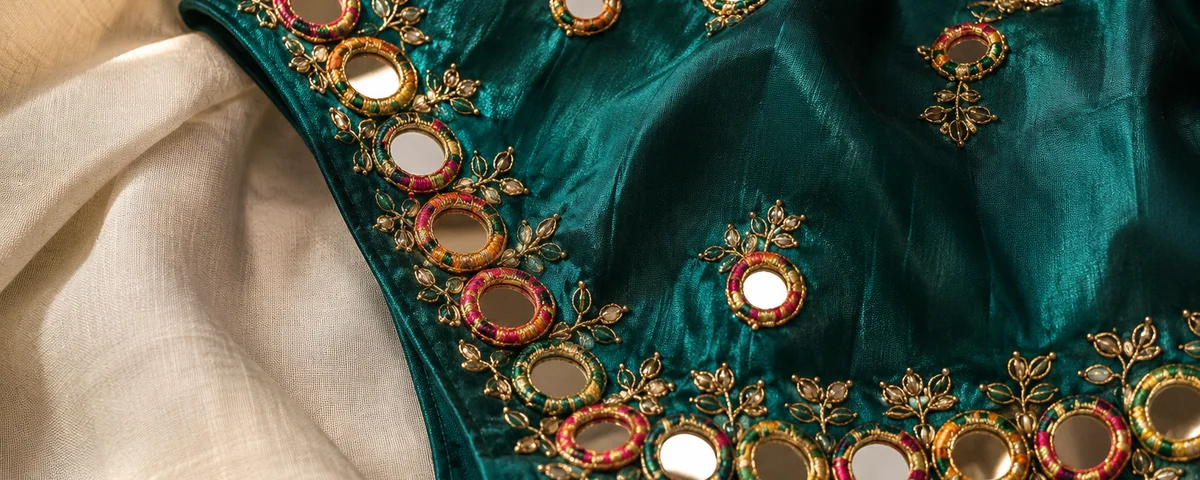
A customer from Malleshwaram came to us just before Navratri last year, holding a mirror work blouse she had bought ready-made two seasons earlier. Half the mirrors on one sleeve were gone — the thread that held them had frayed and they had simply dropped off during a night of garba. She wanted the same look, but made to last this time. That blouse taught her what most people learn the hard way: mirror work blouse designs live or die on how the mirrors are set, not just how they look on the hanger. This guide covers the designs worth asking for, what they cost, and how to make sure the mirrors are still there next Navratri.
What Is Mirror Work (Sheesha Work) on a Blouse?
Mirror work — also called sheesha or abhla work — is embroidery that fixes small mirrors onto fabric using a network of thread stitched around each one. The thread does two jobs: it holds the mirror in place and frames it decoratively. Traditionally from Gujarat and Rajasthan, it has become a festive staple across South India because nothing else catches light quite the way a well-set mirror does.
Two things decide the quality of any mirror work blouse, and neither is the design. The first is the mirror itself — real cut glass reflects with depth and a slight unevenness that reads as rich, while cheap acrylic or plastic mirrors look flat and plasticky under direct light. The second is how the mirror is fixed. Hand-set mirrors sit inside a woven cage of thread that genuinely locks them in; machine or glue-fixed mirrors are faster and cheaper but pop off far sooner. If you have ever had mirrors fall off a blouse, that is almost always the setting, not bad luck — the same difference between hand and machine embroidery applies directly to mirror work.
Mirror Work Blouse Designs for Navratri, Diwali and Festive Occasions
The best mirror work blouse designs for festive wear balance sparkle with restraint — enough mirrors to catch light across a room, not so many that the blouse reads as costume. Here are the designs I recommend most often for Navratri, Diwali, and festive functions, roughly from lightest to heaviest.
- Mirror-and-thread border on the neckline and sleeves. The lightest option — a single line of mirrors framed in bright thread. It suits garba and dandiya nights because it is comfortable to dance in for hours and still catches the light.
- Mirror clusters on a plain yoke. Small groups of mirrors scattered across the front yoke over a solid base. Reads festive without weight, and pairs well with a plain or lightly worked saree.
- Mirror work mixed with aari or thread embroidery. Mirrors used as highlights inside a larger floral or geometric design worked in aari. This is the richest-looking option for its cost, and where mirror work stops looking folk and starts looking designed.
- All-over mirror work for a statement blouse. Dense mirrors across the whole front, usually for a sangeet, a Navratri finale night, or a reception where you want the blouse to be the centrepiece. Heavier and pricier, so worth reserving for one big function.
- Mirror work with contrast piping and latkan tassels. Mirrors paired with a bold contrast border and small hanging tassels — a playful, high-energy look that photographs well for garba.
For garba and dandiya nights
Keep it light and comfortable. A mirror border or scattered clusters on a cotton or light silk blouse lets you dance for hours without the blouse feeling heavy or scratchy. Save the dense all-over work for a night you will mostly be photographed rather than moving through.
For Diwali functions and receptions
You can go richer here. Mirror work combined with gold aari on a silk base reads dressy enough for a Diwali dinner or a reception, especially in a jewel tone. This is also where mirror work pairs beautifully with heavier South Indian sarees — the mirrors pick up the zari without competing with it. If you are choosing between craft styles, how aari, maggam and zardosi work differ explains where mirror work fits among them.
What Does a Mirror Work Blouse Cost in Bangalore?
Mirror work is one of the most affordable festive embroidery options, which is a large part of its appeal. At our studio in Bangalore, a mirror-and-thread neckline border starts around ₹800 to ₹1,500. Scattered mirror clusters on a yoke run ₹1,500 to ₹3,000. Mirror work combined with aari embroidery is ₹3,000 to ₹6,000 depending on coverage, and dense all-over mirror work starts around ₹6,000. Compared with zardosi at the same coverage, mirror work gives you far more visible impact per rupee.
The single biggest cost difference is whether the mirrors are hand-set or machine-fixed. Hand-set real-glass mirror work costs more and takes longer — a worked yoke is 4 to 7 days of hand embroidery — but it is the version that survives being worn and danced in. Machine or glue-set mirror work is cheaper and faster, and fine for a blouse you will wear once or twice. For the full picture across every kind of blouse work, our transparent guide to blouse stitching prices in Bangalore breaks down what moves the number.
Which Colours and Fabrics Make Mirror Work Stand Out?
Mirror work looks best on deep, saturated colours. Jewel tones — emerald green, royal blue, deep magenta, mustard, black, rust — give the mirrors a dark frame to shine against, which is exactly why festive collections lean on them. On pale or pastel fabric, mirrors lose contrast and the whole effect flattens. If you want mirror work to read from across a room, start with a rich base colour.
Best fabrics for a mirror work blouse
Cotton and cotton-silk are the most practical for Navratri because they breathe and stay comfortable through a long night of dancing. Raw silk and dupion carry mirror work with a dressier finish for Diwali and receptions. Georgette and very fine fabrics can take mirror work too, but they need a backing so the weight of the mirrors does not pull the fabric — ask for that backing if your blouse fabric is delicate.
The thread colour changes everything
One detail people overlook: the colour of the thread that cages each mirror changes the whole look. Bright multicolour thread reads folk and festive, ideal for garba. Tonal or gold thread reads more refined and dressy. The same blouse, the same mirrors, a different setting thread gives you two completely different moods — so decide which one you are after before the work starts.
How to Wear and Care for a Mirror Work Blouse
Two rules make a mirror work blouse look expensive rather than busy. First, let the blouse be the sparkle — pair it with a plain or lightly worked saree or lehenga, not another heavily embellished piece. Second, keep jewellery minimal, because the mirrors already do the work of catching light. A mirror work blouse fighting a mirror work lehenga and heavy polki is too much of one idea.
Styling it for the occasion
For garba, lean into the fun — bright thread, a contrast border, oxidised silver jewellery, and you are dressed for the night. For a Diwali dinner or reception, choose gold-thread mirror work on a silk base with a plain silk saree, and it reads dressy rather than folk. The same craft covers both ends depending on how you style it. If you are planning several festive outfits, our festive blouse planning timeline for Navratri and Diwali helps you order early enough to actually get the work you want.
Caring for the mirrors and thread
Mirror work needs a little more care than plain embroidery because the setting thread can snag. Store the blouse folded with a soft cloth or tissue over the mirror work so the mirrors do not rub against other garments. Avoid pulling it over jewellery or bag straps that can catch a thread. Dry clean rather than machine wash — a washing machine will fray the settings and loosen mirrors fast. Handled this way, a hand-set mirror work blouse easily lasts several festive seasons — how to store and care for hand embroidery blouses covers what to do between them. Mirror work is set by hand on every piece that leaves our hand embroidery blouse table.
Frequently Asked Questions
What is mirror work on a blouse called?
Mirror work is also known as sheesha or abhla work. It is embroidery that fixes small mirrors onto fabric with a network of thread stitched around each one, both holding the mirror in place and framing it. Originally from Gujarat and Rajasthan, it is now a festive favourite for Navratri and Diwali blouses across Bangalore.
How much does a mirror work blouse cost in Bangalore?
At Akira Fashion Studio, a mirror-and-thread neckline border starts around ₹800 to ₹1,500, scattered mirror clusters on a yoke run ₹1,500 to ₹3,000, mirror work combined with aari embroidery is ₹3,000 to ₹6,000, and dense all-over mirror work starts around ₹6,000. Hand-set real-glass mirror work costs more than machine-fixed work but lasts far longer.
Why do mirrors fall off a mirror work blouse?
Almost always because the mirrors were machine or glue-fixed rather than hand-set. Hand-set mirrors sit inside a woven cage of thread that genuinely locks them in, while glued mirrors pop off after a few wears, especially during dancing. If you want a mirror work blouse to survive several Navratri seasons, ask specifically for hand-set mirrors — a hand-worked yoke takes 4 to 7 days.
Which colours suit mirror work blouses best?
Deep, saturated jewel tones — emerald green, royal blue, deep magenta, mustard, black, and rust — because mirrors need a dark frame to shine against. Pale and pastel fabrics flatten the effect. The thread colour matters too: bright multicolour thread reads festive and folk for garba, while tonal or gold thread reads dressier for Diwali functions and receptions.
How do I care for a mirror work blouse?
Dry clean it rather than machine washing, which frays the settings and loosens mirrors. Store it folded with a soft cloth over the mirror work so the mirrors do not rub against other clothes, and avoid catching the setting thread on jewellery or straps. Cared for this way, a hand-set mirror work blouse lasts several festive seasons.