
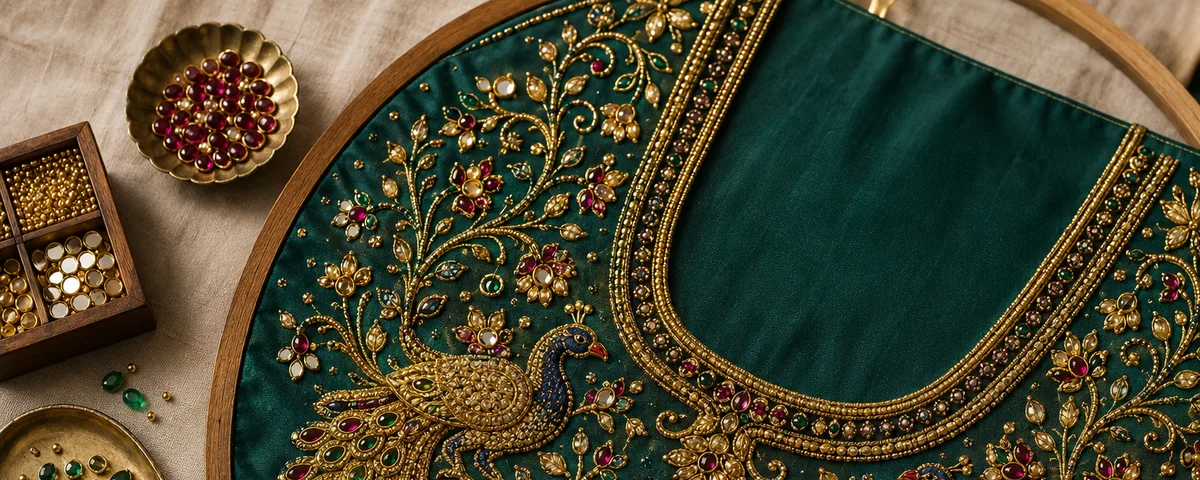
A bride from HSR Layout came in with a screenshot of a bridal yoke so densely packed with stones and gold that she assumed it would cost upward of ₹15,000. It was maggam work — and the version that would actually suit her plain silk saree was a third of the coverage and a third of the price. That gap between what people picture and what they actually need is the whole story with maggam work blouse designs. This guide walks through what maggam work looks like at each level of coverage, what each costs, which sarees it suits, and why so many South Indian brides in Bangalore choose it over lighter or heavier alternatives.
What Does Maggam Work Look Like on a Blouse?
Maggam work is dense, framed hand embroidery that combines a base of aari chain stitch with raised elements — stones, mirrors, beads, sequins, and zari — worked on fabric stretched taut across a wooden frame. On a blouse it reads as rich and textured, catching light in a way flat thread work does not. The name comes from the Telugu word for that frame. If you want the full technical distinction between the techniques, the difference between aari, maggam and zardosi work lays it out — this guide is about the designs themselves.
In Bangalore, and across Karnataka and Tamil Nadu, you will hear the same framed technique called both maggam and heavy aari — the terms overlap. What matters for choosing a design is not the label but the coverage and the elements: how much of the blouse is worked, and whether it is mostly thread, mostly stones, or a mix. Those two decisions shape both the look and the price.
Common maggam motifs
- Floral vines and creepers along the neckline and sleeve edges — the most requested and most versatile.
- Peacock, parrot, and temple motifs — traditional South Indian bridal choices that suit silk sarees.
- Mango (paisley) buttas scattered across the yoke or placed as a single statement motif.
- Mirror (sheesha) clusters for festive blouses, which add shimmer without the weight of heavy stones.
Maggam Work Blouse Designs by Coverage Level
The single decision that shapes a maggam blouse most is how much of it is covered. I take every customer through four coverage levels, because the level decides the cost, the timeline, and which saree it will suit.
Light — neckline and sleeve border
A vine or motif border along the neckline and sleeve edges, mostly thread with a few stone accents. This is the lightest maggam design and the most wearable for long events. It suits heavy sarees that already carry their own work — a maggam neckline on a Kanjivaram is usually all the blouse needs, as our Kanjivaram bridal blouse guide explains.
Medium — worked yoke
The full front yoke — neckline down to the mid-chest — worked with a denser motif and moderate stone or mirror accents. This is the most popular level for reception blouses, and for brides who want presence without full coverage.
Heavy — full front and back
Front yoke, back panel, and sleeves worked densely with stones, beads, and zari. This is bridal-level maggam, meant to be the centrepiece of the outfit, and it suits plainer silks that give the work room to be seen.
Combination — maggam with zardosi
Many bridal blouses layer zardosi metal-wire work over a maggam base for maximum richness and dimension. It is the heaviest and most expensive route, and it needs a strong base fabric to carry the weight — our zardosi blouse design guide shows where that layering earns its cost.
How Much Do Maggam Work Blouse Designs Cost in Bangalore?
Maggam work blouse designs in Bangalore range from about ₹1,500 for a light neckline border to ₹12,000 or more for full bridal coverage. Density — how tightly the surface is packed with stones and stitches — drives the price far more than the size of the blouse. Two blouses of the same coverage area can differ by several thousand rupees purely on how heavily they are worked.
- Light neckline and sleeve border: ₹1,500 to ₹4,000.
- Medium worked yoke: ₹4,000 to ₹7,000.
- Heavy full front and back bridal coverage: ₹8,000 to ₹12,000 and upward.
- Maggam layered with zardosi: ₹12,000 and up, depending on the wire work.
These are embroidery costs; the base blouse stitching and fabric are separate. For how the full quote is built up and what pushes it up or down, our transparent guide to blouse stitching prices in Bangalore breaks it down.
Which Sarees Suit Maggam Work Blouses?
Maggam work suits medium-weight and plain silks best, where the blouse has room to carry the design. On a heavily woven saree that already carries dense gold work, keep the maggam light — a neckline border, not a full yoke — so the two do not compete.
- Plain or lightly woven silk sarees: full yoke or heavy maggam reads well, because the saree is understated.
- Georgette and lightweight silks: light-to-medium maggam with mirrors, kept away from heavy stones that pull the fabric.
- Kanjivaram and Banarasi: a light maggam neckline only — the woven border is already the statement.
If you want a lighter alternative to maggam altogether — genuine hand embroidery at a lower cost and weight — aari work blouse stitching is the sister technique to consider, and it costs and photographs differently. For specific ideas at that lighter weight, these aari work blouse designs for weddings and festivals cover the five designs customers order most.
Why Do South Indian Brides Choose Maggam Work?
South Indian brides choose maggam work because it delivers rich, traditional hand embroidery — temple motifs, mirrors, gold — at a lower cost and weight than full zardosi, while still photographing well under mandap and reception lighting. It is the practical middle ground between light aari and heavy metal-wire work.
- It photographs with texture and shine indoors, which matters for reception photography.
- It carries traditional South Indian motifs — temple, peacock, mango — that suit silk bridal sarees.
- It is lighter to wear for a long muhurtham than full zardosi, which uses heavy metal wire.
- It costs less than zardosi for a similar visual richness, so more of the budget can go to coverage.
How Long Does a Maggam Work Blouse Take?
A maggam work blouse takes 8 to 25 days of embroidery depending on coverage, before base stitching and a trial fitting are added. Plan 6 to 8 weeks ahead for a bridal maggam blouse in Bangalore, and 3 to 4 weeks for a festive or reception piece.
- Light neckline border: 8 to 12 days of embroidery.
- Medium worked yoke: 12 to 18 days.
- Heavy full bridal coverage: 20 to 25 days.
Maggam cannot be rushed without the density suffering — the stones and stitches that give it richness are exactly what take time. Booking early also protects the trial fitting, where we check that a heavy worked yoke sits correctly under your jewellery. Maggam yokes are worked frame by frame as part of our hand embroidery blouse service.
Frequently Asked Questions
What is maggam work on a blouse?
Maggam work is dense hand embroidery done on fabric stretched across a wooden frame (maggam means frame in Telugu). It combines a base of aari chain stitch with raised stones, mirrors, beads, and zari. On a blouse it appears as textured, light-catching neckline borders, worked yokes, or full bridal coverage. A light maggam neckline in Bangalore starts around ₹1,500.
How much does a maggam work blouse cost in Bangalore?
A light maggam neckline border costs ₹1,500 to ₹4,000, a medium worked yoke ₹4,000 to ₹7,000, and heavy full bridal coverage ₹8,000 to ₹12,000 or more. Density drives the price more than blouse size. These are embroidery costs — base stitching and fabric are charged separately.
What is the difference between maggam work and aari work?
Maggam refers to framed embroidery — fabric stretched taut across a wooden frame — which allows dense stone and mirror work. Aari refers to the hooked-needle chain stitch, which is lighter and more economical. The two overlap and are often combined; in Bangalore both terms are used for the same framed hand embroidery tradition, with maggam typically implying the heavier, denser version.
Which saree is maggam work best for?
Plain and medium-weight silks suit maggam work best, because the blouse has room to carry the design. On a heavily woven Kanjivaram or Banarasi, keep maggam to a light neckline border so it does not compete with the saree's own gold work. Georgettes take light-to-medium maggam but not heavy stones, which pull the fabric.
How far in advance should I order a bridal maggam work blouse?
Order 6 to 8 weeks before your wedding function for a bridal maggam blouse, and 3 to 4 weeks for a festive or reception piece. Heavy bridal maggam coverage takes 20 to 25 days of embroidery alone, before base stitching and a trial fitting. Rushing it thins the density that gives maggam its richness.