
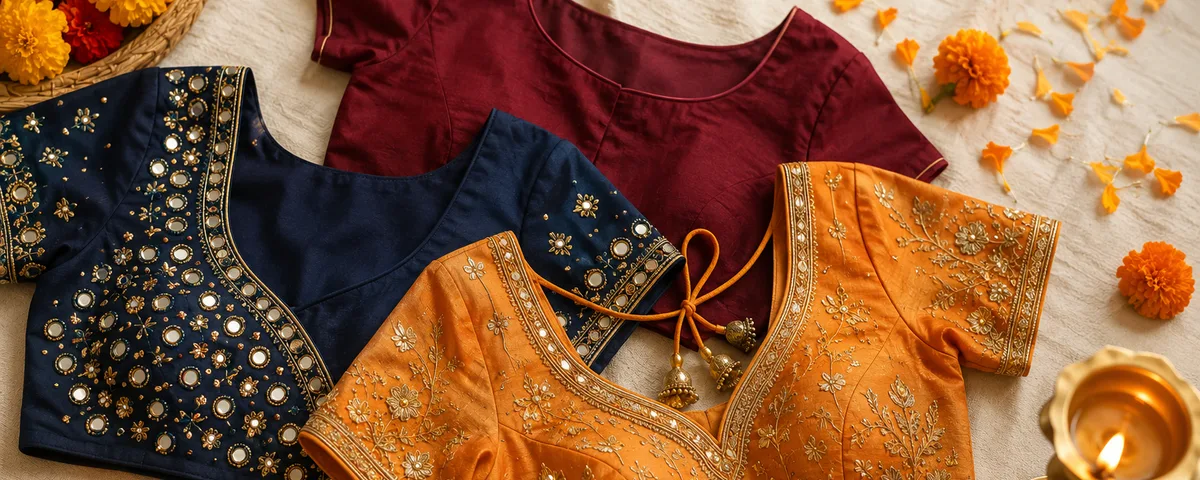
Every year I can tell festive season has started not by the calendar but by the phone. From about the third week of September, the requests change tone — they stop saying "sometime next month" and start saying "I need this for Saturday." Navratri usually falls in late September or October, Diwali a few weeks after, and by then every good boutique in Bangalore is already full. The customers who get exactly what they wanted are not the ones who paid the most. They are the ones who came early. So before you start saving festive blouse designs to a folder, the more useful question is: how much time do you actually have, and what does that time allow? This is the timeline I give people who ask.
Why Festive Season Is Different From the Rest of the Year
For most of the year, a boutique's capacity comfortably matches its orders. A regular blouse in 7 to 10 days, an embroidery blouse in 2 to 3 weeks — those timelines hold because the workload is steady. Festive season breaks that. Suddenly half of Bangalore wants a new blouse in the same four-week window, and the embroidery workers who do the hand work are the bottleneck. There are only so many of them, and they can only work so many hours.
What this means in practice: the same blouse that takes us two weeks in June can take three to four weeks in October, simply because the queue ahead of it is longer. A boutique that tells you "two weeks" in peak season is either not busy — which raises its own questions — or not being honest. The realistic festive lead times for blouse stitching in Bangalore stretch precisely when demand is highest. The only real protection against this is starting before the rush, which for Navratri means ordering by the first half of August.
The Festive Blouse Timeline: Working Backwards From Your Function
Instead of asking what you want and then finding out it is impossible in the time you have, do it the other way around. Count the weeks between today and your function, and let that decide what is realistic. Here is what each window genuinely allows during festive season.
8 weeks out — everything is on the table
With eight weeks before your function, you can do anything: heavy hand embroidery, custom aari or maggam work, a fully designed blouse with two trial fittings and unhurried corrections. This is the only window where you genuinely have choices rather than compromises. If you know Navratri or Diwali matters to you this year, this is when to come in — even if you have not finalised the design. We can hold the slot and design later.
4 weeks out — embroidery still works, but choose your technique
Four weeks is enough for most embroidery, but not all of it. Light to medium aari work, thread work, and mirror work fit comfortably. Heavy maggam or zardosi coverage becomes tight and depends entirely on how booked the studio already is. At this stage you should be deciding the technique with the boutique, not just the look — ask directly what can be finished in time with a trial fitting still included. Skipping the trial to save a few days is the wrong trade for a blouse you will be photographed in.
2 weeks out — simple stitching and machine work only
Two weeks before your function, hand embroidery is mostly off the table during peak season. What is realistic: a well-stitched plain blouse, a machine embroidery neckline or border, or a simple ready-design altered to fit. This is not a lesser outfit — a clean blouse on a good saree always looks right. For festive wear specifically, machine embroidery is often the sensible choice because nobody at a family function is inspecting your neckline from thirty centimetres away. Spend your two weeks on fit, not on work that cannot be finished well.
1 week out — fit is the whole game
With a week to go, do not chase embroidery. The single best thing a boutique can do for you now is stitch a plain blouse that fits perfectly, or restyle a blouse you already own, which takes 2 to 4 days rather than two weeks. A blouse that fits cleanly will photograph better than rushed, puckered embroidery every time. Bring the saree, be flexible on the design, and be honest about the deadline so the boutique can tell you what it can actually keep.
What Kind of Festive Work Actually Suits Navratri and Diwali
Festive blouses are a different brief from bridal ones, and treating them the same is how people overspend and run out of time. For a wedding, the blouse is the centrepiece and the budget and timeline are built around it. For Navratri or Diwali, you usually want to look festive across several occasions without the cost and lead time of bridal work. The techniques that suit this are the lighter, faster ones.
- Mirror work — bright, festive, and genuinely quick to execute. It reads beautifully under festive lighting and suits Navratri's colourful, energetic mood.
- Thread work and light aari — adds craft and texture without the weight, cost, or long timeline of heavy bridal embroidery.
- Machine embroidery necklines and borders — the practical festive workhorse when the occasion is family-facing rather than camera-facing up close.
- A clean plain blouse on a worked saree — the most underrated festive choice. If the saree is doing the work, the blouse does not need to compete.
Heavy zardosi or full hand-embroidered coverage is wonderful, but it belongs to bridal and big-occasion timelines, not a festive turnaround. If you genuinely want that level of work for a Diwali function, treat it like a bridal order and start eight weeks ahead — the cost will sit closer to our heavier blouse stitching price ranges than a festive budget usually expects.
Navratri vs Diwali: Different Outfits, Different Planning
These two festivals ask for different things, and planning them as one lump is a mistake. Navratri, for many families, means several days of dressing up — you are not styling one outfit, you are styling a few. Diwali is usually a single statement occasion. That changes what is worth stitching.
For Navratri, I usually advise spreading a modest budget across two or three lighter blouses — mirror work, a bright plain blouse, a simple machine-worked one — rather than putting everything into a single heavy piece you wear once. For Diwali, the opposite: one well-made blouse for your best saree, planned properly, is the better use of both money and time. If you are dressing for both, order them together in August so the whole festive wardrobe is handled in one planning round instead of two panics.
How to Avoid the Last-Minute Festive Rush in Bangalore
The advice is simple and almost nobody follows it: come in August. Ordering eight weeks before Navratri means you get the technique you want, the worker is not exhausted from a backlog, and there is room for a proper trial fitting and corrections. The customers who come in August pay normal prices for normal timelines. The ones who come in the first week of October pay in stress and compromise, whatever the rate card says.
Two practical habits help. First, decide your sarees before your blouses — bring the actual saree, not a phone photo, because the blouse is designed around the fabric and fall. Second, if you know you will need several festive blouses, batch them in one visit. A boutique can plan a clean run of three blouses far better than three separate last-minute orders, and you will spend less time travelling back and forth across Bangalore for fittings. If you are working to a fixed festival date, the same discipline that prevents last-minute stress with bridal blouses applies here — start early, decide early, and leave room for one round of correction. Festive orders run through the same custom stitching process as everything else, only with a tighter calendar.
Frequently Asked Questions
When should I order my blouse for Navratri or Diwali in Bangalore?
Order by the first half of August. Navratri usually falls in late September or October, and good boutiques in Bangalore fill up four to five weeks before. Coming in August means you can still get hand embroidery, a proper trial fitting, and normal prices. Leaving it to late September or October limits you to plain stitching or machine work, because the embroidery queue is already full.
How long does festive blouse stitching take during peak season?
Longer than the rest of the year, because the embroidery workers are the bottleneck. A regular blouse that takes 7 to 10 days normally can take up to two weeks in October. An embroidery blouse that is 2 to 3 weeks in June can stretch to 3 to 4 weeks in peak festive season. Plain stitching and machine embroidery hold up best to short timelines.
What blouse work can I still get done two weeks before a festival?
With two weeks left during peak season, realistic options are a well-fitted plain blouse, a machine embroidery neckline or border, or altering a ready blouse you already own. Hand embroidery is mostly not possible in that window once boutiques are booked. For festive wear, machine embroidery looks perfectly good at family functions, so this is a sensible rather than a compromised choice.
Is machine embroidery good enough for festive blouses?
For Navratri and Diwali family functions, yes. Machine embroidery costs ₹300 to ₹800 for a neckline or border, finishes in a day or two, and looks good at normal viewing distance. Hand embroidery is worth it for weddings and close-up photography, but festive wear rarely needs that level. Spending your limited festive time on a clean fit matters more than the embroidery technique.
Should I get one heavy blouse or several lighter ones for Navratri?
For Navratri, where you dress up across several days, I usually recommend two or three lighter blouses — mirror work, a bright plain blouse, a simple machine-worked one — rather than one heavy piece. It gives you variety across the festival for the same budget. For Diwali, which is usually a single occasion, one well-made blouse for your best saree is the better choice.