
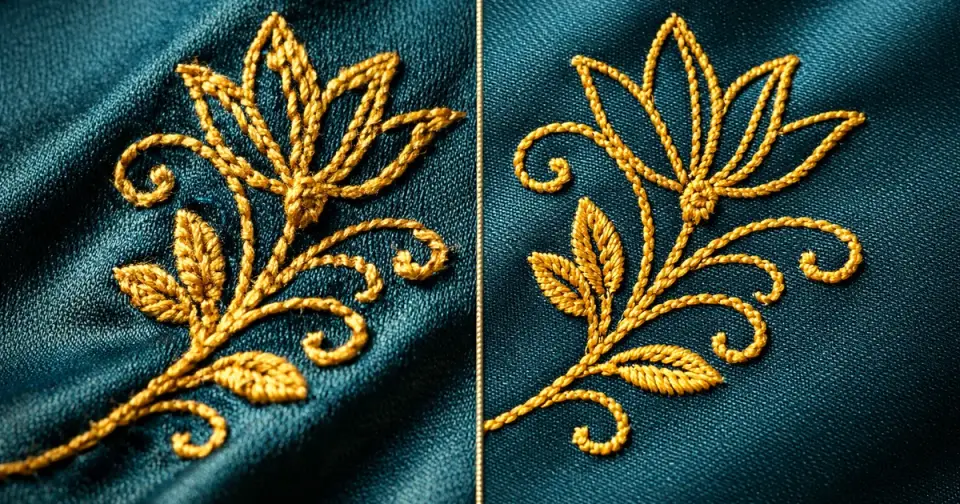
A customer came in recently with a bottle-green Banarasi saree and a photo from Instagram — she was not sure whether the embroidery on the blouse in the photo was hand or machine work. From a phone screen at arm's length, you genuinely cannot always tell. The honest answer I gave her: it depends on what the blouse is actually for, and how closely anyone will be looking. Here is how I think through that decision — including the situations where I recommend machine embroidery without hesitation.
What Is the Actual Difference Between Hand and Machine Embroidery?
Machine embroidery is executed by a computerised embroidery machine that runs pre-programmed thread patterns at high speed. The machine places stitches with perfect regularity — identical stitch length, identical tension, identical spacing across the entire design. The result is flat, consistent, and repeatable. A neckline design that takes a skilled hand embroiderer 8 days takes a machine 3 to 4 hours.
Hand embroidery is placed stitch by stitch by a person. The tension varies slightly across the work. The stitches are not identical — each one is affected by the angle of the needle, the pull of the thread, the density of the fabric at that exact point. This variation is not a flaw. It is what gives hand embroidery its depth and life. Under close inspection — and in good lighting — you can see that the surface has movement in a way that machine work does not.
From 2 metres away, on a moving person, machine and hand embroidery in the same design can look similar. From 30 centimetres away, in a photograph, or under direct light, the difference is clear. Machine work lies flat. Hand work has a slight relief, a texture, a quality that reads as crafted rather than manufactured.
How to Tell Hand Embroidery From Machine Embroidery on a Blouse
Turn the blouse over and look at the reverse side. Hand embroidery shows the back of each individual stitch — a slightly irregular pattern of thread ends and crossings. Machine embroidery shows a perfectly uniform underside, often with a bobbin thread running in a straight line beneath the design. This is the most reliable test.
On the front, look at the edges of the design. Hand embroidery has slightly soft, organic transitions where one colour or area meets another. Machine embroidery has sharp, precise edges because the machine follows a programmed path exactly. Neither of these is inherently better — they are simply different qualities that suit different purposes.
Also check the density and coverage. Machine embroidery struggles with very dense or heavily layered coverage — the fabric puckers under the weight of too many programmed stitches at once. Hand embroidery handles dense, heavily worked coverage like bridal zardosi or full yoke aari work in ways machines cannot replicate — if those terms are new to you, the difference between aari, maggam and zardosi work is worth a read.
Hand Embroidery vs Machine Embroidery: Cost and Time Comparison
This is where the decision usually gets made. Here are realistic numbers for the most common blouse embroidery requests at our studio in Bangalore.
Neckline border design
Machine embroidery: ₹300 to ₹700, completed in 1 day. Hand embroidery (aari work): ₹800 to ₹2,000, completed in 5 to 8 days. The machine version uses a fixed pattern from the machine's library. The hand version can be any pattern, customised to your neckline shape and fabric colour.
Yoke coverage (front neckline and shoulder area)
Machine embroidery: ₹800 to ₹1,800 depending on density and coverage, completed in 2 to 3 days. Hand embroidery: ₹2,000 to ₹5,000 for aari or thread work, completed in 10 to 15 days. Heavy hand embroidery yoke work (maggam or zardosi): ₹4,000 to ₹9,000, completed in 15 to 22 days.
Full bridal coverage (front, back, sleeves)
Full bridal coverage cannot be done well by machine. The density, the customisation, the dimensional quality that photographs correctly at a wedding — these require hand work. At Akira Fashion Studio in Bangalore, full bridal hand embroidery coverage starts from ₹8,000 and takes 20 to 30 days depending on the embroidery style chosen.
When to Choose Hand Embroidery and When Machine Embroidery Is Enough
I will be direct about this because most studios will not say it: machine embroidery is a perfectly reasonable choice for certain blouses. The decision should be based on what the blouse is actually for.
Choose hand embroidery when:
- The blouse is for a wedding or significant event where it will be photographed at close range.
- The design needs to be customised — a specific motif, a coverage that follows your exact neckline shape.
- The saree or lehenga is heavily worked and the blouse needs to hold its own visually.
- You want the piece to last and be worn more than 2 to 3 times over several years.
- You are in Bangalore with at least 4 weeks before the occasion.
Machine embroidery is the right choice when:
- The blouse is for regular festive wear — Navratri, Diwali, a family function — where nobody is looking closely.
- The budget is under ₹1,500 for embroidery and the occasion does not require more.
- You need the blouse within 7 to 10 days.
- The design is a standard border or simple geometric pattern.
- You are pairing it with a plain or lightly worked saree where the blouse is an accent, not the centrepiece.
Where I draw the line: I would not recommend machine embroidery for bridal work, for events where photographs will be taken at close range, or for blouses paired with premium sarees. The difference shows in those contexts, and it is not something you can fix after the fact. And if the real question is whether to stitch at all rather than buy off the shelf, hand embroidery blouses compared with readymade works through the fit and total-cost side of that decision. We are transparent about which is which on every hand embroidery blouse quote.
Frequently Asked Questions
Is hand embroidery on a blouse worth the extra cost?
For bridal wear, significant functions, and blouses you plan to wear repeatedly over several years — yes. Hand embroidery photographs better, holds up better over time, and can be customised to your exact design in ways machine work cannot. For regular festive wear or everyday blouses, machine embroidery at ₹300 to ₹800 is a reasonable and practical choice.
How much does hand embroidery cost for a blouse in Bangalore?
At Akira Fashion Studio in Bangalore, hand embroidery for a neckline border starts from ₹800. Yoke coverage in aari or thread work costs ₹2,000 to ₹5,000. Heavy maggam or zardosi work for a bridal blouse ranges from ₹4,000 to ₹10,000 depending on coverage and density. The final quote is given after the design consultation.
Can you tell the difference between hand and machine embroidery on a blouse?
Yes — look at the reverse side. Hand embroidery shows irregular thread crossings on the back. Machine embroidery shows a perfectly uniform bobbin thread line. On the front, hand embroidery has slight surface variation and depth. Machine embroidery is flat and perfectly regular. The difference is most visible in photographs and under direct lighting.
How long does machine embroidery take compared to hand embroidery?
A neckline border in machine embroidery takes 1 day. The same design in hand embroidery (aari work) takes 5 to 8 days. Full yoke coverage takes 2 to 3 days by machine and 10 to 22 days by hand depending on the technique. Machine embroidery is significantly faster, which is one of its main practical advantages for time-sensitive orders.
Does machine embroidery last as long as hand embroidery on a blouse?
Machine embroidery thread is locked tightly by the bobbin thread, which makes it durable for regular washing. Hand embroidery with silk or cotton thread also holds well with proper care — hand wash or dry clean. Zardosi (metal wire hand embroidery) is the most delicate: it does not survive machine washing and should be dry-cleaned only. For blouses worn frequently, machine embroidery or aari thread work holds up better than zardosi.