
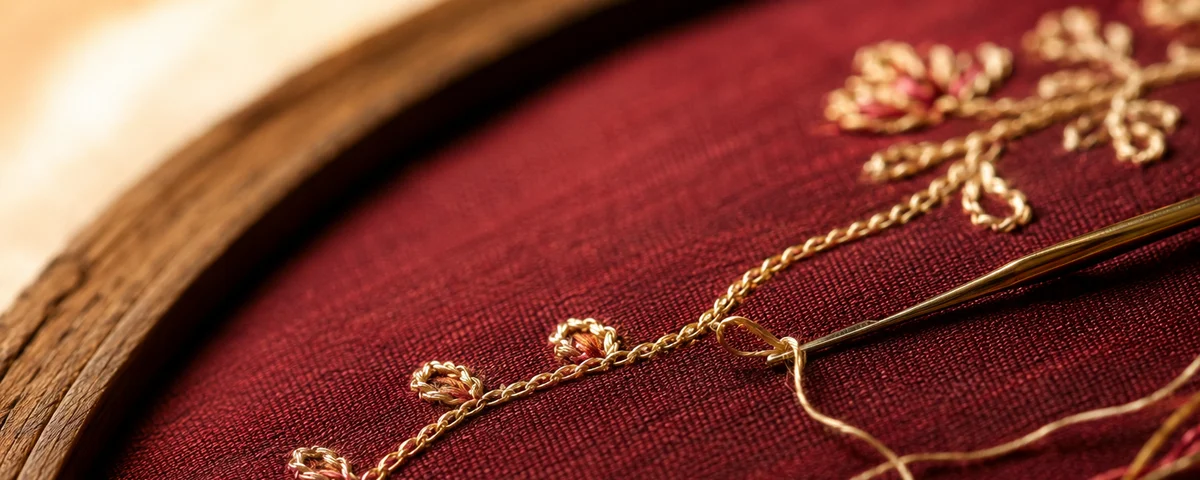
Of every ten aari work blouse designs a customer saves on her phone, maybe two get ordered — and they are rarely the two she walked in expecting to order. The designs that look richest in a reel are often wrong for the saree in hand, and the quieter designs outperform them at the actual event. After years of running these consultations at our studio in Bangalore, I know which aari designs get ordered again and again, which get regretted, and which get re-worn for years afterwards. This guide walks through aari blouse design ideas for weddings and festivals — organised by placement, occasion, and saree — with what each design honestly costs and how long it takes to make.
The Five Aari Work Blouse Designs Customers Actually Order
Nearly every aari blouse that leaves our studio is a variation of five designs. Instagram will show you hundreds, but they reduce to these — and knowing which one your occasion needs makes every later decision easier.
The floral vine border
A thread-work vine along the neckline and sleeve edges is the most ordered aari design there is, and the one I recommend most often. It adds ₹800 to ₹2,000 to the blouse and takes 5 to 8 days of embroidery. It suits heavily woven sarees — Kanjivaram, Banarasi — where the saree is already the centrepiece and the blouse only needs a finished edge.
The worked yoke
The yoke design fills the neckline down to the mid-chest with a worked motif — usually florals or paisley — in thread with light beads and sequins. At ₹2,000 to ₹5,000 and 10 to 15 days of embroidery, this is the middle of the aari range and the design most festive and reception customers land on. It reads clearly in photographs without weighing the blouse down.
The statement back
A simple front with a single worked motif on the back — a peacock, a paisley drop, or a floral spray around a deep back neckline — is the design I suggest when the saree pallu will cover most of the front anyway. You are seated and photographed from behind at more of a wedding than you expect. The cost sits in the same band as a worked yoke, because it is the density of the motif, not its position, that you pay for.
Scattered buttas
Small motifs scattered across the body of the blouse — mango buttas, floral dots, tiny mirrors — give an airy look that suits georgette and chiffon sarees. Depending on the count and spacing, buttas run ₹1,500 to ₹4,000. This is the design I steer customers towards when they want all-over interest without a heavy, filled front.
The full aari front
Full front coverage — neckline to hem in thread, beads, sequins, and selective stones — is the bridal end of aari, at ₹5,000 to ₹10,000 and 15 to 20 days of embroidery. One honest caution: once a reference photo is dominated by stones and raised gold, it has usually crossed out of aari territory. The difference between aari, maggam and zardosi matters here, because it decides both the quote and the timeline.
Which Aari Blouse Designs Work Best for Weddings?
For a wedding, the aari designs that work are the ones that hold up over a 6-to-8-hour day and in close-up photographs — a worked yoke or a full front in gold-toned thread, with stones kept selective and the motif matched to the saree rather than to a trend. Wedding lighting rewards texture over shine, which is why quieter designs often photograph better at a real mandap than the bright ones that do well in reels.
Last November a bride from Indiranagar brought us a plain rose-pink Mysore silk saree and a screenshot of a fully stoned bridal front. The screenshot was maggam-level work — around ₹12,000 — and it would have fought with her temple jewellery. We kept a full aari front but in gold thread, with stones only along the neckline: about ₹6,500, finished in 18 days, and in the photographs the saree, blouse, and jewellery read as one outfit instead of three competing ones.
- Muhurtham and long ceremonies: a worked yoke in thread and light beads — comfortable for hours under a heavy silk saree.
- Reception: a full aari front or a statement back with sequins and stones, made to catch indoor light.
- Plain or lightly woven bridal sarees: let the blouse carry the design with a full front.
- Heavily woven Kanjivaram or Banarasi: keep to a vine border or a light yoke so the blouse does not compete with the saree.
If your saved references are dense with stones, mirrors, and raised work, price them as maggam work blouse designs instead — the look is achievable, but it is a different technique with a different cost and timeline. Either way, bridal hand embroidery needs 6 to 8 weeks of lead time in Bangalore, and more in wedding season.
Aari Blouse Designs for Navratri, Diwali and Festive Wear
Festive aari designs should be lighter, brighter, and quicker than bridal work — mirror and thread designs rather than stone-heavy ones. A festive blouse is worn for an evening, danced in at a pandal, and paired with lighter sarees, so comfort and colour matter more than density.
- Mirror clusters on the yoke or sleeves — the classic Navratri look, and lighter to wear than stones.
- A contrast-colour thread vine on cotton silk — festive without being heavy, and comfortable for a full day.
- Small sequin buttas scattered on georgette for Diwali evenings, where lamplight does the work.
- A sleeve-border-only design for days that go straight from the office to a function.
Most festive aari designs sit between ₹800 and ₹4,000 and need 1 to 2 weeks of embroidery — but the queue in Bangalore lengthens sharply from August onwards. The Navratri and Diwali blouse planning timeline shows what is still possible at eight, four, and two weeks out.
Which Aari Motifs Suit Which Saree?
Match the motif and its density to the weight of the saree, not to how the motif looks on its own. The same peacock that anchors a plain silk blouse looks crowded against a heavily woven one. This pairing decision is where I spend the most consultation time, because it is the one customers can least judge from photographs.
- Kanjivaram and Banarasi: thread-only vine borders or a light yoke — the woven gold is already the centrepiece.
- Plain and lightly woven silks: filled yokes, full fronts, temple and peacock motifs — the blouse has room to lead.
- Georgette and chiffon: scattered buttas and fine vines; heavy stones pull and distort these fabrics.
- Cotton and cotton silk: contrast thread work and mirrors — festive designs that keep the easy drape of the fabric.
How Much Do Aari Work Blouse Designs Cost in Bangalore?
Aari work blouse designs in Bangalore run from ₹800 for a thread vine border to ₹10,000 for a full bridal front, on top of base blouse stitching that starts at ₹800. Density is the price driver — a small, tightly filled motif can cost more than a large airy one — so two blouses with the same design idea can be quoted thousands apart.
- Floral vine border: ₹800 to ₹2,000, with 5 to 8 days of embroidery.
- Worked yoke or statement back: ₹2,000 to ₹5,000, with 10 to 15 days.
- Scattered buttas: ₹1,500 to ₹4,000, depending on count and spacing.
- Full aari front: ₹5,000 to ₹10,000, with 15 to 20 days.
Those are embroidery costs alone; fabric, lining, and the base stitching are separate, and every design needs time for a trial fitting after the embroidery is done. For the full picture — what the technique is, how to order, and how to check you are getting genuine hand work — our complete guide to aari work blouse stitching in Bangalore covers it end to end. Aari is one of the core techniques in our hand embroidery blouse work.
Frequently Asked Questions
Which aari work blouse design is best for a wedding?
A worked yoke or a full aari front in gold-toned thread with selective stones works best for weddings. The yoke costs ₹2,000 to ₹5,000 and suits long ceremonies; a full front runs ₹5,000 to ₹10,000 and suits receptions and plainer bridal sarees. Order 6 to 8 weeks ahead for bridal aari work.
What is the simplest aari blouse design?
A thread-work floral vine along the neckline and sleeve edges. It costs ₹800 to ₹2,000, takes 5 to 8 days of embroidery, and suits heavily woven sarees like Kanjivaram and Banarasi, where the blouse only needs a finished edge rather than its own heavy design.
Are aari work blouse designs suitable for Navratri and Diwali?
Yes — festive aari designs use mirrors, contrast thread, and small sequin buttas rather than heavy stones, so they are lighter to wear and quicker to make. Most festive designs cost ₹800 to ₹4,000 and need 1 to 2 weeks of embroidery, but book 3 to 4 weeks ahead because the queue lengthens from August.
Can I give my tailor an Instagram photo of an aari blouse design?
Yes, and you should — a reference photo makes the density and placement clear from the start. Expect the design to be adapted to your saree and fabric, though, and be aware that many photos labelled aari are actually stone-heavy maggam work, which is quoted and scheduled differently.
How long does an aari work blouse design take to make?
A vine border takes 5 to 8 days of embroidery, a worked yoke 10 to 15 days, and a full aari front 15 to 20 days — plus base stitching and a trial fitting on top. Plan 3 to 4 weeks ahead for festive designs and 6 to 8 weeks for bridal work in Bangalore.