
A customer from JP Nagar showed me a Pinterest photo of a heavily stone-worked bridal yoke last month and asked for a quote for “aari work,” and when I told her the picture was mostly stones and maggam, not plain aari, she was genuinely surprised — she had assumed aari work meant any hand embroidery on a blouse. It is one of the most common mix-ups I see, and it matters, because what you call the work decides what you pay and how long you wait. Aari is a specific technique, and knowing what it actually is — and is not — is the difference between a quote that makes sense and a surprise later. If you are considering an aari work blouse in Bangalore, here is what the technique is, what it costs, how long it takes, and how to order one without the confusion that customer walked in with.
What Is Aari Work on a Blouse, Exactly?
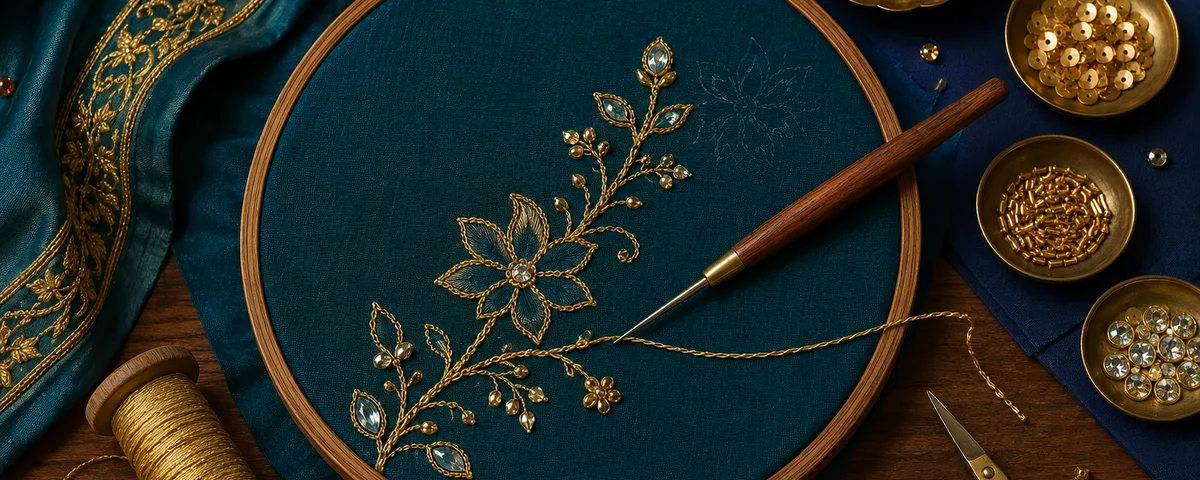
Aari work is a hand embroidery technique done with a hooked needle called an aari, which pulls thread through the fabric in a fine, continuous chain stitch. On a blouse it shows up as flowing outlines, floral vines, and filled motifs, and it is the base technique that most thread, bead, and light stone work is built on. The fabric is stretched tight over a wooden frame, and the embroiderer works the design from above with the hook, one chain stitch at a time.
What makes aari the workhorse of hand embroidery is that it is faster and more economical than heavier techniques while still being genuine hand work. It is versatile — plain thread for a subtle finish, or combined with beads, sequins, and small stones for a richer look. Where people get confused is the boundary between aari and the heavier techniques like maggam and zardosi: once a design is dense with stones and raised metal-wire work, you are paying for those additions, not the aari chain stitch underneath.
What Does Aari Work Blouse Stitching Cost in Bangalore?
Aari work blouse stitching in Bangalore starts at around ₹800 for a simple thread-work neckline, on top of the base blouse stitching, and rises with coverage, beads, and stones. The embroidery is charged separately from the base blouse, so it helps to see the two parts of the bill clearly.
What aari embroidery adds, by coverage
These are the realistic bands we quote at the studio in Bangalore for the aari work itself, on top of base blouse stitching that starts at ₹800.
- A neckline or sleeve border in plain aari thread work: ₹800 to ₹2,000.
- A worked front yoke — neckline and shoulders — in aari with light beads: ₹2,000 to ₹5,000.
- Full front coverage, or front and back, with beads, sequins, and small stones: ₹5,000 to ₹10,000.
- Dense, heavily stoned aari that edges into bridal territory: ₹8,000 and upward — at which point maggam work is often the better-value choice for that look.
The single biggest cost driver is density — how tightly the design is filled and how many beads and stones it carries — not the size of the blouse. A small, heavily filled motif can cost more than a large, airy vine. If you want the fuller picture of what pushes any blouse quote up or down, our transparent guide to blouse stitching prices in Bangalore breaks it down from plain to heavy work.
How Long Does Aari Work Take on a Blouse?
A plain aari neckline takes 5 to 8 days of embroidery, a worked yoke 10 to 15 days, and full front coverage with beadwork 15 to 20 days — and that is the embroidery time alone, before base stitching, a trial fitting, and any corrections. Aari is quicker than maggam or zardosi for the same area, which is part of why it costs less.
In practice I tell occasion customers in Bangalore, whether they are coming from Koramangala or further out, to come 3 to 4 weeks ahead for an aari yoke, and more in festive and wedding season when the embroidery queue ahead of your order is longer. Aari’s speed gives you a little more room than heavy hand work does, but it is still hand work — a bead-heavy front cannot be rushed into a few days without the quality showing it.
Which Aari Work Blouse Designs Suit Which Occasion?
Match the density of the aari work to the occasion, not to what looks impressive in a photo. Aari runs from a fine thread outline for everyday wear to a stone-and-bead front for a reception, and the right choice depends on where you will wear it and which saree it sits against. If you want the design ideas themselves — motifs, placements, and what each costs — these aari work blouse designs for weddings and festivals walk through the five we make most.
- Everyday and office festive wear: a fine aari thread neckline or a sleeve border — subtle texture at ₹800 to ₹2,000, and comfortable for long hours.
- Navratri and Diwali festive wear: an aari front yoke with thread, small mirrors, and a few beads — festive texture without the weight or cost of heavy bridal work.
- Reception and party wear: aari with sequins, stones, and zari on the yoke and back, where the blouse is meant to catch light and be noticed.
- Bridal wear: aari as the base outline, combined with maggam stones and zardosi for density — at this level the aari is the foundation and the heavier techniques do the rich work on top.
The customer from JP Nagar settled on an aari base with selective stones on the yoke — richer than plain aari, lighter and cheaper than the full maggam bridal look she first pointed at, and ready in two weeks. That middle path is where a lot of good occasion blouses land. If you are at the stage of choosing motifs and placement, here is how I think through hand embroidery blouse designs for weddings and festivals.
How to Order an Aari Work Blouse in Bangalore
To order an aari work blouse, bring the actual saree or fabric to the studio, a reference image of the design you like, and a clear idea of the occasion and date. The blouse is designed around the fabric’s weight and colour, so a phone photo of the saree is not enough — we need to see it in real light.
One thing worth checking before you commit anywhere in Bangalore: whether the aari work is genuine hand embroidery or a machine imitation. Machine embroidery can mimic an aari look at a lower price and a faster turnaround, and for some festive blouses that is a sensible choice — but it is a different product. The honest comparison of hand versus machine embroidery is worth reading before you decide which one you are actually paying for. Everything we quote as hand embroidery is worked by hand, and we will show you the reverse of the fabric to prove it.
- Bring the saree or blouse fabric, not just a photo — the design is matched to the real fabric in real light.
- Bring a reference image of the aari design you like, so the density and placement are clear from the start.
- Ask exactly what the quote covers — plain aari, or aari with beads and stones — because that is where prices diverge.
- Confirm the delivery date includes a trial fitting, not just the embroidery time.
- Ask to see a finished aari piece in person, ideally the reverse, where hand work shows its quality.
Frequently Asked Questions
What is aari work on a blouse?
Aari work is hand embroidery done with a hooked needle that pulls thread through the fabric in a fine, continuous chain stitch. On a blouse it appears as outlines, floral vines, and filled motifs, and it is the base technique that most thread, bead, and light stone work is built on. It is more economical and faster than heavier hand techniques like maggam and zardosi.
How much does an aari work blouse cost in Bangalore?
The aari embroidery starts at ₹800 to ₹2,000 for a thread-work neckline, on top of base blouse stitching that also starts at ₹800. A worked yoke with light beads is ₹2,000 to ₹5,000, and full front coverage with beads and stones ₹5,000 to ₹10,000. Density, not the size of the blouse, is the biggest cost driver.
How long does aari work take on a blouse?
A plain aari neckline takes 5 to 8 days of embroidery, a worked yoke 10 to 15 days, and full front coverage with beadwork 15 to 20 days — before base stitching and a trial fitting. Come 3 to 4 weeks ahead for an aari yoke, and earlier in festive and wedding season when the embroidery queue is longer.
What is the difference between aari work and maggam work?
Aari is the fine chain-stitch technique done with a hooked needle, and it is the most cost-effective hand embroidery. Maggam is broader frame work that often combines aari with stones, beads, and zari, making it heavier and richer. Many bridal blouses use an aari base with maggam stones on top, so the two are often used together rather than being rivals.
Is aari work hand embroidery or machine work?
True aari work is hand embroidery, worked stitch by stitch with an aari hook on fabric stretched over a frame. Machine embroidery can imitate the aari look at a lower price and a faster turnaround, but it is a different product without the texture and customisation of hand work. Always confirm which one a quote is for before you book.