
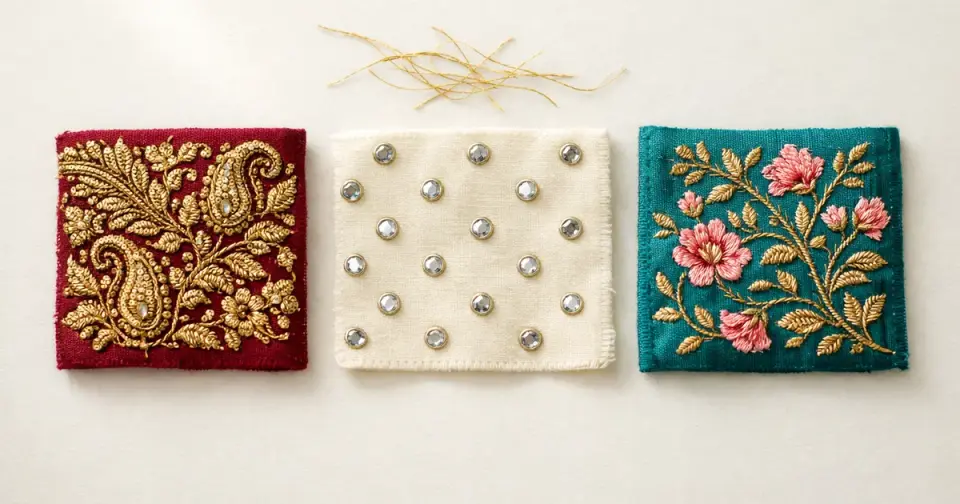
The most common thing I hear at the start of an embroidery consultation is: "I have seen so many designs, I do not know what to choose." Last week a customer came in with 47 saved Instagram posts. We looked at them for two minutes, then I asked her to show me the saree. In three minutes we had a direction. The saree always tells you where to start — not the saved posts. Here is how to make that decision quickly and confidently.
Start With the Saree, Not the Blouse
Your embroidery should complement the saree, not compete with it. A Banarasi or Kanjeevaram saree with heavy woven work already carries a lot. A richly embroidered blouse in a similar palette will make the combination feel heavy and unbalanced. In these cases, clean embroidery on just the neckline and sleeve border — rather than all-over work — lets the saree breathe while still feeling deliberate and finished.
For plain or lightly woven sarees — a plain georgette, soft chiffon, or simple cotton silk — the blouse can carry much more embroidery without overwhelming the look. This is where you have room for back designs, mirror work, dense floral patterns, or cut-out backs with intricate detailing. The saree becomes the canvas; the blouse becomes the statement. Just remember the blouse fabric itself has to hold that work — which fabrics take heavy embroidery and which need backing is worth checking before you commit to an all-over design.
How Your Occasion Changes the Design
A wedding blouse and a Navratri blouse are both festive, but they serve different purposes. Bridal embroidery is designed to hold up under close attention, photography, and the extended wear of a full wedding day. Festival blouses can be bolder in colour and pattern without needing the same refinement.
Understanding the scale of your occasion helps calibrate how much embroidery is the right amount — and which type of handwork is appropriate. Heavy zari work is well-suited for bridal events. Mirror or thread work often reads better for festivals and smaller functions. If your function is Navratri or Diwali, the festive blouse planning timeline for Bangalore shows what work is still possible at eight, four, or two weeks out.
Understanding Embroidery Placement
Neckline and sleeve border embroidery
Embroidery along the neckline and sleeve hems is the most versatile choice. It frames the face, draws attention upward, and works well with both plain and woven sarees. For a first-time embroidery blouse, neckline work is usually the safest starting point.
Back designs
A bold back design creates strong impact when you are seated at a wedding function or photographed from behind. Back embroidery works especially well when the front of the blouse is relatively simple — the contrast reads as intentional rather than busy.
All-over embroidery
All-over embroidery is a strong choice for plain sarees where the blouse needs to anchor the entire look. It works best when the saree is lightweight and unadorned. With a heavily worked saree, all-over blouse embroidery tends to overwhelm.
How to Finalise Your Design With Your Studio
A good embroidery studio will walk you through what the final result will look like before a single stitch is placed on your blouse fabric — either through samples, reference pieces, or mock placement. The best embroidery blouse is not the one with the most work on it. It is the one where every design decision was made intentionally, and it shows. If you want the technique-by-technique detail with honest prices and timelines, what to know before booking hand embroidery blouse stitching in Bangalore covers it. Design selection happens face to face at a hand embroidery blouse consultation, with your saree in hand.
Frequently Asked Questions
What is the most popular hand embroidery style for bridal blouses?
Zari and thread embroidery are the most common for bridal work in Bangalore. Zari gives a rich, traditional finish suited for silk sarees and heavy occasion wear. Thread embroidery is lighter and works well for daytime functions and softer fabrics. Mirror work is popular for festive and Navratri blouses.
How much does hand embroidery blouse stitching cost in Bangalore?
At Akira Fashion Studio, hand embroidery blouses start from ₹2,500. The final price depends on the density of the embroidery, the type of work (zari, thread, mirror, bead), and the surface area covered. A heavily embroidered bridal blouse with all-over work will cost more than a blouse with neckline embroidery only.
How long does hand embroidery blouse work take?
The embroidery work itself takes 10 to 14 days after measurements. Add 2 to 3 days for the trial fitting and final corrections. Plan for at least 3 weeks from the first consultation to delivery for hand embroidery blouses. For heavy bridal embroidery, allow 5 to 6 weeks.
Can embroidery be added to an existing blouse?
Yes, in most cases. The studio will assess the fabric, the existing construction, and the placement options before confirming. Adding embroidery to an existing blouse works well when the fabric is stable and the design is placement-based (neckline or back) rather than all-over.