
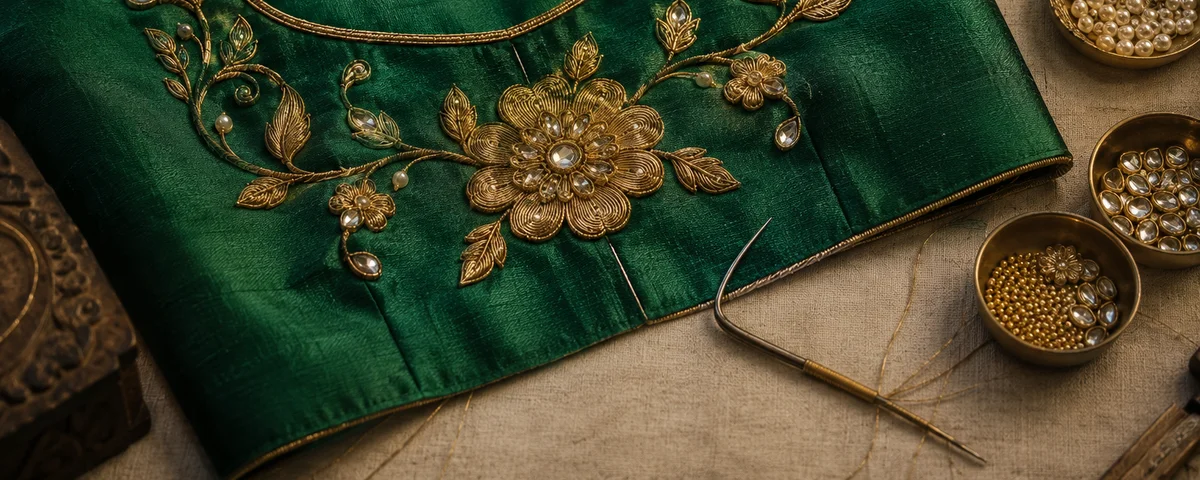
The zardosi blouse designs that photograph best at a wedding are rarely the ones with the most wire on them. Zardosi is raised metal embroidery, and raised work needs plain fabric around it to shine against — pack every inch and the design flattens into a general glitter. That is the single most useful thing I can tell you before you start saving reference photos, and it shapes every recommendation in this guide. Here are the zardosi designs brides and reception customers order most at our Bangalore studio, the motifs that earn their metal, which saree each one suits, and what every design honestly costs.
The Zardosi Blouse Designs Brides Order Most
Almost every zardosi order we take is one of five designs. Zardosi is the most expensive hand embroidery per square inch, so these designs have been shaped by decades of brides deciding where the metal is actually worth it.
The collar necklace
Dense zardosi worked around the neckline in the shape of a jewellery collar — deep enough to read as a necklace in photographs. At ₹3,500 to ₹6,000 and 10 to 15 days of embroidery, this is the design I recommend most, because it concentrates the metal exactly where every camera and every pair of eyes lands. Some brides skip a heavy necklace entirely and let the collar do that work.
The bridal yoke
A worked yoke carries a centred motif — a temple arch, a peacock, or a floral spread — from the neckline to the mid-chest, usually with kundan or pearl accents. It runs ₹6,000 to ₹12,000 with 15 to 25 days of embroidery, and it is the standard choice for brides whose saree is rich but not overwhelming.
The border-and-plain design
Zardosi kept to the sleeve edges and hem, with the body left plain. It sits in the same price band as a collar, and it is the design for a bride whose saree already carries heavy woven gold. Restraint reads as confidence here — the wire frames the saree instead of arguing with it.
The full bridal front
Front coverage from neckline to hem — the centrepiece design, for plain, heavy silks that give the wire room. This is ₹12,000 to ₹25,000 or more and 25 to 35 days of embroidery, quoted only after a design consultation. It is the design people picture when they say zardosi, and also the one that most often should have been something else: on the wrong saree it is expensive competition, not richness.
The combination design
Most bridal zardosi is actually a combination: zardosi wire for the centrepiece motif, with the surrounding areas filled in lighter thread and bead work so the raised metal stands out. The filling is the same work covered in our aari work blouse design guide, and it keeps both the weight and the cost down while making the zardosi look denser than it is.
Which Zardosi Designs Suit a Wedding vs a Reception?
For the wedding ceremony itself, choose designs that survive weight and duration — a collar or a border design rather than a full front, because a muhurtham is long and metal-wire work is heavy to wear. For a reception, the rules loosen: the event is shorter, the lighting is indoor and directional, and raised gold is at its best.
Last December a customer from Whitefield brought a plain deep-emerald raw silk saree for her reception and asked for full zardosi coverage, like a lehenga blouse she had seen. Full coverage would have been around ₹18,000 and heavier than the evening called for. We built a zardosi collar with a single worked motif on the back instead — about ₹9,000, finished in 4 weeks — and under reception lighting it read richer than full coverage would have, because the raised wire had plain silk around it to shine against.
- Muhurtham and temple weddings: a collar or border design — real presence without hours of metal weight.
- Receptions and sangeets: a yoke or full front — indoor light is where raised gold performs.
- Two-event brides: one zardosi blouse for the reception and a lighter worked blouse for the ceremony usually serves better than one blouse trying to do both.
Which Zardosi Motifs Work Best on a Bridal Blouse?
The motifs that work best in zardosi are the ones that use its dimension — shapes with strong outlines and raised centres, rather than fine filigree the wire cannot render. Five motifs come up again and again in our bridal orders because they earn their metal.
- Temple arches — gopuram lines across the yoke, the South Indian bridal classic, structured enough for wire.
- A peacock on the back with the tail fanned — the raised feathers catch light every time the bride turns.
- Paisley (kalga) motifs at the shoulders, mirrored left and right for symmetry in photographs.
- A floral jaal — a lattice of small flowers — for full fronts, where even coverage matters more than a single hero motif.
- Mango buttas with kundan centres, scattered or set in a border, for designs that need tradition without density.
How to Keep a Zardosi Design From Overpowering Your Saree
Match the coverage of the design to how much gold the saree already carries — that one rule prevents nearly every zardosi regret I have seen in Bangalore. Zardosi is the loudest voice in the room; decide how much you want it to say before you choose the design.
- Heavily woven Kanjivaram or Banarasi: a collar or borders only — our Kanjivaram bridal blouse guide explains why the blouse should frame the saree, not fight it.
- Plain or lightly woven heavy silk: a yoke or full front — the saree is the canvas and the blouse leads.
- Velvet, for winter receptions: the deep pile sets off raised gold more than any silk does.
- Light georgette or chiffon: zardosi needs a heavy base — stitch the blouse in a coordinating raw silk instead.
And if the honest answer is that your saree or your budget calls for something lighter, maggam work blouse designs give a similar traditional richness with stones instead of wire, at roughly half the price.
What Do Zardosi Blouse Designs Cost in Bangalore?
Zardosi blouse designs in Bangalore start around ₹3,500 for a collar or border and rise to ₹25,000 or more for full bridal coverage, on top of base blouse stitching that starts at ₹1,500 for bridal-grade fabric. Wire density and the stones set alongside it drive the price, not the size of the blouse.
- Collar necklace or border-and-plain: ₹3,500 to ₹6,000, with 10 to 15 days of embroidery.
- Bridal yoke: ₹6,000 to ₹12,000, with 15 to 25 days.
- Full bridal front: ₹12,000 to ₹25,000 and above, with 25 to 35 days.
- Kundan, pearls, and stones: priced on top of the wire work, by density.
Whichever design you choose, come 10 to 12 weeks before a wedding and never less than 8 — zardosi has the longest queue of any embroidery in wedding season. For the technique itself — the fabrics that can carry the wire, the process, and how to care for the blouse for years afterwards — our complete guide to zardosi blouse stitching in Bangalore covers what this designs guide does not. Every design here is executed by hand at our hand embroidery blouse studio in Bangalore.
Frequently Asked Questions
Which zardosi blouse design is best for a bride?
A collar necklace or worked yoke for the wedding ceremony, and a yoke or full front for a reception. The collar runs ₹3,500 to ₹6,000, the yoke ₹6,000 to ₹12,000, and full coverage ₹12,000 to ₹25,000 or more. Choose by how much gold your saree already carries — a heavily woven Kanjivaram needs only a collar or borders.
How much does a zardosi blouse design cost?
In Bangalore, ₹3,500 to ₹6,000 for a collar or border design, ₹6,000 to ₹12,000 for a bridal yoke, and ₹12,000 to ₹25,000 or more for a full bridal front, on top of base stitching from ₹1,500. Kundan, pearls, and stones are priced on top of the wire work by their density.
Can a zardosi design be made for a georgette or chiffon saree?
Not on the light fabric itself — zardosi is metal wire and needs a heavy base like raw silk, dupion, or velvet, or the fabric puckers and sags. The standard route is to stitch the blouse in a coordinating heavy fabric while the saree stays light. A firm lining can support a light collar design, but not heavy coverage.
What is the difference between a zardosi design and a maggam design?
Zardosi builds its design from raised metal wire, so it reads dimensional and antique-gold; maggam builds it from stones, beads, and thread worked on a frame, so it reads dense and textured. Zardosi costs roughly double for similar coverage — a maggam yoke runs ₹4,000 to ₹7,000 against ₹6,000 to ₹12,000 for a zardosi yoke.
Can a zardosi blouse design be reused after the wedding?
Yes — well-made zardosi can be carefully removed and re-worked onto a new blouse later, which is part of what justifies the price. Keep it dry-clean only and store it flat in muslin, and the design outlasts the original blouse. Many of our Bangalore brides plan the design as a keepsake from the start.