
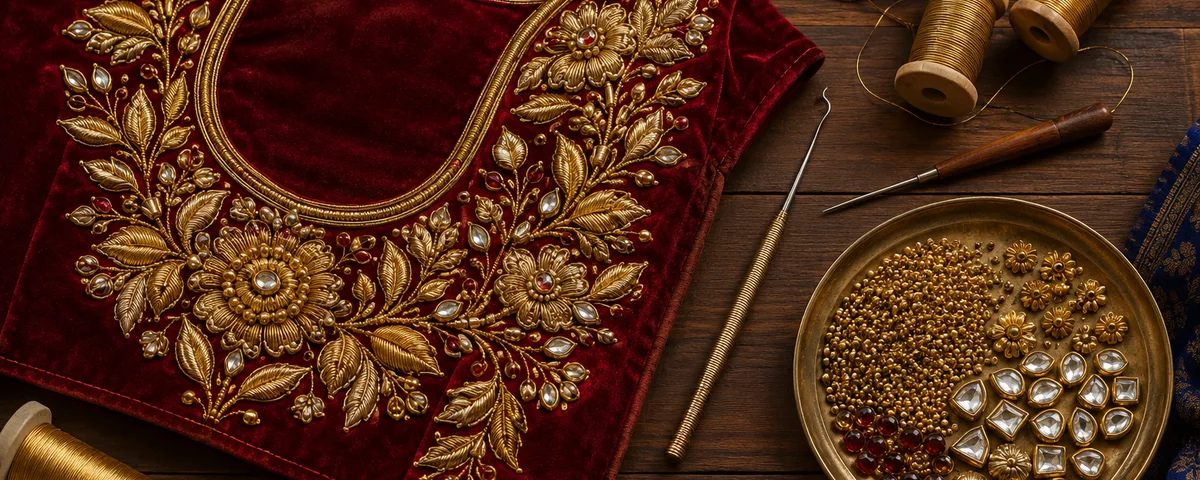
A bride from HSR Layout brought us a soft georgette saree last season and a reference photo of a heavily zardosi-worked bridal blouse, and I had to give her an answer she did not want to hear: that exact blouse could not be made on that fabric. Zardosi is metal-wire work — it is heavy, and a fine georgette will not carry it without puckering and pulling out of shape within a few wears. We found a way to give her the look she wanted, but it meant rethinking the fabric first. That is the honest starting point with zardosi blouse stitching in Bangalore: it is the most premium hand embroidery there is, and also the most particular about where it can go. Here is what it costs, how long it takes, which fabrics it works on, and how to look after it once it is yours.
What Is Zardosi Work on a Blouse?
Zardosi is hand embroidery worked in metal wire, not thread — fine gold- or silver-coloured wire couched onto the fabric to build a raised, dimensional, antique-gold surface you can feel with your fingers. The name comes from the Persian for gold embroidery, and it is a Mughal-era technique. On a blouse it reads as rich and sculptural in a way that flat thread work does not, and that depth is exactly what makes it the most premium hand embroidery — and the most delicate. If you are still collecting ideas, these zardosi blouse designs for brides and receptions show where the metal is worth it.
Because it uses real metal wire, zardosi is heavier and more demanding than aari or maggam work, and it sits at the top of both the price and the timeline. If you are still sorting out which technique is which, the difference between aari, maggam and zardosi work is worth ten minutes before you commit — it changes what you should ask for and what you should expect to pay.
What Does Zardosi Blouse Stitching Cost in Bangalore?
Zardosi blouse stitching in Bangalore starts around ₹3,500 for a worked neckline and runs to ₹15,000 and beyond for a fully covered bridal blouse, on top of the base blouse stitching. It is the most expensive of the hand techniques because metal-wire work is slow and the material itself costs more than thread.
What zardosi embroidery adds, by coverage
These are the realistic bands we quote at the studio in Bangalore for the zardosi work itself, on top of base blouse stitching that starts at ₹1,500 for bridal-grade fabric.
- A neckline or collar in zardosi work: ₹3,500 to ₹6,000.
- A worked front yoke — neckline and shoulders — in zardosi: ₹6,000 to ₹12,000.
- Heavy bridal coverage across the front, and often the back and sleeves: ₹12,000 to ₹25,000 or more, set only after a design consultation.
- Zardosi combined with stones, kundan, or pearls, as most bridal work is: priced on top of the wire work, by the density of the added elements.
The biggest cost driver is density — how tightly the wire is packed and how much stone and bead work sits alongside it — not the size of the blouse. If you want to see where zardosi sits against every other kind of work, from plain to heavy, our transparent guide to blouse stitching prices in Bangalore lays the full range out. And if the zardosi budget is a stretch, there is an honest alternative worth knowing about, which I come to below.
How Long Does Zardosi Blouse Stitching Take?
Plan for the longest timeline of any blouse work: a zardosi neckline takes 10 to 15 days of embroidery, a worked yoke 15 to 25 days, and full bridal coverage 25 to 35 days — the embroidery alone, before base stitching, a trial fitting, and corrections. Metal wire cannot be worked quickly, because each element is couched down by hand.
In practice I tell bridal customers in Bangalore to come 10 to 12 weeks before the wedding function for heavy zardosi, and never less than 8. In wedding season the embroiderers who do fine zardosi are the most in demand and the most booked, so the queue ahead of your order is longer than for any other technique. Because zardosi is almost always a bridal or reception choice, the same care that goes into choosing a boutique for bridal blouse stitching in Bangalore applies doubly — you are trusting someone with your most-photographed garment on the longest timeline.
Which Fabrics Work for Zardosi — and Which Do Not?
Zardosi needs a base fabric strong enough to hold the weight of metal wire, so it works on heavy silks, raw silk, dupion, and velvet — and does not work on fine georgette, chiffon, or lightweight net. This is the single most important decision, and the one the bride from HSR Layout learned the hard way: put heavy wire on a fabric that cannot carry it and the blouse puckers, sags, and pulls out of shape.
If you have your heart set on zardosi but your saree is a light one, there are two honest routes.
- Stitch the zardosi blouse in a coordinating heavy fabric — a matching raw silk or dupion — rather than the saree fabric itself, so the blouse carries the weight while the saree stays light.
- Back the lighter fabric with a firm lining or underlay so it can bear moderate zardosi. This works for a neckline or light yoke, not for heavy all-over work.
Either way, bring the actual saree to the consultation in Bangalore. Fabric weight and drape cannot be judged from a phone photo, and with zardosi the fabric decides what is possible before the design does.
How to Care for a Zardosi Blouse So It Lasts
Zardosi is dry-clean only — never machine wash it and never hand wash it in water, because water tarnishes the metal wire and loosens the couching threads. The full routine for storing and airing worked pieces is in our guide to hand embroidery blouse care. Stored and cleaned properly, a zardosi blouse lasts for years and can be re-worn or even re-worked onto a new blouse later. Treated carelessly, the wire dulls and the threads pull within a season.
- Dry clean only, and tell the cleaner it is zardosi so they handle it gently — ordinary pressing flattens the raised work.
- Store it flat or rolled in a muslin cloth, not on a hanger, so the weight of the wire does not distort the shape.
- Keep it away from moisture and perfume, both of which tarnish metal wire over time.
- Never iron directly over the zardosi; press only the plain fabric, and from the reverse.
This is also why zardosi is worth the premium for a keepsake bridal blouse and less sensible for something you will wear casually and wash often. For a blouse you want to wear and launder without ceremony, aari work gives you genuine hand embroidery at a fraction of the cost and none of the care restrictions — it is the honest alternative I mention to customers in Indiranagar and elsewhere whose occasion does not truly call for metal-wire work. Save zardosi for the blouse that deserves it, and it will still look rich at your anniversary. When it is the right call, zardosi is worked by hand at our hand embroidery blouse studio.
Frequently Asked Questions
How much does a zardosi blouse cost in Bangalore?
Zardosi work starts around ₹3,500 for a neckline and ₹6,000 to ₹12,000 for a worked yoke, on top of base blouse stitching from ₹1,500. Heavy bridal coverage runs ₹12,000 to ₹25,000 or more, and stones, kundan, or pearls are priced on top. Density — how tightly the wire and stones are packed — drives the cost more than the size of the blouse.
How long does zardosi blouse stitching take in Bangalore?
It is the longest of the hand techniques: a neckline takes 10 to 15 days of embroidery, a yoke 15 to 25 days, and full bridal coverage 25 to 35 days, before base stitching and a trial fitting. Come 10 to 12 weeks before a wedding function for heavy zardosi, and never less than 8 — in wedding season the queue is longest for this work.
What fabric is best for a zardosi blouse?
Heavy silks, raw silk, dupion, and velvet, because they can carry the weight of the metal wire. Fine georgette, chiffon, and lightweight net are not suitable for heavy zardosi — the fabric puckers and pulls out of shape. If your saree is light, stitch the blouse in a coordinating heavy fabric, or use a firm lining for lighter neckline work.
Is zardosi work worth it over aari or maggam work?
For a bridal or reception blouse you want to keep and re-wear for years, yes — zardosi has a raised, dimensional richness that flat thread work cannot match. For festive or everyday wear, aari or maggam gives genuine hand embroidery at a fraction of the cost and without the dry-clean-only care. Match the technique to the occasion, not to the most expensive option.
How do you care for a zardosi blouse?
Dry clean only — water tarnishes the metal wire and loosens the couching. Store it flat or rolled in muslin rather than on a hanger so the weight does not distort it, keep it away from moisture and perfume, and never iron directly over the zardosi. Cared for this way, a zardosi blouse lasts years and can be re-worked onto a new blouse later.