
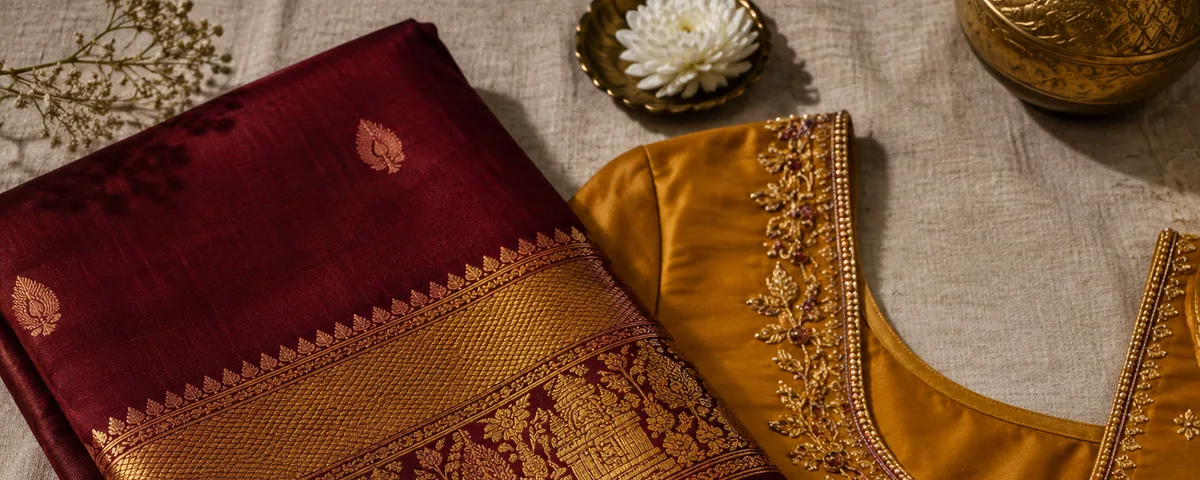
A bride from Jayanagar brought in her Kanjivaram three months before her muhurtham — a deep maroon nine-yard with a wide gold temple border that had been her grandmother's. She had saved fourteen blouse references, and twelve of them were heavy maggam pieces from Instagram. When we laid the saree flat on the table, the answer was obvious: that border was already doing the work, and piling dense embroidery on top would have buried it. Choosing a bridal blouse for a Kanjivaram saree is less about adding and more about knowing what the silk has already given you. This guide is how South Indian brides in Bangalore make that decision without guessing.
How the Weight of a Kanjivaram Saree Decides the Blouse
A Kanjivaram is one of the heaviest sarees you will ever wear, and that weight is the single most important fact about designing its blouse. A genuine silk Kanjivaram with a wide zari border weighs anywhere from 700 grams to over a kilogram. The border, the pallu, and the woven body are all carrying dense gold work before the blouse enters the picture. The blouse's job is to complete the silhouette, not to compete with the saree.
This is the opposite of designing for a plain georgette or a lightweight silk, where the blouse is expected to carry the design. On a Kanjivaram, full maggam or heavy zardozi across the whole blouse usually reads as too much — two dense elements fighting for the same attention. I explain this at nearly every Kanjivaram consultation in our Bangalore studio, and it is almost always the point where a bride's reference folder gets cut in half. If you want the full logic of matching blouse weight to saree weight across every fabric, our guide to choosing a blouse design for your wedding saree covers it saree by saree.
Should Your Kanjivaram Blouse Match or Contrast the Saree?
For a Kanjivaram, a contrast blouse is the traditional South Indian choice, and it is usually the stronger one. Classic Kanjivarams are woven with a contrast border and pallu already — a maroon body with a mustard border, a green body with a red border. The saree itself is telling you which contrast colour to pull for the blouse. A matched blouse is not wrong, but it flattens the silhouette that the weavers deliberately built with the korvai border.
When a contrast blouse works best
- The saree has a clearly different border and body colour — pick the blouse from the border, not the body.
- You want the traditional temple-border look that reads correctly in muhurtham photographs.
- You are wearing temple jewellery or heavy gold, which sits better against a solid contrast blouse than a busy matched one.
When a matching tone-on-tone blouse works
- The saree is a single-colour Kanjivaram with a self-border in the same shade, where there is no contrast colour to draw from.
- You want an elongated, understated line for a reception rather than a ceremony.
- The blouse carries a back design or neckline embroidery that would get lost against a busy contrast.
Which Embroidery Works Best on a Kanjivaram Bridal Blouse?
Neckline and border embroidery in aari or zari thread work is the most reliable choice for a Kanjivaram bridal blouse — not full-coverage maggam or zardozi. The reason is simple: the saree already carries the heavy metal work, so the blouse looks most intentional when it echoes the border with a lighter, cleaner hand rather than matching it gram for gram.
Aari and zari thread work
Aari work along the neckline and sleeve edges picks up the gold of the Kanjivaram border without adding bulk. It is quicker and lighter than maggam, and it photographs cleanly in both daylight and mandap lighting. Aari work on a bridal blouse at our Bangalore studio starts from around ₹2,500 and rises with coverage — our guide to aari work blouse stitching in Bangalore breaks down what drives the cost and how long it takes.
When maggam or zardozi is worth it
Save heavy maggam or zardozi for a reception blouse, or for a plainer silk saree, not a fully woven Kanjivaram. If you genuinely want dense work on a Kanjivaram, confine it to the back panel or a single yoke so it has room to be seen. If you are unsure which technique you are actually looking at, the difference between aari, maggam and zardosi work explains how each one looks and what it costs.
Neckline and Back Designs That Suit a Kanjivaram Blouse
Lock the neckline first — it is the one element that cannot be changed once stitching begins. For a Kanjivaram, a clean boat neck or a modest round neck at the front paired with a detailed back is the combination that suits the saree's structured drape and the temple jewellery most brides wear with it.
Front neckline
- Boat neck: sits well under a heavy South Indian necklace and frames the collarbone — the most requested front for Kanjivaram bridal blouses at our studio.
- Round neck with a zari border: understated and reliable, letting the saree and jewellery lead.
- Deep V or sweetheart: works, but only if your jewellery is a long haaram rather than a close choker that would clash with the depth.
Back design
The back is where a Kanjivaram blouse can carry its design, because the pallu is draped forward and the back is fully visible in photographs. A keyhole or a modest cut-out with an aari or zari border reads as clean and considered without adding weight. Reserve heavy stone or maggam back panels for receptions — for a long muhurtham, comfort against a chair for 4 to 6 hours matters more than density. Getting placement and density right is its own decision, and how to choose hand embroidery blouse designs walks through it.
The Best Contrast Colour Combinations for Kanjivaram Blouses
The most dependable contrast blouse colours are the ones already present in the saree's border or checks. Pull the blouse colour from the zari border or the contrast pallu and it will always look intentional. These combinations consistently photograph well under both daylight and reception lighting, drawn from the Kanjivaram bridal blouses we stitch most often in Bangalore.
- Maroon or deep red saree with a mustard-gold or antique-gold blouse.
- Bottle green saree with a deep red or maroon blouse.
- Magenta or pink saree with a green or gold blouse.
- Mustard or haldi-yellow saree with a maroon or dark green blouse.
- Peacock blue or teal saree with a red or gold blouse.
- Ivory or off-white saree with a gold, maroon, or deep jewel-tone blouse.
Avoid pastel or very light blouses under a heavy Kanjivaram — a pale blouse under deep silk tends to wash out in photographs and breaks the traditional weight balance. If you want lightness, put it in the embroidery, not the base fabric.
How Early Should You Order a Bridal Blouse for a Kanjivaram Saree in Bangalore?
Order your Kanjivaram bridal blouse at least 6 to 8 weeks before your wedding function, and allow 10 weeks if you want heavy hand embroidery. Kanjivaram silk is dense and slips under the needle — it takes more time to handle cleanly than a lightweight fabric, and rushing it shows in the finish.
A plain, well-finished Kanjivaram blouse with a trial fitting takes about 10 to 14 days at our Bangalore studio. Add aari or zari neckline work and you are looking at 2 to 3 weeks. Full back embroidery or maggam work pushes it to 4 to 6 weeks. Booking early also protects your trial fitting — the step where we catch how the neckline actually sits under a heavy necklace, which no measurement on its own can predict. Kanjivaram bridal blouses are one of the most frequent bridal and occasion wear orders we take.
Frequently Asked Questions
What blouse design suits a Kanjivaram wedding saree?
A contrast blouse in a colour pulled from the saree's border, with aari or zari thread embroidery along the neckline. Avoid full maggam or zardozi coverage — a genuine Kanjivaram already weighs 700 grams to over a kilogram with its own zari work, so a lighter, cleaner blouse reads as more intentional. A boat neck front with a detailed back is the most requested combination in our Bangalore studio.
Should a Kanjivaram blouse match or contrast the saree?
A contrast blouse is the traditional South Indian choice and usually the stronger one, because Kanjivarams are woven with a contrast border and pallu. Pull the blouse colour from the border — mustard-gold on maroon, red on green. A tone-on-tone matching blouse works only for single-colour Kanjivarams with a self-border, or when you want an understated reception look.
What is the best colour blouse for a maroon Kanjivaram saree?
Mustard-gold or antique-gold is the most reliable choice for a maroon or deep-red Kanjivaram, echoing the gold zari border. Deep green also works if the saree has a green contrast pallu. Avoid pale or pastel blouses under deep maroon silk — they wash out in photographs and break the traditional weight balance.
How much does a bridal blouse for a Kanjivaram saree cost in Bangalore?
A plain, well-finished Kanjivaram bridal blouse starts from ₹1,500 with a trial fitting included. Aari or zari neckline work starts from ₹2,500, and heavy back embroidery or maggam work ranges from ₹4,000 to ₹8,000 depending on coverage. Silk handling adds a little to the stitching time and cost, since Kanjivaram is denser and slower to sew than lightweight fabric.
How early should I order my Kanjivaram bridal blouse?
At least 6 to 8 weeks before your wedding function, and 10 weeks if you want heavy hand embroidery. A plain Kanjivaram blouse takes 10 to 14 days at our Bangalore studio; aari neckline work takes 2 to 3 weeks; full maggam or back embroidery takes 4 to 6 weeks. Booking early also secures your trial fitting, where the neckline is checked against your actual jewellery.