
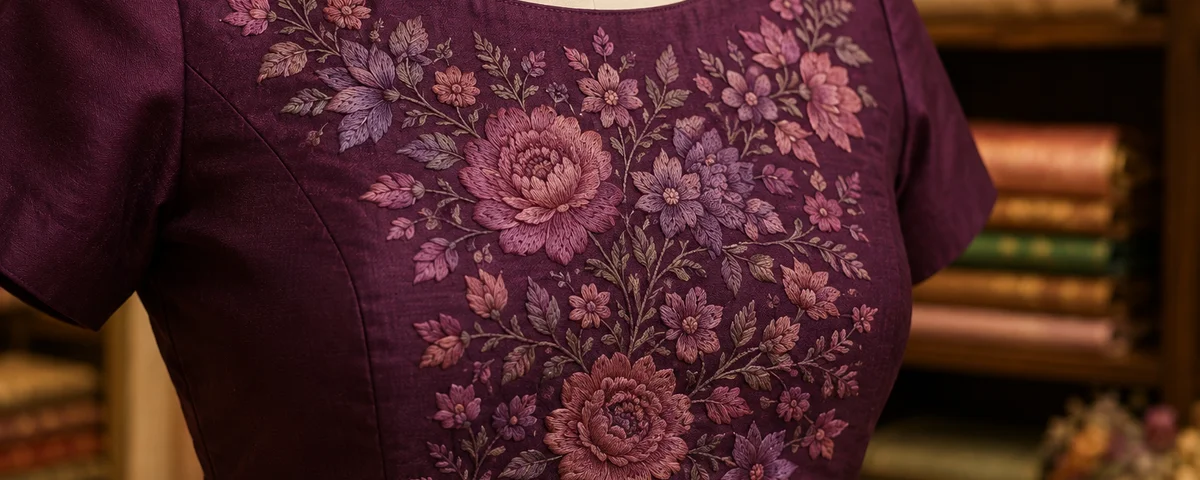
A customer from Whitefield brought in a plain pastel silk saree and asked for "embroidery, but not the heavy gold kind" — she did not know the word for what she wanted, only that she had seen a soft, shaded floral pattern worked in coloured thread on a friend's blouse, and it looked nothing like the zari-heavy work every shop kept pushing on her. What she was describing is thread work, sometimes called resham embroidery, and it is one of the most requested and least understood embroidery categories at our Bangalore studio. We stitched her a shaded floral panel across the front in soft dusty-pink and sage thread, and it was exactly the effect she had been struggling to describe. Thread work blouse designs range from a single delicate border to full-coverage floral or paisley motifs, and unlike zardosi or maggam work, the richness comes from shading and stitch direction rather than metal thread or stones. This guide covers what thread work actually is, how it differs from the zari-based techniques most people default to, and how much coverage suits which occasion.
What Is Thread Work Embroidery on a Blouse?
Thread work — also called resham embroidery — is embroidery done entirely in coloured silk or cotton thread, without any metal zari, sequins or stone work. The design comes from stitch technique alone: chain stitch for clean outlines, satin stitch for solidly filled petals and leaves, and long-and-short stitch for shaded, realistic florals where one thread colour blends into the next. It is lighter, more breathable, and considerably less expensive than zari-based embroidery, which is exactly why it is the technique I recommend most often to a customer who wants visible craft without the weight or cost of gold work.
Thread Work Blouse Designs: From a Simple Border to Full Coverage
How much of the blouse gets worked is a separate decision from which stitch is used, and it is the one that changes the price and the finished look the most.
A single border along the neckline or sleeve
A fine floral or paisley line following the neckline edge or sleeve hem is the lightest and most versatile option. It adds visible hand-work without changing how the blouse wears, and it is the version I suggest to a first-time thread work customer who is not sure how much detail they actually want.
A worked yoke or front panel
Extending the design into a filled yoke or a panel down the front gives thread work a proper focal point, usually a cluster of shaded flowers or a paisley motif, while the sleeves and back stay plain. This is the most requested coverage level at our Bangalore studio, since it reads as considered without asking for full-blouse commitment.
Full coverage — an all-over floral or paisley spread
Full coverage extends the worked area across the entire front, and often the back, in a continuous floral or paisley spread. It takes the longest to complete and asks the most of the base fabric, but because there is no metal thread adding weight, even a fully worked thread work blouse stays noticeably lighter than an equivalent zardosi piece.
How Is Thread Work Different From Aari, Maggam or Zardosi?
The difference is what creates the pattern, not how much of the blouse is covered. Aari work vs maggam work vs zardosi uses a hooked needle to pull thread into a continuous chain stitch, or metal wire couched onto the surface for zardosi — both build the design through the needle or the material itself. Thread work uses an ordinary embroidery needle and relies on stitch variety and thread shading to create depth, which is why it can achieve a soft, painterly gradient that a chain stitch alone cannot.
- Weight — thread work is the lightest of the four techniques, since there is no metal wire, mirror or stone involved.
- Look — aari and thread work can both use coloured silk thread, but aari's chain stitch gives a smoother, more linear surface, while thread work's mixed stitches give a shaded, almost painted texture.
- Cost — thread work generally costs less than aari or maggam work of similar coverage, since it does not require a stretched frame or specialised hooked-needle training.
Which Sarees and Occasions Suit a Thread Work Blouse?
Thread work suits soft and mid-weight silks best, and occasions where you are wearing the outfit for several hours rather than a short evening function. What fabric works best for hand embroidery blouses covers this pairing logic in more depth, but the short version for thread work specifically is that it needs a fabric with enough body to hold the stitching flat without puckering — soft silk and Mysore silk both qualify, and a lighter Kanjivaram can work too if the weave is not too dense.
For festive wear — Navratri, Diwali, a family wedding as a guest — a worked yoke or border in shaded thread reads as festive without the weight of a bridal-grade piece. Mirror work blouse designs for Navratri and Diwali covers a related festive option if you want more shimmer than thread work alone provides; the two techniques are sometimes combined, with mirror accents placed inside a thread-worked floral outline. Both fall under the hand embroidery blouse work we do in-house, so a combined design is quoted as one piece rather than two.
How Much Does Thread Work Blouse Embroidery Cost in Bangalore?
Price and timeline scale with how much of the blouse gets worked, not with any single stitch being more expensive than another:
- Single border along the neckline or sleeve — ₹600 to ₹1,500, 5 to 7 days.
- Worked yoke or front panel — ₹1,800 to ₹4,000, 8 to 12 days.
- Full coverage across the front and back — ₹4,500 to ₹9,000, 15 to 20 days, still noticeably less than an equivalent zardosi piece of similar coverage.
It is worth checking that instinct against what heavy hand embroidery is actually worth on a bridal blouse before assuming heavier automatically means better — thread work's advantage is precisely that it does not need to go heavy to look considered.
A customer from Koramangala came in wanting a fully worked thread embroidery blouse for her sister's reception, initially asking for it in 10 days. We were honest that full coverage shading work needs 15 to 20 days to do properly — rushing the long-and-short stitch produces flat, uneven shading rather than the soft gradient that makes thread work worth choosing over a simpler technique. She moved her booking a week earlier instead of asking us to compress the timeline, and the finished blouse held the shading exactly as planned.
Frequently Asked Questions
What is thread work embroidery on a blouse?
Thread work, also called resham embroidery, is embroidery done entirely in coloured silk or cotton thread using stitches like chain, satin and long-and-short stitch, without any metal zari, mirrors or stones. It is lighter and less expensive than zari-based techniques like zardosi, and it is what gives a blouse a soft, shaded floral look rather than a metallic one.
Is thread work the same as aari work?
No. Aari work uses a hooked needle to pull thread into a continuous chain stitch, giving a smooth, linear surface. Thread work uses an ordinary embroidery needle and a mix of stitches — including long-and-short stitch for shading — which produces a softer, more painterly texture. Both can use coloured silk thread, but the technique and the finished look are different.
How much does a thread work blouse cost in Bangalore?
A single border costs ₹600 to ₹1,500 and takes 5 to 7 days at our Bangalore studio. A worked yoke or panel runs ₹1,800 to ₹4,000 over 8 to 12 days, and full coverage costs ₹4,500 to ₹9,000 and takes 15 to 20 days.
Does thread work suit a bridal blouse or only festive wear?
It works for both, though it is more common for festive and everyday premium wear than for bridal blouses, where zardosi and maggam work remain the standard choice for their richer, more dimensional look. A bride wanting a lighter alternative to heavy zari work can reasonably choose thread work, especially for a soft silk or Mysore silk saree.
How long does full coverage thread work embroidery take?
Full coverage across the front and back takes 15 to 20 days at our Bangalore studio. Compressing this timeline produces flat, uneven shading, since the long-and-short stitch that creates thread work's soft gradient needs unhurried, careful work to look right.