
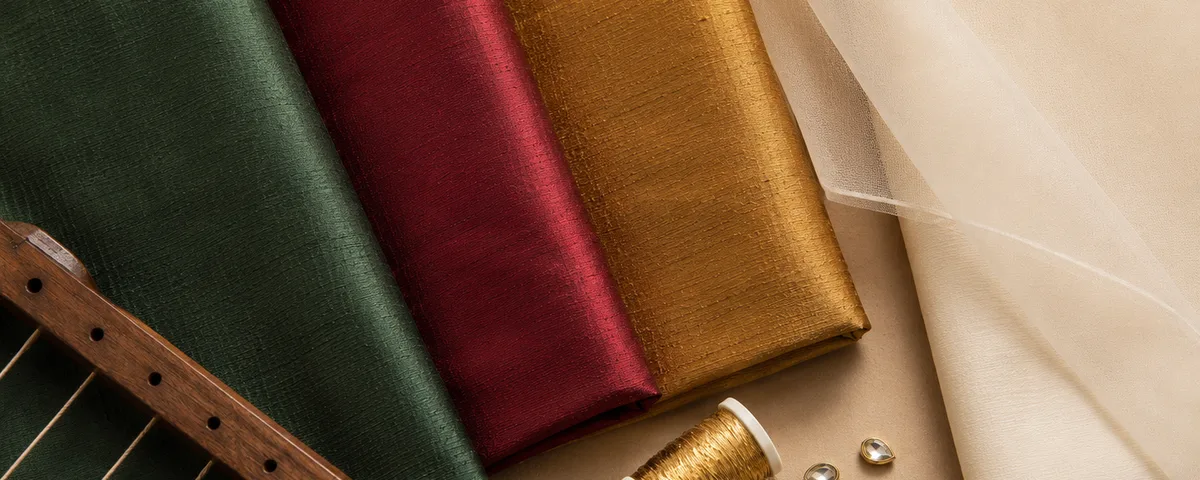
A customer from Jayanagar brought in a soft pastel chiffon saree with its matching chiffon blouse piece, and a phone full of heavy maggam yokes she wanted copied onto it. I gave her the honest answer before we discussed a single motif: that blouse piece would not hold that work. Dense embroidery would drag the light chiffon out of shape within one season of wear. The design was never the problem — the fabric was. This is the decision most people skip when they plan an embroidered blouse, and it is the one that quietly determines whether the work sits well for years or slowly ruins the blouse. So before you fall for a design, here is how to choose the right fabric for a hand embroidery blouse.
Why Fabric Matters More Than the Design in a Hand Embroidery Blouse
The fabric is the ground the embroidery sits on, and it carries the entire weight of the work. Pick a fabric that cannot take the weight, and even flawless embroidery will pucker, sag, or pull the blouse out of shape over time. This is why I look at the fabric before I look at the design. A hooked aari needle and a threaded zardosi wire both put real tension on the cloth as thousands of stitches go in, and only a fabric with enough body and a stable weave holds that tension without distorting.
Three things decide whether a fabric can carry hand embroidery well:
- Weight and body — the fabric needs enough substance to support the stitches without collapsing under them. This is why silks outperform sheer, floaty fabrics for heavy work.
- Weave tightness — a tightly woven fabric grips each stitch and resists puckering, while a loose or slippery weave lets stitches shift and the surface ripple.
- Stretch — stretchy or very soft fabric moves under the needle, so the embroidery ends up uneven and the fitted blouse loses shape at the seams.
Get those three right and almost any design becomes possible. Get them wrong and we spend the consultation talking you out of the work you came in for.
Which Fabrics Work Best for Hand Embroidery Blouses?
For most hand embroidery blouses, raw silk and pure silk are the most reliable fabrics — they have body, a firm weave, and they hold heavy work without complaint. Art silk and cotton-silk are dependable mid-range options, and cotton suits lighter festive work. Sheer fabrics like georgette, chiffon and net can be embroidered, but only with the right backing and a lighter design. Here is how each one behaves under the needle.
Raw silk and pure silk
Raw silk is the fabric I recommend most often for embroidered blouses. It has natural body, a matte texture that flatters gold and zari, and a weave tight enough to hold everything from fine aari to heavy zardosi. Pure silk behaves similarly and photographs cleanly. Both take dense work without puckering and keep their shape through a full wedding day. Expect to pay ₹400 to ₹1,200 a metre for good raw silk in Bangalore, and more for pure silk.
Art silk and silk blends
Art silk and poly-silk blends are the practical middle choice — they cost less than pure silk, usually ₹150 to ₹400 a metre, and carry light to medium embroidery well. They work for neckline borders, yokes, and festive aari or thread work. Their limit is heavy bridal work: under dense maggam or zardosi, cheaper blends can look strained and the sheen can read as synthetic in close-up photographs. For lighter designs they are honest value.
Cotton and cotton-silk
Cotton and cotton-silk are strong choices for lighter, everyday and festive embroidery — thread work, light aari, mirror work. Cotton grips stitches well because of its matte, tightly woven surface, and it stays comfortable through long daytime functions in Bangalore’s warmer months. It is not the fabric for heavy stone or zardosi work, where the weight would eventually distort a softer cotton. For a Navratri or Diwali blouse with thread and mirror work, though, it is breathable and dependable.
Georgette, chiffon and net
These sheer fabrics can take hand embroidery — a great deal of bridal and reception work is done on net and georgette — but never on their own. They must be backed with a lining fabric so they can carry the weight, and even then the design should be placement-based rather than all-over. This is exactly where my Jayanagar customer’s plan fell apart: her chiffon piece had no backing and she wanted dense all-over work. On backed net with a considered design, the same idea would have worked. Sheer fabrics reward restraint and punish density.
The right fabric is partly a function of the technique you choose, because a light aari neckline and a heavy zardosi yoke ask very different things of the cloth. If you are still deciding between them, the difference between aari, maggam and zardosi work is worth reading first — the technique narrows the fabric choice for you.
What Fabric Suits Heavy Bridal Embroidery vs Light Festive Work?
Heavy bridal embroidery needs a firm, substantial ground fabric — raw silk, pure silk, or backed net — because dense zardosi, stones, and maggam put serious weight on the cloth. Light festive work in thread, mirror, or fine aari sits happily on softer fabrics like art silk, cotton-silk, and cotton. The rule is simple: the heavier the work, the more body the fabric needs beneath it.
For full bridal blouses we almost always use raw silk or a properly backed net, because those pieces get worn for hours, photographed closely, and often kept for years. If you are weighing how much heavy work is actually worth putting on a blouse, what makes heavy hand embroidery worth its price walks through it honestly. For a one-evening festive blouse there is no need to over-build the fabric — a good cotton-silk with thread work costs less and wears more comfortably.
Why Backing Fabric Matters for an Embroidery Blouse
Backing fabric is a second layer of cloth — usually a fine cotton mull or lining — placed behind the area that will be embroidered, and for anything beyond light work it is not optional. It carries the weight of the stitches, keeps the surface from puckering, and stops heavy work from tearing at the main fabric over time. On sheer fabrics it is mandatory; on silks it is standard for medium and heavy work.
Adding backing is inexpensive — usually ₹100 to ₹300 in material — and it is one of the clearest signs of whether a boutique in Bangalore is doing the work properly. If a studio quotes you heavy embroidery on chiffon or net with no mention of backing or lining, ask about it directly, because skipping it is how blouses come back puckered after one wear. For the full picture of how fabric and technique choices feed into a real quote, what to know before booking hand embroidery blouse stitching in Bangalore covers the process end to end.
What Fabric Should You Buy to Match Your Saree?
If your saree came with a matching blouse piece, start there — check its weight and weave before assuming you need to buy new fabric. Many blouse pieces are perfectly good for neckline or light work. If the piece is too sheer or too flimsy for the design you want, buy a matching embroidery-friendly fabric instead. For most blouses you need 0.8 to 1 metre; add 0.3 to 0.5 metre for full or elaborate sleeves.
The safest approach is to decide the fabric with the designer, not before. Bring the actual saree and its blouse piece to the consultation so the fabric can be matched in real light against the real drape. An HSR Layout customer last month brought three matching fabric options; laid against her saree, only one held both the colour and the weight the design needed. That is a five-minute decision in the studio and an expensive guess online.
A few things to keep in mind when you buy blouse fabric for embroidery:
- Buy a slightly deeper shade than the saree if you cannot match it exactly — embroidery reads better against a marginally darker ground than a lighter, washed-out one.
- Avoid very stretchy or heavily synthetic fabric for anything but the lightest work; it moves under the needle and loses shape at the seams.
- Buy a little extra — around 1.2 metres rather than the bare 0.8 — so there is margin for the trial fitting and any correction.
- Take a small swatch home before committing to a full piece if the shop allows it, and check the colour in daylight rather than shop light.
If you want a complete list of what to carry to that first meeting, what to bring to your blouse consultation in Bangalore covers it, fabric included. Fabric suitability is assessed in person before any hand embroidery blouse design is finalised.
Frequently Asked Questions
What is the best fabric for a hand embroidery blouse?
Raw silk and pure silk are the best all-round fabrics for a hand embroidery blouse. They have enough body and a tight enough weave to hold everything from fine aari to heavy zardosi without puckering. Good raw silk costs about ₹400 to ₹1,200 a metre in Bangalore. Art silk and cotton-silk are dependable for lighter work, while sheer fabrics like georgette and net need a backing layer.
Can you do hand embroidery on georgette or chiffon?
Yes, but only with a backing fabric behind the embroidered area and a placement-based design rather than all-over work. Georgette, chiffon and net are too light to carry dense stitching on their own and will pucker or sag without a lining. The backing adds only ₹100 to ₹300 in material and is not optional for these fabrics.
How much fabric should I buy for an embroidery blouse?
Buy 0.8 to 1 metre for a standard blouse, and add 0.3 to 0.5 metre for full or elaborate sleeves. It is worth buying about 1.2 metres so there is margin for the trial fitting and corrections. If your saree came with a good-quality matching blouse piece, you may not need to buy fabric at all.
Does heavy bridal embroidery need a special fabric?
Heavy bridal embroidery needs a firm, substantial ground fabric — raw silk, pure silk, or properly backed net — because dense zardosi, stones and maggam put real weight on the cloth and softer fabrics distort under it over time. For full bridal blouses we almost always use raw silk or backed net so the work holds its shape through a long wedding day and keeps for years.
Can hand embroidery be done on the blouse piece that comes with a saree?
Often yes, provided the piece has enough weight and a stable weave for the design you want. Neckline and light aari work suit most blouse pieces. For heavy maggam or zardosi, a flimsy or sheer piece will need backing or replacing with a sturdier fabric. Bring the saree and its blouse piece to the consultation so the fabric can be checked in real light before any work is planned.