
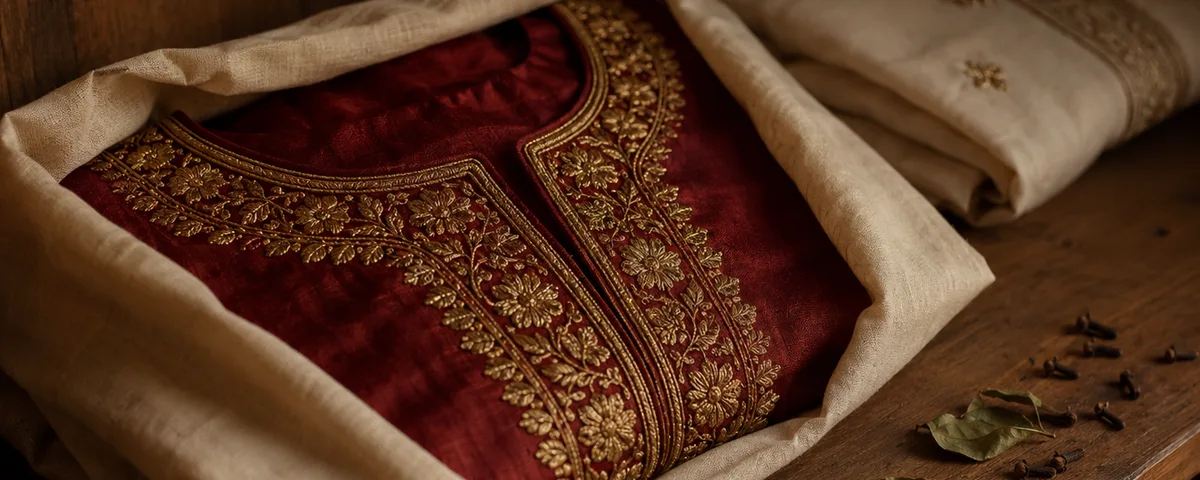
A bride from Indiranagar brought back her wedding blouse two years after we made it, hoping to wear it to her sister’s reception. She had done everything she thought was right — dry-cleaned it the week after the wedding, sealed it in the shop’s plastic cover, and put it at the back of a cupboard. The plastic had held Bangalore’s humidity against the fabric for two monsoons. The gold zardosi had gone dull grey along every fold line, and the silk underneath had faint brown spots. Nothing had been worn out. It had been stored wrong. Hand embroidery blouse care is almost entirely a storage problem, not a cleaning one, and the mistakes that cost people their best pieces are the ones that feel most responsible.
How Do You Care for a Hand Embroidery Blouse?
Keep it dry, keep it dark, keep it out of plastic, and keep the folds away from the worked areas. Those four rules cover most of what goes wrong. Everything below is detail on how to follow them.
- Store folded flat in unbleached cotton or muslin — never in a plastic or polythene cover
- Refold along different lines every 3 to 4 months so no crease sets permanently into the work
- Air the blouse for an hour in shade twice a year — never in direct sun, which fades silk and dulls metal
- Spray perfume and deodorant before you dress, never while wearing the blouse
- Repair a loose thread the week you notice it, not the week before the next function
The last one matters more than it sounds. Hand embroidery is a continuous structure — in zardosi and aari, one couching thread holds a long run of metal or a whole line of chain stitch. When a single stitch gives way, the run beside it starts to slacken every time the fabric moves. Caught early it is a few minutes of work. Left for a year, it is a re-embroidered panel.
How to Store a Hand Embroidery Blouse So the Work Does Not Flatten
Fold it flat, in cloth, with the embroidery facing inward and the fold lines running through plain fabric rather than across worked areas. Heavy pieces should never hang. A yoke carrying dense zardosi or maggam work is heavier than the silk holding it, and on a hanger that weight pulls at the shoulder seams for months until the neckline sits wider than it was cut.
- Lay the blouse flat and fold along the side seams first, so creases fall on plain fabric
- Place a strip of soft muslin between the folded layers wherever embroidery would otherwise press against embroidery
- Wrap the whole thing in unbleached cotton — bleached cloth and newspaper both transfer over time, and newsprint ink is the worse of the two
- Keep it in the middle of a shelf rather than the bottom, where cupboard damp settles
- Use dried neem leaves or cloves against insects, not naphthalene balls, which give off fumes that tarnish zari and kasab
On plastic specifically: the cover a dry cleaner returns your blouse in is for the journey home, not for storage. Sealed plastic traps moisture against the fabric, and in Bangalore that means eight months of humidity a year working on the metal in your embroidery. Take it off the day it comes back. The dimensional quality that makes heavy hand embroidery worth its price is the first thing lost to a flattened, tarnished store.
Can You Wash a Hand Embroidery Blouse, or Must It Be Dry-Cleaned?
Dry-clean only, for every technique with metal in it — zardosi, zari, kasab, and most maggam work. Water tarnishes metal wire and slackens the couching threads holding it down, which is why zardosi blouses in particular are unforgiving of a wash. Thread-only work such as resham aari on cotton can take a careful cold hand wash, but the safer default across all hand embroidery is dry cleaning, and less often than most people think.
Clean it because it is soiled, not on a schedule. Every dry-clean cycle puts solvent and press heat through the work, and a bridal blouse worn once and aired properly usually needs nothing at all. When you do send it, say out loud that it is hand embroidery and ask for two things: no direct press on the worked areas, and a hand finish rather than a machine press. A hot press flattens raised zardosi permanently — the coils crush and never lift again.
- Zardosi, zari and kasab — dry clean only, never water
- Maggam work with mirrors or beads — dry clean, and ask them to check settings before and after
- Resham thread work on cotton — cold hand wash is possible, no wringing, dry flat in shade
- Mirror work — never machine wash, which frays the settings and loosens mirrors, as our mirror work guide explains in more detail
What Actually Damages Hand Embroidery Blouses in Bangalore
Sweat and deodorant, in that order, ahead of anything to do with wear. The underarm is where blouses die. Aluminium salts in antiperspirant react with silk and with metal thread, and the damage is cumulative and invisible until the fabric thins and discolours. By then the blouse is not repairable in that area — it is a rebuild.
A customer in HSR Layout had a five-year-old aari blouse she had worn perhaps eight times. The embroidery was intact. The underarm silk had gone. We could not save that blouse, but the embroidery panel and the fit were both usable, which is often the outcome — updating an old blouse design starts from exactly this kind of salvage rather than from a blank piece of fabric.
- Let deodorant dry completely before dressing, and consider underarm shields for long functions
- Air the blouse for a few hours after wearing before it goes back into storage — putting a worn blouse straight into a cupboard sets sweat into the fibre
- Keep it away from direct sunlight, which fades silk dye faster than any number of wears
- Remove jewellery carefully — a zardosi neckline snags on a necklace clasp, and a pulled coil takes a karigar to fix
- Check the hooks and the back closure after each wear, since those pull hardest and give way first
How to Preserve a Bridal Blouse You Will Not Wear Again
If the blouse is going into storage as a keepsake rather than a wardrobe piece, treat it as an archive job and do it once, properly. Have it cleaned before it is stored, not after — sweat and food traces that are invisible now will oxidise into brown marks over five years. Then wrap and forget it, with one calendar reminder.
- Dry-clean it once, soon after the wedding, and remove the plastic the moment it comes home
- Wrap in acid-free tissue or washed unbleached muslin, with tissue padding inside the sleeves and bust so the shape holds
- Store flat in a cloth bag or a cardboard box, never a sealed plastic container
- Set a reminder to open, air and refold it once a year — this single habit prevents almost every permanent crease
- Keep it away from the outer wall of a cupboard, where condensation collects during the monsoon
One thing worth saying to brides planning a heavy piece: a blouse designed to be preserved and a blouse designed to be re-worn are not always the same garment. If you want to wear it again to a reception or a family wedding, tell us at the design stage and we will keep the embroidery placement and the fit adaptable. That conversation happens at the start of every hand embroidery blouse order we take in Bangalore, and it costs nothing to have.
Frequently Asked Questions
How should I store a hand embroidery blouse?
Folded flat in unbleached cotton or muslin, never in plastic, with the fold lines running through plain fabric rather than across the embroidery. Refold along different lines every 3 to 4 months, and never hang a heavy zardosi or maggam piece — the weight pulls the shoulder seams out of shape.
Can a hand embroidery blouse be washed at home?
Only resham thread work on cotton, in cold water with no wringing, dried flat in shade. Anything containing metal — zardosi, zari, kasab, most maggam work — is dry-clean only, because water tarnishes the wire and loosens the couching threads holding it in place.
Why has the gold zari on my blouse turned dull or black?
Almost always moisture, and usually from storage in a sealed plastic cover, which traps Bangalore humidity against the metal. Naphthalene balls do the same through their fumes. Light tarnish can sometimes be improved by a specialist, but prevention is the only reliable answer — cotton wrapping and no plastic.
How often should a hand embroidery blouse be dry-cleaned?
Only when it is genuinely soiled. Every cycle puts solvent and press heat through the work, and a bridal blouse worn once and aired properly often needs no cleaning at all. When you do send it, ask for a hand finish and no direct press on the worked areas.
Can a damaged hand embroidery blouse be repaired?
Loose couching threads, a pulled zardosi coil, or a lost mirror are all repairable, and quickly if caught early. Thinned or discoloured underarm fabric is not — at that point the embroidery panel and the fit can be reused for a rebuild, but the original blouse cannot be saved.