
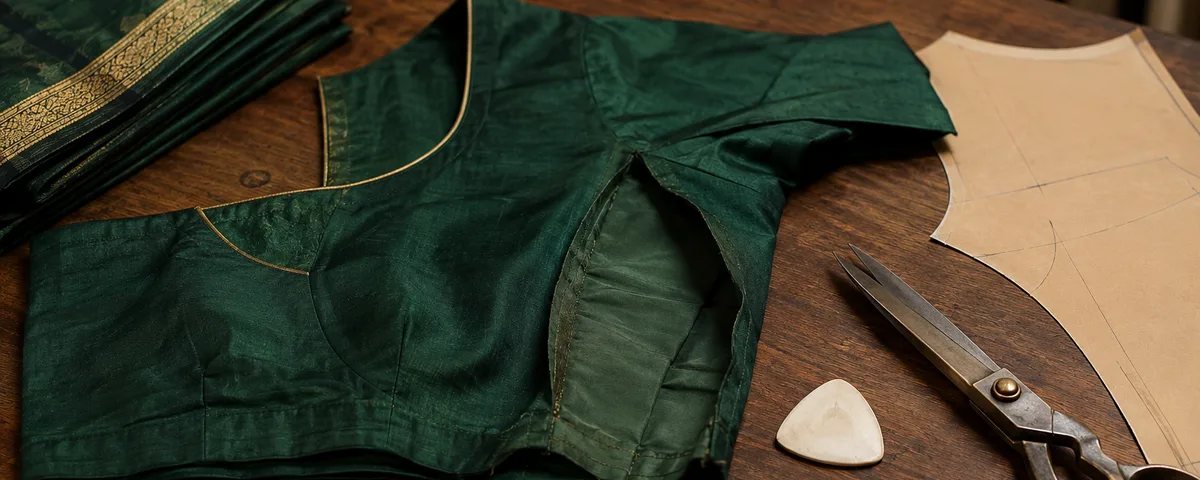
A customer from Malleswaram brought me a Kanjivaram her mother wore in 1994. The saree was in better condition than most sarees bought last year — but the blouse stitched for it had elbow-length puff sleeves, a high round neck, and shoulder padding. She had assumed the whole thing was finished and she would need to buy a new saree to get a look she would actually wear. She did not. We reshaped the neckline, removed the padding, and cut the sleeves to a straight three-quarter, and she wore it to a wedding three weeks later. Knowing how to update an old blouse design is mostly about knowing what the fabric will still allow you to do — and that is a narrower question than most people expect.
How to Update an Old Blouse Design Without Buying a New Saree
There are four routes, and they cost very different amounts. Which one applies depends on the condition of the fabric and how far the blouse is from what you want now.
- Restyle the existing blouse — reshape the neckline, change the sleeves, alter the fit. Cheapest, fastest, most limited.
- Rebuild using the old blouse as a pattern — we take the fit from it and cut fresh fabric. You keep the fit you know works.
- Add work over the existing blouse — embroidery, a border, or a contrast panel to bring a plain old blouse forward.
- Stitch a new blouse from the saree’s own fall or a matched fabric — when the original blouse is beyond altering.
Most people arrive assuming they need the fourth and leave with the first. The saree itself is almost never the problem. A silk saree that has been stored properly outlives three or four blouse fashions, which is exactly why this question comes up in Bangalore every festive season.
What Can and Cannot Be Changed on an Already-Stitched Blouse
Alterations are one-directional. Almost everything you can do to a finished blouse removes fabric, and fabric that has been cut away cannot be put back. This single rule explains every answer I give at the counter.
- Taking in — always possible. A blouse can be made smaller at the side seams, the darts, and the sleeve.
- Letting out — only as far as the original seam allowance goes. Most tailors leave half an inch to an inch per side seam, so you might gain 2 to 4 inches of total girth, and often less.
- Shortening sleeves — straightforward. Lengthening them needs matching fabric you probably do not have.
- Deepening or widening a neckline — straightforward. Raising or narrowing one needs an added yoke or panel, which reads as a repair unless designed deliberately.
- Opening up the back — a closed back can become a deeper back or a tie-back. The reverse needs new fabric.
- Adding embroidery — possible on almost any blouse. Removing embroidery leaves permanent needle holes in silk, which no press will close.
Why the seam allowance decides everything
Before I quote anything, I open a side seam and look at how much fabric the original tailor folded in. That hidden margin is the entire budget you have to work with, and it was set years ago by someone who was not thinking about you today. A generously cut blouse from a careful tailor might give you two sizes of room. A tightly cut one gives you none, and then the honest answer is that we are rebuilding, not altering.
This is also why I ask people to bring the blouse in rather than describe it on WhatsApp. The seam allowance is not visible from the outside, and neither is the condition of the fabric under the arms, which is where old blouses fail first.
What Does It Cost to Restyle an Old Blouse in Bangalore?
Restyling costs a fraction of a new blouse, which starts at ₹800 for standard stitching. As a rough guide, simple fit alterations run ₹300 to ₹600, a neckline or sleeve reshape ₹500 to ₹900, and a full restyle combining neckline, sleeves, and back ₹1,200 to ₹2,000. Adding hand embroidery to an existing blouse starts at ₹2,500, the same as it would on a new one, because the work is identical once the garment is on the frame.
Turnaround is 2 to 4 days for straightforward alterations and 7 to 10 days for a full restyle with a trial. If you are planning around a festival, our festive planning timeline for Navratri and Diwali applies to alterations too — the studio calendar fills the same way for a restyle as for a new order. For how these numbers sit against new stitching across every category, our transparent guide to blouse stitching prices in Bangalore has the full breakdown.
When Is It Better to Stitch a New Blouse Than Alter the Old One?
When the fabric has aged badly, when the gap between what you have and what you want is more than two changes, or when the original cut is wrong for you. I would rather tell someone this at the counter than take an alteration charge and hand back something that still does not sit right.
- Underarm fabric is thinned, discoloured, or perished — this is where sweat and deodorant do their damage, and it does not reverse
- The blouse is more than two sizes too small and the seam allowance is minimal
- You want a substantially different silhouette — a corset-style or princess-seam blouse cannot be produced from a simple darted one
- The original dart placement sits wrong on you, which no amount of side-seam work corrects
- The fabric has permanent fold lines from years on the same crease, which show badly under a camera flash
In those cases the old blouse still earns its keep as a pattern. We use it to take the fit you already know is comfortable, then cut fresh fabric — which is faster and more reliable than measuring from scratch, and it is why I ask you to bring an old well-fitting blouse to any custom stitching appointment.
How to Make a Dated Blouse Look Current Without Losing the Saree’s Character
Three things date a blouse more than anything else: the shoulder line, the sleeve shape, and the neckline height. Fix those and a fifteen-year-old blouse reads as contemporary without touching the saree it belongs to.
- Remove shoulder padding — this alone takes about a decade off a blouse and costs almost nothing
- Convert a puff or gathered sleeve to a straight elbow or three-quarter sleeve, which suits almost every saree
- Lower a high round neck to a shallow V or a wider boat neck; both use fabric you already have
- Replace a full back closure with a deeper back and a single hook or tie, which changes the whole silhouette
- Add a narrow zari or thread border at the neckline and sleeve edge to lift a plain blouse without weight
On necklines specifically, restyling is more constrained than starting fresh — you can go deeper and wider but never back — so decide with the saree draped on you rather than from a photograph. How to choose a blouse neckline for your body type and occasion walks through that decision, and the same logic applies here with one extra rule: choose the shape you will still like in five years, because you only get to cut once.
A restyle still goes through a trial fitting before final finishing, same as a new blouse. That matters more here, not less — we are working with fabric that has already been cut and has no margin for a second attempt. What actually happens at your trial covers what we check and why.
Frequently Asked Questions
Can an old blouse be made bigger?
Only as far as the original seam allowance allows, which is usually half an inch to an inch on each side seam and gives you 2 to 4 inches of total girth at most. If the blouse is more than two sizes too small, we rebuild using it as a fit pattern rather than altering it.
How much does it cost to restyle an old blouse in Bangalore?
Simple fit alterations run ₹300 to ₹600, a neckline or sleeve reshape ₹500 to ₹900, and a full restyle of neckline, sleeves, and back ₹1,200 to ₹2,000. A new blouse starts at ₹800, so a full restyle only makes sense when the fabric is worth keeping.
How long does a blouse alteration take?
Two to four days for straightforward fit alterations, and 7 to 10 days for a full restyle that includes a trial fitting. Adding hand embroidery extends this to 10 to 21 days depending on the coverage, because the work is the same as on a new blouse.
Can embroidery be removed from an old blouse?
Not cleanly. Taking out aari, zardosi, or maggam work leaves permanent needle holes in silk that no press or steam will close. It is almost always better to work with the existing embroidery — or add to it — than to try to strip it back.
Can a high-neck blouse be converted to a deep neck?
Yes, and it is one of the most common restyles we do. Lowering or widening a neckline only removes fabric, so it needs no new material. Going the other way — raising a neckline — requires an added yoke, which usually reads as a repair unless it is designed as a feature.