
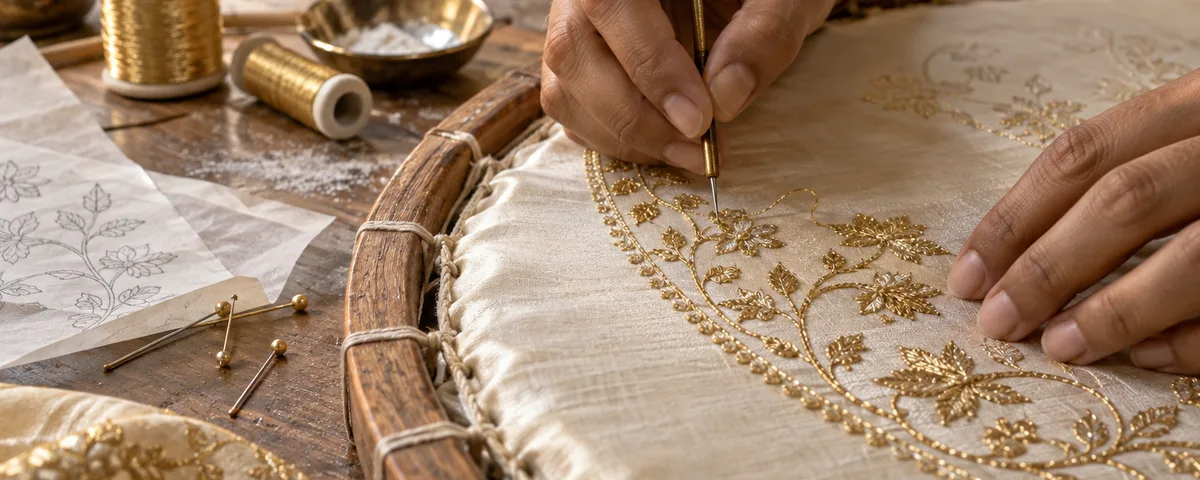
A customer from Indiranagar sat at the studio for nearly twenty minutes last month, watching an embroiderer work a gold thread border stitch by stitch, and said what I hear often: "I did not realise this was still done by hand." Most customers only see the finished blouse — never the fabric before a single stitch, the frame it was stretched on, or the hands that worked it. This is the hand embroidery blouse making process at Akira, from the first pencil mark on fabric to the finished piece that leaves our studio in Bangalore ready for an event.
The Hand Embroidery Blouse Making Process at Akira, Start to Finish
A hand embroidered blouse moves through six stages before it is ready to wear: design and fabric selection, transferring the design onto the fabric, stretching the fabric on a frame, the embroidery itself, a quality check before cutting, and finally assembling and stitching the finished blouse. Each stage exists to protect the one after it — a design transferred badly cannot be corrected once embroidery begins, and embroidery with uneven tension cannot be fixed once the fabric is cut.
- Design and fabric selection — the motif, placement, and thread colours are settled, and the base fabric is chosen to suit the technique
- Design transfer — the confirmed design is traced onto the fabric itself, not worked freehand
- Framing — the fabric is stretched taut on a wooden frame so the embroiderer's tension stays even across the whole piece
- Embroidery — the longest stage, worked stitch by stitch by hand
- Quality check — the finished embroidery is inspected on both sides before a single cut is made into the fabric
- Assembly and finishing — the embroidered panel is cut, lined, and stitched into the blouse body
How the Design Is Transferred Onto the Fabric Before Any Stitch Is Made
The design is traced onto the fabric using a perforated paper pattern, not drawn freehand. We prick the confirmed design into a sheet of tracing paper along every outline, pin the sheet onto the fabric, and dust it with a fine chalk or ink powder that passes through the pinholes and leaves a dotted outline on the cloth beneath. The embroiderer then joins those dots into a continuous line.
Why freehand tracing is a risk on bridal work
Freehand marking is faster, and some smaller setups do it, but the design then exists only in one person's hand that day. A perforated pattern can be reused if a second piece is needed, or pulled out again for a correction — which matters on a bridal order where the blouse and dupatta border are meant to echo the same motif.
Why the Fabric Is Stretched on a Frame Before Embroidery Begins
At our studio in Bangalore, the fabric is stretched taut on a wooden frame so tension stays even from the first stitch to the last — hand-held fabric shifts slightly as you work, and that small drift is what makes embroidery on a large yoke look uneven at the edges. This stretched-frame method is exactly what maggam work is named for — maggam is the Telugu word for frame — and the difference between aari, maggam and zardosi work goes into how the frame changes what a technique can achieve, beyond just keeping the fabric still.
Not every fabric tolerates frame tension equally well. A firm silk holds its shape under the pins; a loosely woven fabric can pucker or stretch out of shape once it is released from the frame. Which fabrics carry heavy hand embroidery well is a decision we make before the design consultation ends, not something adjusted once cutting has started.
How Many People Actually Work on One Embroidered Blouse
A single neckline border is usually one embroiderer's work from start to finish. A heavily worked bridal yoke is different — it can have two or three embroiderers working from opposite ends of the same frame toward the centre, so the coverage meets a wedding date without one person rushing the stitch quality. Each embroiderer specialises in the technique they are fastest and most precise at, so a piece combining zardosi and aari work is often worked by two different people rather than one doing both.
This division of labour is also why a boutique in Bangalore that can tell you exactly which artisan works on your technique, rather than a vague "our team", is worth trusting with hand embroidery blouse work. The full range of our hand embroidery blouse work is organised by technique for exactly this reason.
What Happens After the Embroidery Is Finished: Quality Checks Before Cutting
The embroidered panel is checked from the front and the back before a single cut is made into the fabric. On the front, we look for even stitch density, symmetry between the two sides of a yoke, and any loose thread ends. On the back, we check that the tension is consistent — a piece with uneven tension on the reverse will pucker on the front once the blouse is stitched and worn, even if it looks fine lying flat on the frame.
This is also the stage where a flaw, if there is one, is cheapest to fix — a section can be picked out and reworked while the fabric is still uncut and on the frame. Once the panel is cut to the blouse pattern, correcting a mistake means reworking that section on a smaller, harder piece of fabric.
How the Embroidered Panel Becomes a Finished Blouse
Only after the embroidery passes inspection is the panel cut to the blouse pattern and handed to the tailor for assembly — lining is added where the fabric needs support, the panel is joined to the rest of the blouse body, and the neckline, sleeves, and back are stitched to the measurements taken at the consultation. What happens at every stage of custom blouse stitching in Bangalore covers this assembly and fitting side of the process in full; the embroidery stage above is what happens before the tailor's part even begins.
The finished blouse then goes through a trial fitting, a final press, and a last check for stray threads or loose beads before it is ready to leave the studio in Bangalore. From the first pencil mark on fabric to a blouse ready for an event is usually 10 to 25 days, depending on how much of the surface is embroidered — and once it has done its job at the event, how to store and care for a hand embroidery blouse is worth reading, because handwork that took weeks to create needs a little care to last for years. The full sequence, from consultation to delivery, is also set out on our studio process page.
Frequently Asked Questions
How long does it take to make a hand embroidery blouse from start to finish?
From the first design transfer to a finished blouse ready to wear, plan 10 to 25 days depending on coverage. A neckline border can be embroidered and assembled in about 10 days. Full bridal coverage with zardosi or heavy maggam work, plus assembly and a trial fitting, takes closer to 25 to 30 days.
Is the embroidery done before or after the blouse is stitched?
Before. The embroidery is worked on a flat, framed piece of fabric first, checked for quality, and only then cut to the blouse pattern and handed to the tailor for assembly. Embroidering after the blouse is fully stitched is far harder to do evenly and is not how bridal hand work is made at our studio.
How many artisans work on one hand embroidery blouse?
A simple neckline border is usually one embroiderer's work from start to finish. A heavy bridal yoke can involve two or three embroiderers working the same frame from opposite ends, plus a separate tailor for assembly, so a single bridal blouse can pass through four or five pairs of hands before it is finished.
How is the embroidery design transferred onto the fabric?
Through a perforated paper pattern, not freehand drawing. The confirmed design is pricked into tracing paper, pinned onto the fabric, and dusted with chalk powder that passes through the pinholes to leave a dotted outline, which the embroiderer then joins into a continuous line.
What happens if a flaw is found in the embroidery?
If it is found before the fabric is cut, the flawed section is picked out and reworked while the piece is still on the frame — the cheapest and safest point to fix it. A flaw found after cutting is far harder to correct, which is why the quality check happens before, not after, cutting into the panel.