
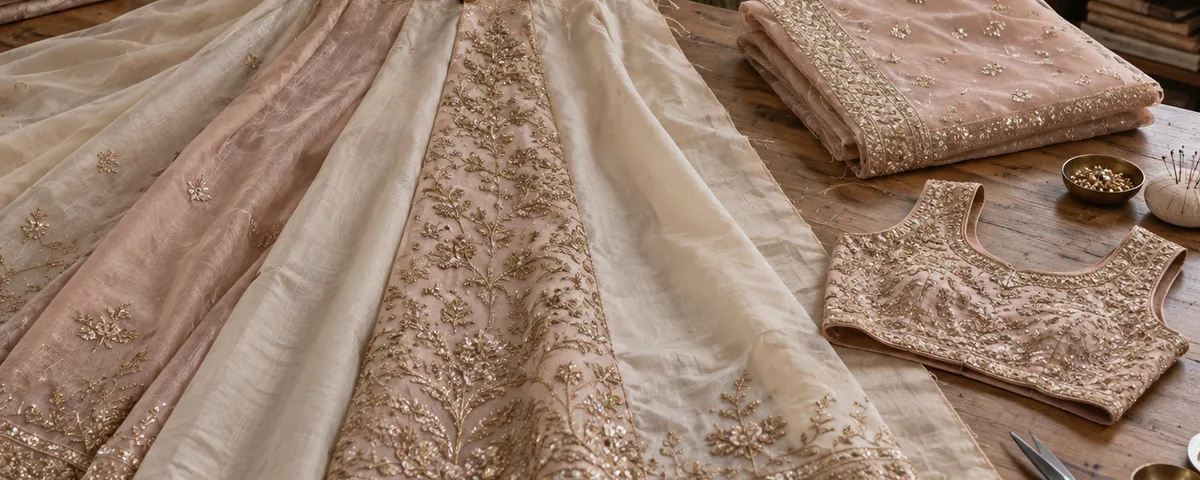
A bride from Whitefield called four days after her first lehenga consultation, unsure why she had not heard from us. She had stitched a bridal blouse before — one round of measurements, one trial, ready in ten days — and expected a lehenga to move at the same pace. It does not, and nobody had told her that going in. This is what the custom lehenga stitching experience actually looks like at our studio in Bangalore, appointment by appointment, from the first conversation to the day you collect three pieces built to agree with each other.
What the Custom Lehenga Stitching Experience Looks Like, Step by Step
A custom lehenga moves through five stages — consultation, measurement and cutting, a first trial on the skirt alone, embroidery, and a second trial where the full set comes together with the blouse and dupatta. Each stage answers a different question, and skipping ahead is where lehengas go wrong. For the pricing and timeline behind each stage, our full guide to lehenga stitching in Bangalore sets out the numbers — this article is about what actually happens at each appointment.
- Consultation — silhouette, fabric, embroidery direction, and how the blouse and dupatta will relate to the skirt
- Measurement and cutting — the skirt, choli, and dupatta cut from the same fabric lot so colour and finish stay consistent
- First trial — the skirt alone, checked for waist, length, and flare before any embroidery begins
- Embroidery — the longest single stretch, worked separately on the skirt and blouse panels
- Second trial — the full set assembled together: skirt, embroidered blouse, and dupatta, tried on as one outfit
What Happens at the First Lehenga Consultation
The first meeting decides how the three pieces will relate to each other, before a single cut is made. At our Bangalore studio, we ask what function the lehenga is for, how long you will be on your feet in it, and whether the dupatta will be pinned or carried loose — that last answer changes where the embroidery budget should go. This is also where we settle the outline, not the fine detail; the colour and embroidery-balance decisions between blouse and skirt come slightly later.
What to bring to the consultation
Bring the actual fabric if you already have it, or come with a clear budget if you want us to source it — a photo on your phone cannot show how a georgette will fall compared to a raw silk. If you already own the blouse or dupatta piece from elsewhere, bring those too, because matching a new skirt to an existing piece is a different job from starting all three from scratch.
Why a Lehenga Needs Two Trial Fittings, Not One
A lehenga needs two trials because the skirt and the assembled set cannot be judged at the same time. A blouse gets one trial because it is a single piece of fitted fabric — the pattern predicts fairly reliably how it will sit. A lehenga skirt cannot be judged the same way: the flare only tells the truth once it is stitched, lined, and stood in. That is why the first trial happens on the skirt alone, days before embroidery starts, and the second trial happens only once the embroidered blouse and finished dupatta are ready to be tried together. What a blouse trial fitting actually checks is a useful comparison — a lehenga skirt trial checks similar things, fit and movement, but on a garment whose fall cannot be predicted until it exists.
What we check at the first trial
At the first trial we check the waist, the hip sit, the length against your footwear, and how the flare moves when you walk and sit — a flare that looks right standing still can pull wrong once you sit down for a ceremony. Any structural correction at this stage, taking in the waist or adjusting panels for flare, is still simple. Raising the same concern only at the second trial means undoing embroidery to fix it.
What we check at the second trial
The second trial is about the set, not the skirt alone: whether the blouse colour and embroidery agree with the skirt in daylight, whether the dupatta drape sits the way you planned, and whether the whole outfit moves and photographs as one. By this point the skirt's own fit should already be settled — the second trial is for catching set-level issues, not skirt-level ones.
How the Blouse, Skirt and Dupatta Are Sequenced to Match
The skirt is cut first, the blouse fabric next, and the dupatta last — all three cut from the same fabric lot at the same time, even though they are stitched and embroidered on different timelines. Cutting together is what keeps the colour consistent: fabric dyed in different lots, even under the same shade name, rarely matches once you compare the pieces in daylight. What matching a bridal blouse to a lehenga actually involves covers the colour and embroidery-balance decisions in depth; the point here is sequencing, not matching — deciding early which piece is cut first so nothing is left guessing later.
- Skirt fabric cut first, since it carries the most fabric and sets the working colour reference for the other two pieces
- Blouse (choli) fabric cut from the same lot immediately after, even though it is not stitched until closer to the embroidery stage
- Dupatta cut and its border decided last, once the drape style agreed at the consultation is confirmed
What Happens During the Lehenga Embroidery Stage
Embroidery is the longest stretch of the whole experience, and it happens on the skirt and blouse separately before they are ever tried on together. A heavily worked lehenga skirt can occupy an embroiderer for several weeks on its own, because the surface is many times larger than a blouse. We place hand embroidery on the visible yoke, hem, and blouse front, and reserve machine work for less-scrutinised areas when a bride wants heavy coverage within a set budget — hand embroidery versus machine embroidery for blouses covers that trade-off in detail, and the same logic scales up across a lehenga's larger surface.
You will not hear from us daily during this stage, and that is normal — embroidery does not produce a visible update every few days. What you should expect is one check-in partway through, mainly to confirm the embroidery density is landing the way you pictured it, while it is still early enough to adjust.
What Happens If Something Needs Correcting Close to Your Wedding Date
Tell us the specific problem, not just that something feels off, and we will tell you honestly whether it can be fixed in the time left. A flare that sits slightly wide can usually be taken in within a day. A colour that reads differently under function lighting than it did at the consultation is harder to correct once the embroidery is already in place, and sometimes it cannot be corrected at all. A bride from Koramangala came to her second trial two weeks before her wedding feeling the dupatta border was heavier than she remembered agreeing to; because she raised it as a specific concern with two weeks still on the clock, we thinned the border rather than remaking it, and it was ready four days later.
The honest limit is time, not effort. A correction raised at the second trial with three to four weeks to spare has real options. The same request made ten days before the wedding narrows to what can be adjusted without unpicking embroidery. I would rather hear about a concern at the first trial, even a small one, than have you leave the second trial still unsure. Lehengas are scheduled and quoted through our bridal and occasion wear service in Bangalore, and the full sequence from consultation to delivery is also set out on our studio process page.
Frequently Asked Questions
How many trial fittings does a custom lehenga need?
Two. The first trial fits the skirt alone — checking waist, length, and flare — usually 10 to 14 days after measurements, before embroidery begins. The second trial happens once the embroidered blouse and dupatta are ready, so the full set can be tried together, typically 4 to 5 days before delivery.
How long does the full custom lehenga stitching experience take from consultation to delivery?
Plan for 4 to 8 weeks for a lehenga with moderate work, and 10 to 12 weeks if it carries heavy hand embroidery. This article covers what happens inside that window; pricing and timelines by design type are broken down separately in our lehenga stitching guide.
Why does the flare of a lehenga skirt only show up at the first trial?
Flare depends on how the fabric falls once the seams, lining, and any cancan underneath are all in place — a pattern on paper cannot predict it accurately. This is why the first trial happens on the skirt alone: correcting flare at that stage takes about a day, far less than unpicking finished embroidery would.
Can I request changes at the second trial if my wedding is close?
Yes, if the request is specific and there is still time. A flare or fit adjustment usually takes a day or two. A colour or embroidery-density concern raised with two to three weeks left still has real options, like thinning or reworking a section; the same concern raised ten days out is limited to what does not require unpicking embroidery.
Do the blouse, skirt and dupatta have to be stitched together, or can I bring an existing piece?
Stitching all three together, cut from the same fabric lot, gives the most reliable colour and finish match. You can bring an existing blouse or dupatta piece instead, but flag it at the first consultation — matching a new skirt to it after cutting has already happened can add a week or more to the timeline.