
A customer from Koramangala once skipped her trial fitting to save a trip across Bangalore, collected the blouse unchecked, and discovered at the function that the armhole bit into her the moment she raised her arms for photographs. A two-minute correction at the trial became a blouse she was uncomfortable in all evening. The blouse fitting process exists precisely to catch what a tape measure cannot — how a neckline sits when you stand, whether a sleeve fights your bangles, whether a deep back gapes when you move. This guide walks through what actually happens at a blouse trial fitting, what to bring, what to check, and why it is the one step worth protecting even when your schedule is tight.
What Happens During a Blouse Fitting?
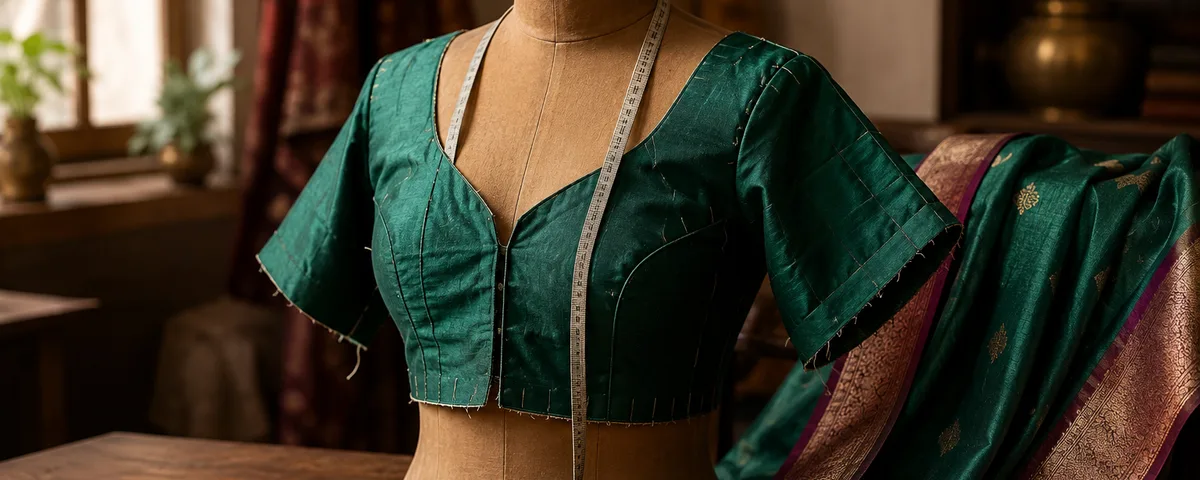
At the trial fitting, you try on the partly finished blouse over the actual saree it is meant for, and we check the fit at every point that measurements alone cannot predict — the neckline, the armhole, the back closure, the sleeve, and the length. The blouse comes to the trial stitched but deliberately unfinished: hooks not yet fixed, hems still open, seams reachable, so anything can be let out, taken in, or reshaped. A standard trial takes about 15 to 20 minutes, and it is scheduled 2 to 3 days before your collection date so there is time to make the corrections without a rush.
This is stage four of five in how a custom blouse is made — after the consultation, the measurements, and the stitching, and before final delivery. What to expect at every step of custom blouse stitching sets out the whole sequence; the fitting is where all of it is tested on your body rather than on a pattern.
Why the Trial Fitting Is Not a Formality
The fitting catches problems no measurement can predict, because a body moves and a mannequin does not. A neckline that measures correctly can still stand away from the chest when you sit. A sleeve that fits at rest can pinch when you lift your arm. A back that closes flat can gape the moment you reach forward. None of these are stitching errors — they are the difference between how fabric behaves on a still measurement and on a moving person, and the trial is the only place to catch them before the event rather than during it.
A bride from Whitefield came for her trial in a rush and wanted to approve the blouse over her kurti to save time. I asked her to change into the actual Kanjivaram first. Over the real saree, the neckline that had looked fine sat a full centimetre higher because of the saree pleats at the waist, and the back hook landed exactly where her petticoat knot sat. Both were five-minute fixes at the trial. Neither would have been fixable on the morning of the wedding. This is the entire reason we insist the fitting is done over the real outfit, at our Bangalore studio, and not squeezed into a phone photo of the blouse on a hanger.
What to Bring to Your Blouse Trial Fitting
Bring the same outfit you will actually wear, not a stand-in. The trial is only honest if the blouse is judged against the real saree, the real petticoat, and the real inner-wear — the same principle that makes the consultation productive when you come prepared. Carry these to the fitting.
- The actual saree or lehenga the blouse is for, so the drape, the neckline depth, and the length are judged against the outfit and not guessed.
- The petticoat or fall and the correct inner-wear you will wear on the day — these change the fit more than most people expect, especially on a fitted or deep-back blouse.
- The jewellery you plan to wear, particularly a heavy necklace or an armlet, so the neckline and sleeve can be seen sitting around it.
- The heels or footwear of the height you will wear, if the length matters for a gown or a floor-length outfit.
What to Check and What to Say at the Fitting
Check five things, and move in the blouse while you do — sit down, raise your arms, reach forward. A blouse that only fits standing still is not fitted for a wedding you will move through for hours. When something is wrong, say exactly what and where, because specific feedback is what we can act on. "The neckline gapes when I sit" is fixable in a way that "something feels off" is not.
- Neckline — does it sit flat against you when you stand and when you sit, or does it gape or dig in? Check the depth against your jewellery. This is the check that a good neckline choice sets you up for but only the fitting confirms.
- Armhole and sleeve — lift your arms the way you will for photographs and the jaimala. The armhole should not cut in, and the sleeve should not ride up over your bangles or restrict the lift.
- Back and closure — reach forward and twist. A back with hooks or a concealed zip should stay closed without pulling, and a deep back should not gape when you move.
- Bust and body — the blouse should be snug without straining at the seams. Say if it pulls anywhere or if there is loose fabric that should be taken in.
- Length — check it ends where you tie your saree, against the real petticoat, not higher or lower than your usual drape.
The neckline and the back are the two places most brides discover a gap between the design they chose and how it sits in real life. If either needs rethinking, how to choose a blouse neckline for your body type explains what can be adjusted at this stage and what cannot — a neckline can be raised or a back eased, but a shape change usually means re-cutting.
How Many Fittings Do You Need, and What Do Alterations Cost?
A standard blouse needs one trial fitting; a structured or heavily worked garment often needs two. A boned bodice, a gown, or a deep-back bridal blouse cannot be judged in a single sitting, because the structure has to be corrected before the finishing goes on. At our Bangalore studio, one trial fitting and one round of post-fitting adjustments are included in the stitching price — you do not pay extra to have the neckline raised half an inch or the armhole eased.
What is charged separately is a design change, not a fit correction. Asking for a different neckline shape, added embroidery, or a deeper back after cutting is a new decision with a new cost, which is exactly why the design is locked at the consultation and only the fit is settled at the trial. The fitting also shapes your calendar: it sits 2 to 3 days before collection, so an order booked too late to leave room for it is a blouse delivered unchecked. How long blouse stitching takes by design type builds that fitting window into every timeline, which is why booking early protects the fit as much as the embroidery. The trial is a fixed stage in our custom stitching process, not an optional extra.
Frequently Asked Questions
What happens during a blouse trial fitting?
You try on the partly finished blouse over the actual saree it is for, and the fit is checked at the neckline, armhole, back closure, sleeve, and length — the points a tape measure cannot predict. The blouse is stitched but not yet hemmed or hooked, so it can still be adjusted. A standard trial takes 15 to 20 minutes and is scheduled 2 to 3 days before your collection date.
Do I really need a trial fitting for a simple blouse?
Yes, even a plain blouse benefits from one trial fitting, because how a neckline and armhole sit on a moving body cannot be judged from measurements alone. One fitting is standard for a regular blouse and it is included in the stitching price. Skipping it to save a trip is the most common reason a blouse turns out uncomfortable at the event, when it is too late to fix.
How many trial fittings does a blouse need?
One trial fitting is enough for a standard blouse. A structured or heavily worked garment — a gown, a boned bodice, or a deep-back bridal blouse — usually needs two, because the structure has to be corrected before the finishing is added. This is also why a gown or lehenga takes more calendar time than a plain blouse.
Are blouse alterations after the fitting charged extra?
At Akira Fashion Studio, one trial fitting and one round of post-fitting adjustments are included in the stitching price, so fit corrections such as raising the neckline or easing the armhole cost nothing extra. A design change requested after cutting — a different neckline shape, added embroidery, a deeper back — is a new decision and is charged separately, which is why the design is locked at the consultation.
What should I wear and bring to a blouse fitting?
Bring and wear the actual saree or lehenga the blouse is for, the petticoat or fall, the correct inner-wear, and the jewellery you plan to wear on the day. Trying the blouse over the real outfit rather than over street clothes is the only way to judge the neckline depth, the back closure, and the length accurately. For a gown, also bring the heels you will wear so the length is set correctly.