
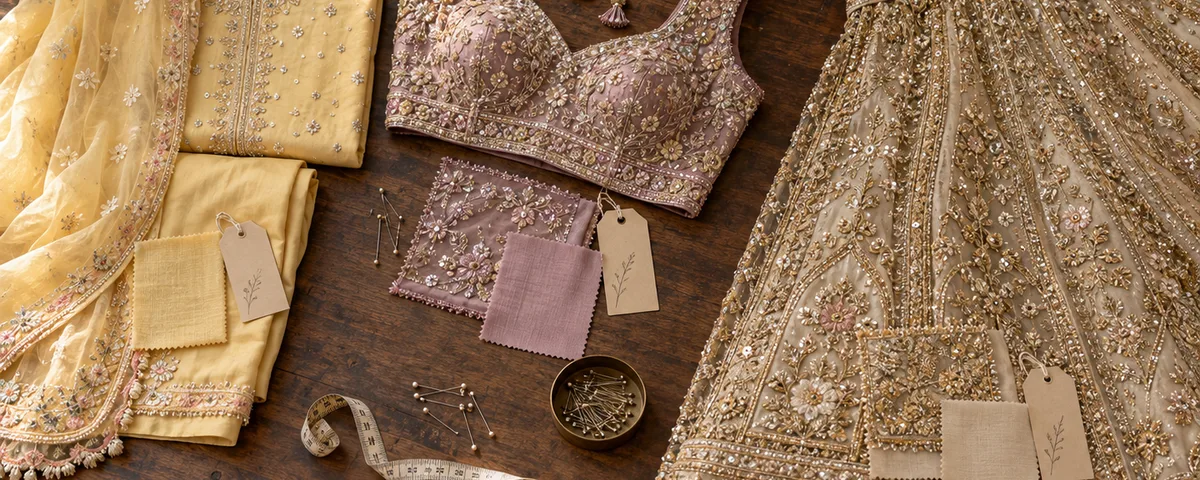
A bride from JP Nagar came to us in June with five functions across nine days in December — a haldi, a sangeet, the wedding ceremony, a reception, and a family function at her in-laws' the day after — and five outfits that all had to be finished, fitted, and delivered on five different dates before she left Bangalore for the wedding. A single bridal blouse is one project. An order like hers is five, running in parallel, each with its own deadline inside one wedding season. This is the Akira Fashion Studio bridal process — how we plan, sequence, and deliver a full bridal order rather than one outfit at a time.
The Akira Fashion Studio Bridal Process Starts With the Whole Wedding Calendar
The first conversation covers the whole wedding calendar, not the first outfit. We ask for every function date, not just the wedding day, because a haldi three weeks before the reception changes how we sequence the work — the lighter, less time-consuming outfits go first, and the heaviest hand embroidery piece gets the most calendar room. For the bride from JP Nagar, that meant her haldi outfit, a simple cotton set, was finished within two weeks, while her reception lehenga with full zardosi coverage got the remaining ten weeks.
What we ask for at the intake call
Every function date, which outfit is for which function, and which one matters most if something has to give. Brides rarely think of it as prioritising, but every multi-outfit order eventually needs one — a fabric delay or an embroidery correction on one piece should never be allowed to threaten a different, more time-critical piece.
How We Sequence Multiple Outfits Across One Wedding
We work backward from the earliest function date, not forward from today. The haldi or engagement outfit, usually the least embroidery-heavy, gets made and delivered first, which also gives us an early, low-stakes trial fitting to confirm sizing before the bigger pieces are cut. The wedding day blouse and the reception lehenga, almost always the most heavily embroidered pieces, get scheduled with the longest lead time and the most room for a second correction round.
- Haldi or engagement outfit — usually light work, finished first, and used as an early fit check
- Sangeet outfit — moderate embroidery, scheduled mid-order
- Wedding ceremony blouse — heavy hand embroidery, given the longest lead time
- Reception lehenga or gown — heaviest single piece, scheduled to finish last but fitted with the most buffer for corrections
This is different from stitching each outfit as a separate order that happens to arrive around the same time. What actually happens across the two trial fittings a custom lehenga needs describes one piece of this in detail; in a multi-outfit bridal order, we run that same discipline in parallel across four or five garments at once, sharing the same embroidery queue and the same trial-fitting calendar. The same lead-time discipline behind planning a single bridal blouse scales up directly, multiplied across every additional outfit in the order.
How Embroidery Gets Shared Across Multiple Garments in One Order
The embroiderers working on your wedding blouse are often the same artisans working on your reception lehenga, so the order is scheduled as one shared workload, not five separate queues. How a hand embroidery blouse is actually made covers what one garment's embroidery stage involves; across a full bridal order, that stage is staggered so the heaviest piece gets priority access to the studio's most experienced embroiderers while lighter pieces move through in parallel.
This is also where wedding season matters most. In October through February, when most Bangalore weddings happen, the embroidery queue across every boutique in the city gets longer, and a five-outfit order needs more lead time than the same order placed in April. We tell every bridal customer this honestly at the intake call, because it changes the calendar math.
Who Is Your Point of Contact for a Multi-Outfit Bridal Order?
One person, from the first call to the final delivery, not a different coordinator for each outfit. For an order with five garments moving through cutting, embroidery, and fitting on different schedules, a single point of contact is the difference between you tracking five separate conversations and having one person who knows exactly where every piece stands. At our Bangalore studio, that person is usually the same designer who ran your first consultation.
What Happens in the Final Weeks Before the Wedding
Trial fittings get scheduled in the order the functions happen, not in the order the outfits were finished, so you are never trying on your reception lehenga a week before you need your haldi outfit. What a trial fitting actually checks applies to each individual piece; across a multi-outfit order, we sequence those checks against the function calendar rather than the production calendar, so nothing arrives out of order.
If something needs correcting close to a function date, we tell you plainly what can be fixed in the time left and what cannot — the same honesty that applies to a single blouse order. The bride from JP Nagar needed her sangeet blouse's sleeve taken in four days before the function; because it was raised early and was a specific, small fix, it was ready the next day. A full bridal order is planned and delivered through our bridal and occasion wear service, coordinated as one calendar rather than five separate bookings, and the individual stages behind each piece are also set out on our studio process page.
Frequently Asked Questions
How does Akira manage a bridal order with multiple outfits for different functions?
We plan the whole wedding calendar at the first call, not one outfit at a time, and sequence the work backward from the earliest function date. Lighter outfits like a haldi set are finished first, often within 2 weeks; the most heavily embroidered pieces, usually the wedding blouse and reception lehenga, get the longest lead time and one dedicated point of contact through the whole order.
How far in advance should I book a multi-outfit bridal order in Bangalore?
Plan for 8 to 12 weeks for a full order of 4 to 5 outfits with a mix of light and heavy embroidery, and closer to 12 to 14 weeks if most pieces carry heavy hand embroidery. In wedding season, October through February, the embroidery queue across Bangalore is longer, so earlier booking matters more.
Do all my outfits get the same designer or different people for each piece?
The same designer manages your order from the first consultation to the final delivery across all 4 to 5 garments, even though different embroiderers and tailors work on individual pieces. One point of contact means you are tracking one conversation about five outfits, not five separate ones.
What happens if one outfit in my order needs more time than the others?
We flag it as early as possible and adjust the sequence, not the honesty of the timeline. A correction or delay on one piece, such as heavier embroidery adding 3 to 4 extra days, is managed against the function calendar so it does not put a more time-critical outfit at risk.
Can I add an outfit to my bridal order after it has started?
Yes, if there is at least 2 to 3 weeks of calendar room left for the embroidery and fitting it needs. We would rather tell you honestly whether a late addition fits the remaining timeline than accept it and rush the work — the same standard that applies to any single bridal blouse booked close to a wedding date.