
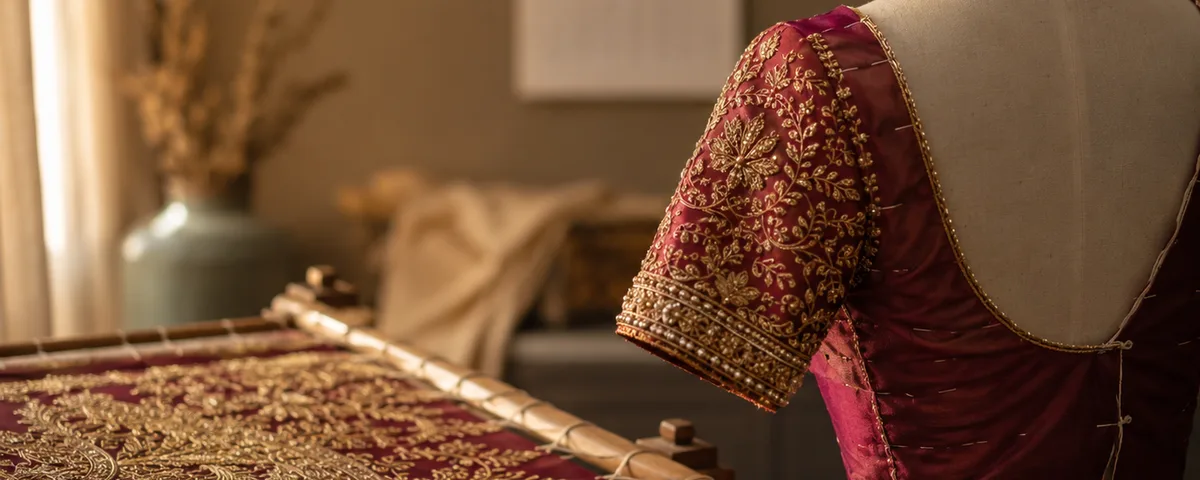
A bride from Jayanagar called us on a Tuesday in November asking for a fully embroidered bridal blouse for a wedding nineteen days later. The embroidery and stitching together needed about nine working days, so on paper it fit. We still said no. November is peak muhurtham season in Bangalore, and our karigars already had four bridal orders booked into that exact fortnight. That gap is what most brides miss when they ask how early to order a bridal blouse in Bangalore — the honest answer has less to do with how long the work takes and more to do with how many other brides need the same two weeks.
How Early Should You Order a Bridal Blouse in Bangalore?
Order 10 to 12 weeks before your function for heavy hand embroidery, 6 to 8 weeks for light or moderate embroidery, and 3 to 4 weeks for a plain bridal blouse with no surface work. Between October and February, add another 2 to 3 weeks to each of those. These are booking deadlines, not production times — the date you need to have walked in and left an advance, not the date a karigar picks up the needle.
- Heavy hand embroidery, full yoke or full-body work: book 10 to 12 weeks ahead
- Light to moderate embroidery, neckline and sleeve borders: book 6 to 8 weeks ahead
- Plain bridal blouse with no surface work: book 3 to 4 weeks ahead
- A blouse and a lehenga in the same order: book 12 to 14 weeks ahead
- Any of the above falling between October and February: add 2 to 3 weeks
That is the booking side. For the production side — how many days each stage genuinely takes once the work has started — our breakdown of how long blouse stitching takes in Bangalore covers it by design type. This article is the other half of the question: when you have to be standing in the studio for those timelines to still be available to you.
The Reverse Calendar: Counting Back From Your Wedding Date
To find your own deadline, start at your function date and subtract backwards, one stage at a time. Every bridal blouse moves through the same six stages, and each has a floor below which quality starts to suffer. Subtract them in this order:
- Delivery buffer — 4 to 5 days before the function, so you are not collecting a blouse the night before
- Final finishing after the trial — 3 to 4 days for corrections, hooks, lining, and press
- Trial fitting — held 7 to 10 days before delivery, and it has to suit your calendar as well as ours
- Stitching and assembly — 5 to 7 days once the embroidered panels come back
- Embroidery execution — 10 to 21 days depending on density; a full aari yoke alone runs about 14 days
- Consultation, design lock, and fabric sourcing — 5 to 7 days before any needle moves
A worked example for a heavy embroidery blouse
Take a muhurtham on 15 December. Subtract 5 days of delivery buffer and you are at 10 December. Subtract 4 days of finishing: 6 December. Put the trial fitting 10 days before that: 26 November. Subtract 7 days of stitching: 19 November. Subtract 18 days of embroidery: 1 November. Subtract a week for consultation, design approval, and fabric: 25 October. That is the booking deadline — roughly 11 weeks out, and it assumes nothing goes wrong and no festival week interrupts the karigars.
Notice what that calendar does not contain: a second round of design changes, a re-do if the embroidery reads heavier against your saree than expected, or a week when you are travelling. A bride who books on the deadline gets the blouse. A bride who books three weeks earlier gets the blouse and the room to change her mind. Planning bridal blouse stitching without last-minute stress is mostly about buying yourself that margin.
Why Bridal Blouse Deadlines Move Earlier During Bangalore’s Wedding Season
Between October and February the deadline is set by studio capacity, not by stitching speed. Bangalore weddings cluster around a small number of auspicious muhurtham dates, so twenty brides are not spread evenly across five months — they need delivery inside the same handful of weeks. Hand embroidery is the bottleneck, because a karigar works one bridal piece at a time and the work cannot be split across people the way machine work can.
This is the part that surprises people. A bride from Whitefield came to us in September with a straightforward design — a zardosi neckline and sleeve border, about 12 days of embroidery — for a January wedding. On paper she was four months early. In practice she was taking one of the last January slots we had, because the fortnight either side of her date was already committed.
- October to February — peak season. Add 2 to 3 weeks to every deadline above.
- March to May — moderate. Ugadi and Tamil New Year create short, sharp spikes.
- June to September — quietest. Standard deadlines apply and rush work is genuinely possible.
Embroidery density is the single biggest lever you control on your own deadline, so it is worth deciding early rather than at the second consultation. What is actually worth the price in heavy hand embroidery bridal blouses goes through where dense work earns its cost and where it does not.
Do You Need a Separate Deadline for Each Wedding Function?
Your deadline is set by the earliest function, not the main one. A bride with a mehendi on 10 December and a muhurtham on 15 December has a 10 December deadline for the whole order, because every blouse in it passes through the same karigars and the same trial slot. Ordering all of them in one consultation is faster than staggering them, and it keeps the palette and finishing consistent across the events.
- Order every function’s blouse in one consultation, then count backwards from the earliest date
- Put the heaviest embroidery on the function you will be photographed at most — usually the muhurtham or the reception
- Keep mehendi and haldi blouses lighter; they take less time and free the calendar for the main piece
- Book one trial slot where you try on all the blouses together, so fit corrections happen once rather than three times
We plan multi-function orders this way as standard, and you can see how the consultation, trial, and delivery stages fit together on our bridal and occasion wear stitching page.
What If You Have Already Missed the Booking Deadline?
You still have real options, and they are better than a rushed version of the original plan. The one thing I will not do is accept a heavy hand embroidery order at three weeks and promise it will be the same piece — it will not be, and you will see it at the trial. What we do instead is protect the fit and the finishing, and adjust the embroidery to what the calendar can actually hold.
- Reduce the coverage — a neckline and sleeve border reads intentional and takes about 10 days instead of 21
- Keep the blouse clean and let the saree pallu carry the weight of the look, which often photographs better anyway
- Use machine embroidery for the base and hand work only on the focal panel, saving roughly a week
- Stitch a plain bridal blouse for the earlier function now and order the embroidered piece for the main day
- Bring an existing blouse that fits you well to copy the pattern from — this removes 3 to 4 days of measurement and fit risk
A plain bridal blouse starts at ₹1,500 and hand embroidery work starts at ₹2,500, so simplifying the design usually brings the cost down along with the timeline. Whatever we agree on, the trial fitting stays in the plan. Skipping it to save four days is the one shortcut that reliably shows up in the photographs.
Frequently Asked Questions
How early should I order a bridal blouse in Bangalore?
Book 10 to 12 weeks before your function for heavy hand embroidery, 6 to 8 weeks for light or moderate embroidery, and 3 to 4 weeks for a plain bridal blouse. Between October and February, add 2 to 3 weeks to each, because studio capacity rather than stitching speed becomes the constraint.
Is one month enough time to order a bridal blouse?
One month works for a plain bridal blouse or light neckline embroidery, which needs about 3 to 4 weeks including the trial fitting. It is not enough for a full aari or zardosi yoke, where the embroidery alone runs 14 to 21 days before stitching begins.
Why do bridal blouse deadlines get longer during wedding season?
Bangalore weddings cluster on a small number of muhurtham dates between October and February, so many brides need delivery in the same fortnight. Hand embroidery cannot be split across people — one karigar works one bridal piece at a time — so slots fill 2 to 3 weeks earlier than in the off season.
Should I order all my wedding function blouses at the same time?
Yes. Order them in a single consultation and work backwards from your earliest function rather than the main one. It keeps the palette and finishing consistent across events, and lets us fit every blouse into one trial slot instead of three.
What can I do if my wedding is only 3 weeks away?
Reduce the embroidery coverage rather than rush it. A neckline and sleeve border takes about 10 days against 21 for a full yoke, and a plain bridal blouse from ₹1,500 can be ready in under 2 weeks. Bringing a well-fitting blouse to copy the pattern from removes another 3 to 4 days.