
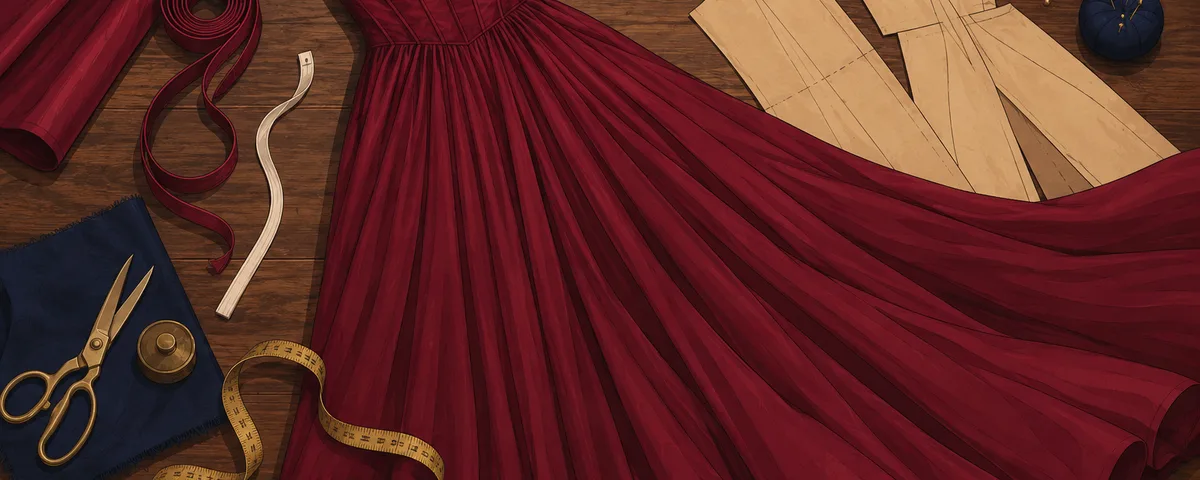
A customer from Indiranagar came in three weeks before her engagement with a satin gown she had bought off the rack, upset that it looked flawless in the store mirror but wrong in every photo her sister took at home. The bodice stood away from her at the back, the waist sat an inch too high, and the skirt fell flat instead of holding its shape. Most of it we corrected, but the bodice fit we could only partly rescue, because there was no seam allowance left to work with. That gap between how a gown looks standing still in a shop and how it holds up when you move and get photographed is exactly why people ask us about gown stitching in Bangalore. A gown is a structured garment, and structure is what a rushed or readymade one usually gets wrong. Here is what custom gown stitching actually involves, what it costs, and what to settle before you commit.
What Does Custom Gown Stitching Actually Involve?
A custom gown is a structured garment built in two connected halves — a fitted bodice and a falling skirt — and most of the work lives in getting the bodice to hold its shape against your body. Unlike a blouse or a kurta, a gown carries internal construction you never see, and that hidden structure is what separates a gown that fits from one that only looks fitted on a hanger.
- The bodice — the fitted upper half, usually built with internal lining, and for structured styles, boning or cups so it holds its shape without pulling or gaping.
- The skirt — where the silhouette lives, from a straight column to a wide flared or layered fall; its shape depends heavily on the fabric and whether it needs net or a can-can underneath for volume.
- The waist join — where the bodice meets the skirt; this seam decides whether the gown reads as one clean line or two pieces stitched together.
- The finishing — the zip or closure, the hem, and any train, all set to your height and to how you plan to stand and move.
Because so much of a gown is internal structure rather than surface fabric, it is the one garment where the trial fitting carries the most weight — the same reason the fitting stage matters so much in custom blouse stitching, only more so. A gown that is off by half an inch at the bodice will show it in every photograph from the event.
How Much Does Gown Stitching Cost in Bangalore?
Gown stitching in Bangalore starts around ₹3,000 for a simple gown stitched from fabric you bring, and climbs with structure, volume, and embroidery. As with any custom work, the stitching charge and the embroidery charge are two separate things, and it helps to see them apart before you set a budget.
What the stitching charge covers
The stitching charge is for constructing the gown — the bodice, lining, skirt, and finishing — from fabric you provide. These are the realistic bands we quote at the studio in Bangalore.
- Simple A-line or straight gown from your fabric, with light or no internal structure: ₹3,000 to ₹6,000.
- Structured gown with a boned or cupped bodice, full lining, and a flared or layered skirt: ₹6,000 to ₹12,000.
- Gown with a train, heavy net volume, or Indo-western draping: ₹10,000 to ₹18,000.
- Full reception or bridal gown with hand embroidery: from ₹18,000 upward, set only after a design consultation.
What embroidery and embellishment add
Embroidery is usually the single biggest cost on a heavily worked gown, more than the stitching itself. A gown has a large surface, so hand embroidery can add anywhere from ₹3,000 for a worked neckline to ₹40,000 and beyond for a fully embellished reception gown. Density — how tightly the surface is packed with work — drives the price more than the size of the gown.
This is where the choice between hand and machine embroidery matters most on a gown, because the surface is so large that the cost difference multiplies across it. A common answer in the studio for a bride who wants richness within a budget is hand work on the bodice, where the eye lingers, and machine or lighter work lower down the skirt.
How Long Does Custom Gown Stitching Take?
Plan for 3 to 6 weeks for a custom gown, and 8 to 10 weeks if it carries heavy hand embroidery. A simple, well-fitted gown with light work can be ready in 2 to 3 weeks. The structured bodice and the embroidery are the two things that stretch the timeline.
A gown almost always needs two trial fittings rather than one, because the bodice structure has to be checked and corrected before the skirt and finishing go on — you cannot properly fit a boned bodice in a single sitting. In wedding and reception season, the embroidery queue in Bangalore is longer, so the same gown takes more calendar time than it would in a quiet month. I tell reception and engagement customers to come 6 to 8 weeks ahead, and earlier if they want heavy work. Coming in two weeks before the function and asking for a structured, embroidered gown is the request I most often have to turn down honestly.
Should You Get a Gown Custom-Stitched or Buy Readymade?
It depends on your fit and your design. If you find a readymade gown that genuinely fits your bodice and only needs minor changes, buying it is faster and often cheaper. If your fit is hard to buy off the rack, or you want a specific silhouette, colour, or neckline, custom stitching is the more reliable route — because a gown’s fit lives in the bodice, and the bodice is the hardest thing to alter on a finished garment.
The honest limit is the same one that caught the customer from Indiranagar: alteration can take a gown in, but it cannot rebuild a bodice that has no allowance left.
- Usually fixable on a readymade gown: taking in the waist, shortening straps, hemming the length, minor nips at the bodice.
- Hard or impossible to fix: letting out a bodice with no seam allowance, changing a fitted silhouette, adding structure to a bodice that was built without it, or lengthening a gown that is simply too short.
If you are choosing between a custom gown and a lehenga for a reception, the two suit different evenings — a custom lehenga reads more traditional and a gown more contemporary, and they cost and take about the same to make well. That is a decision worth making early, because both need weeks, not days.
What to Decide Before You Order a Custom Gown
Settle these before you commit to gown stitching, because each one changes the cost, the timeline, or both. Bringing decisions rather than only questions makes the consultation in Bangalore faster and the quote far more accurate.
- The silhouette — A-line, straight column, mermaid or fishtail, ball gown, or an Indo-western gown with a cape or attached drape; each falls and fits differently.
- The fabric — satin, crepe, georgette, velvet, and net each hold a silhouette differently, so bring the actual fabric, not a phone photo, if you are supplying it.
- The bodice structure — whether you want a boned, cupped bodice that needs no separate inner wear, or a simpler lined one; this is a comfort and fit decision as much as a look.
- The neckline and back — a deep back or a strapless bodice needs more precise fitting and more trial time than a covered one.
- The embellishment — a worked neckline, a full bodice, or an all-over gown, and whether it is hand or machine work.
- The occasion and date — an engagement, a reception, a cocktail evening, or a Christian wedding each pull the design in a different direction, and the date sets how much work is realistic.
One thing I always raise in the consultation is how you will move in the gown. A gown you will only stand and pose in can be cut closer than one you will dance in at a Whitefield reception hall for four hours. If you are still choosing where to have the work done, the same questions that vet a good blouse boutique apply doubly to a gown, because structured work is where boutiques differ most. Gowns are stitched to measurement as part of our custom stitching work.
Frequently Asked Questions
How much does gown stitching cost in Bangalore?
A simple gown stitched from your own fabric starts at ₹3,000 and runs to ₹6,000. A structured gown with a boned bodice, full lining, and a flared skirt is ₹6,000 to ₹12,000, and one with a train or heavy net volume ₹10,000 to ₹18,000. A reception or bridal gown with hand embroidery starts from ₹18,000, because the embroidery — often ₹3,000 to ₹40,000 — costs more than the stitching.
How long does custom gown stitching take in Bangalore?
Plan for 3 to 6 weeks for a custom gown, 2 to 3 weeks for a simple one with light work, and 8 to 10 weeks if it carries heavy hand embroidery. A gown usually needs two trial fittings because the structured bodice has to be corrected before the skirt and finishing go on, so come 6 to 8 weeks ahead for reception or engagement wear.
Can you stitch a gown from my own fabric?
Yes. Most custom gowns are stitched from fabric you bring, which is what lets the colour and fall be matched to what you want. Simple gown stitching from your fabric starts at ₹3,000. Bring the actual fabric to the consultation, because a satin, a crepe, and a net each hold a silhouette differently, and that decides whether a style is even possible.
Is it better to buy a readymade gown or get one custom-stitched?
If a readymade gown fits your bodice and needs only minor changes, buying it is faster and often cheaper — a waist can be taken in or a hem shortened for ₹500 to ₹2,000. If your fit is hard to buy off the rack, or you want a specific silhouette or neckline, custom stitching is more reliable, because a gown’s fit lives in the bodice and a bodice with no seam allowance left cannot be let out.
How early should I order a reception or engagement gown in Bangalore?
Come 6 to 8 weeks before your function for a structured gown, and earlier if you want heavy hand embroidery, which can add several weeks on its own. A gown needs two trial fittings and one round of corrections, and in wedding season the embroidery queue is longer, so starting early is the difference between a gown that fits and a rushed compromise.